
Penetration testing is defined as a manual, authorized simulation of cyberattacks designed to validate whether security controls actually hold up under real attack conditions. Within an Information Security Management System (ISMS), particularly one built on ISO 27001, penetration testing answers the question auditors care about most: do your controls work? ISO 27001 Clause 9.1 requires organizations to monitor, measure, analyze, and evaluate their security controls. Penetration testing is the strongest evidence you can produce to satisfy that requirement. Annex A.8.8 (management of technical vulnerabilities) and Annex A.8.29 (security testing in development and acceptance) are the two controls where auditors expect to see penetration testing evidence most directly.
What is the penetration testing role in ISMS compliance?
ISO 27001 does not name penetration testing explicitly, but auditors treat it as expected for Annex A.8.8 and Clause 9.1 compliance. That distinction matters. Organizations sometimes assume that because the standard does not say “you must run a penetration test,” they have flexibility to skip it. Auditors do not share that view. Failure to produce penetration testing evidence during a Stage 2 audit routinely results in nonconformity findings.
The specific ISO 27001 clauses and Annex A controls where penetration testing carries the most weight are:
- Annex A.8.8 (Management of technical vulnerabilities): Requires active identification and remediation of technical weaknesses. Auditors expect manual validation, not just automated scan output.
- Annex A.8.29 (Security testing in development and acceptance): Requires security testing before systems go live. Penetration testing of pre-production environments directly satisfies this control.
- Annex A.5.36 (Compliance with policies, rules, and standards): Penetration testing provides evidence that technical controls align with documented security policies.
- Clause 9.1 (Monitoring, measurement, analysis, and evaluation): Requires measurable evidence of control effectiveness. A penetration test report with CVSS ratings and exploit proof-of-concept is the clearest form of that evidence.
- Clause 10 (Continual improvement): Findings from penetration tests feed corrective action processes, directly satisfying the improvement cycle.
Understanding the Annex A controls in detail helps compliance officers map each test finding to the right control, which is exactly what auditors want to see.
Pro Tip: Ask your penetration testing provider to structure their report with explicit references to ISO 27001 Annex A controls. A report that maps findings to specific controls saves significant time during audit preparation and reduces the risk of a nonconformity.

How does penetration testing differ from vulnerability scanning in ISMS?
The difference between penetration testing and vulnerability scanning is not a matter of degree. It is a matter of kind. Vulnerability scanning is automated, broad, and fast. It identifies potential weaknesses by comparing system configurations and software versions against known vulnerability databases. Penetration testing is manual, targeted, and slow by design. A qualified tester attempts to actually exploit identified weaknesses to confirm whether they represent real, exploitable risk.
Auditors distinguish clearly between the two. Passing a Stage 2 audit requires proof of exploitability, not just a list of discovered vulnerabilities. A vulnerability scan tells you a door might be unlocked. A penetration test tells you whether an attacker can actually walk through it and reach the server room.
Organizations that rely only on automated scans face a specific audit trap. Providing only scan output without manual verification and exploit proof-of-concept typically results in nonconformities under Annex A.8.8. Auditors have seen this pattern enough times that they now ask directly: “Can you show me the manual testing methodology and the proof-of-concept evidence?”
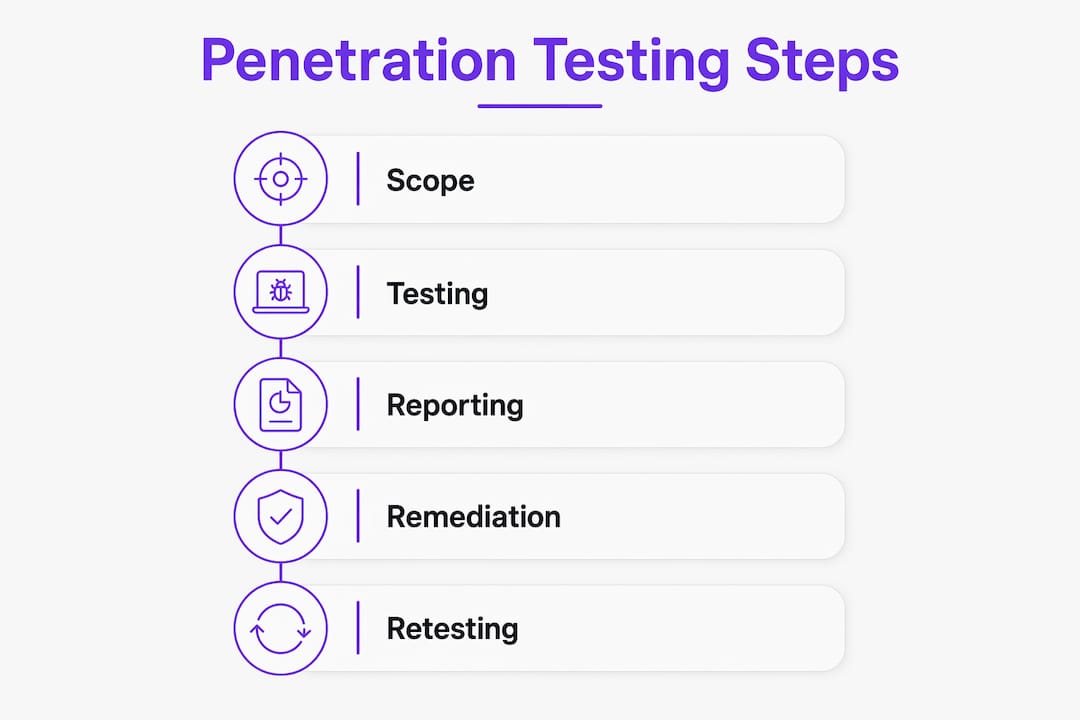
The practical difference shows up in what each activity produces:
Vulnerability scanning produces a list of potential issues ranked by severity, often with significant false positives. Penetration testing produces a report with confirmed exploits, attack chains, business impact analysis, CVSS severity ratings, and retest evidence after remediation. The latter is what effective audit reports require: manual test methodology, CVSS ratings, and verified remediation.
Both activities belong in a mature ISMS. Quarterly vulnerability scans keep your baseline current. Annual penetration testing validates that your controls hold against a skilled attacker. Treating one as a substitute for the other is the most common mistake compliance officers make when building their vulnerability management program.
Pro Tip: Request a retest as part of your penetration testing contract. Remediation without verification is incomplete. Auditors want to see that identified vulnerabilities were fixed and confirmed closed, not just noted in a ticket.
How often should penetration testing be conducted for ISO 27001?
Annual penetration testing is the widely accepted minimum frequency for ISO 27001 compliance. Auditors prioritize tests completed within the last 12 months. A test older than 12 months at the time of a surveillance audit is treated as stale evidence and may trigger a nonconformity.
Annual testing is the floor, not the ceiling. Several conditions require additional testing outside the regular schedule:
- Significant infrastructure changes: Cloud migrations, data center consolidations, or major network reconfigurations change the attack surface. Testing after these events is expected.
- Major application releases: New customer-facing applications or significant updates to existing systems require security testing before or immediately after deployment.
- Security incidents: A confirmed breach or near-miss creates an obligation to test the affected environment once remediation is complete.
- Mergers and acquisitions: Integrating a new organization’s systems introduces unknown risk. Testing the merged environment is standard practice.
- High-risk environments: Financial services and healthcare organizations face regulatory expectations that often push testing frequency to twice per year or more.
Timing penetration tests after significant IT environment changes is a direct auditor expectation. Document the rationale for your testing schedule in your ISMS. If you test annually, write down why annual frequency is appropriate for your risk profile. If you test more often, document the triggers. Auditors want to see that your schedule is risk-based, not arbitrary.
Scope definition is equally important. The penetration test scope must align with your ISMS boundary. If your ISMS covers your cloud infrastructure, customer portal, and internal network, all three belong in scope. A test that covers only one segment leaves gaps that auditors will find.
Pro Tip: Schedule your annual penetration test at least two months before your ISO 27001 surveillance audit. That window gives your team time to remediate findings, run retests, and produce clean documentation before the auditor arrives.
How does penetration testing support continual improvement in ISMS?
Penetration testing is most valuable when it functions as a feedback loop, not a one-time event. Test findings must flow into risk treatment plans and corrective actions. A penetration test report that sits in a folder without connecting to the risk register fails both the audit and the organization.
The integration process works in three steps. First, map each finding to the relevant Annex A control and to the corresponding entry in your risk register. Mapping findings to ISO controls connects vulnerabilities to specific compliance obligations and makes the remediation case to management. Second, create corrective actions for each finding above your accepted risk threshold. Assign owners, set deadlines, and track progress. Third, verify remediation through retesting and update the risk register to reflect the closed finding.
Clause 10.2 of ISO 27001 requires documented corrective actions for nonconformities. A penetration test finding that reveals a real exploitable vulnerability is a nonconformity. Treating it as such, with a formal corrective action record, satisfies Clause 10.2 directly.
The management review process under Clause 9.3 is another integration point. Penetration test results belong on the agenda. Leadership needs to understand what was found, what was fixed, and what residual risk remains. Routine programs that include quarterly scans and annual penetration testing give management a consistent picture of security posture over time.
A pentest report that is not integrated into the ISMS risk management workflow fails continual improvement and audit expectations. The report’s value is not in the findings themselves. The value is in what the organization does with those findings.
- Map findings to the risk register immediately after the report is delivered.
- Assign corrective actions with named owners and firm deadlines.
- Track remediation in your ISMS documentation system.
- Retest remediated findings and record the results.
- Present outcomes at the next management review meeting.
Key Takeaways
Penetration testing is the primary evidence mechanism for demonstrating that ISO 27001 security controls work under real attack conditions, and integrating findings into the risk register is what separates compliance from security.
| Point | Details |
|---|---|
| ISO 27001 expects pen testing | Auditors treat annual penetration testing as required evidence for Annex A.8.8 and Clause 9.1, even without an explicit mandate. |
| Scans do not replace pen tests | Automated vulnerability scans alone produce audit nonconformities; manual exploit validation is required. |
| Annual testing is the minimum | Tests older than 12 months are treated as stale; additional testing is required after major changes or incidents. |
| Findings must enter the risk register | Penetration test reports disconnected from risk treatment plans fail Clause 10.2 continual improvement requirements. |
| Map findings to Annex A controls | Structuring reports around specific ISO controls significantly improves audit evidence credibility. |
Why pen testing is a security discipline, not an audit checkbox
The compliance framing around penetration testing creates a subtle problem. When organizations treat it as something they do for auditors, they optimize for the audit rather than for security. The test gets scoped narrowly to pass, the report gets filed, and nothing changes in the environment.
The organizations I have seen get the most value from penetration testing treat it as a diagnostic tool. They use findings to challenge their assumptions about what is protected and what is not. They bring in testers with genuine independence from the team that built the controls, because a tester who is too familiar with the environment will unconsciously avoid the paths that lead to real findings.
The scope question is where most programs fall short. Compliance officers often define scope based on what is convenient rather than what is realistic. An attacker does not respect your ISMS boundary document. Your scope should reflect what an attacker would actually target, including legacy systems, third-party integrations, and cloud services that teams sometimes exclude because testing them feels complicated.
The other consistent failure I see is unverified remediation. A finding gets logged, a ticket gets closed, and nobody confirms the fix actually worked. Retesting is not optional. It is the only way to know whether your corrective action addressed the root cause or just the symptom. The ISO 27001 gap analysis process is a good starting point for identifying where your testing program has blind spots before an auditor finds them.
Penetration testing done well is one of the most honest conversations a security team can have about its own defenses. Treat it that way.
— Martin
How Ismscalculator supports your penetration testing program
Knowing what penetration testing requires is one thing. Tracking it, documenting it, and connecting it to your broader ISO 27001 program is where most compliance officers lose time.
Ismscalculator gives you the tools to manage that process without building it from scratch. The free 2-minute readiness check identifies gaps in your current security testing practices against ISO 27001 expectations, including where your penetration testing program stands relative to Annex A.8.8 requirements. For organizations that need expert guidance on integrating penetration testing into a full ISMS program, the independent ISO 27001 consultant finder connects you with practitioners who specialize in exactly this work. Use the platform to benchmark your current posture, plan your testing schedule, and prepare audit-ready documentation.
FAQ
What is the penetration testing role in ISMS?
Penetration testing validates that ISMS security controls hold up under real attack conditions, providing the manual exploit evidence that ISO 27001 auditors require for Annex A.8.8 and Clause 9.1 compliance.
Does ISO 27001 require penetration testing?
ISO 27001 does not name penetration testing explicitly, but auditors treat it as expected evidence for Annex A.8.8 compliance, and absence of penetration testing evidence routinely results in Stage 2 audit nonconformities.
How often should penetration testing be done for ISO 27001?
Annual penetration testing is the accepted minimum, with additional tests required after significant infrastructure changes, major application releases, security incidents, or when operating in high-risk sectors like finance or healthcare.
Can a vulnerability scan replace a penetration test for ISO 27001?
No. Auditors reject scan-only evidence for Annex A.8.8 compliance because vulnerability scans do not confirm exploitability. Penetration testing requires manual validation and proof-of-concept exploit evidence that automated tools cannot produce.
How should penetration test findings be used in ISMS?
Findings must be mapped to the risk register and relevant Annex A controls, assigned as corrective actions with owners and deadlines, retested after remediation, and presented at management reviews to satisfy Clause 10.2 continual improvement requirements.