
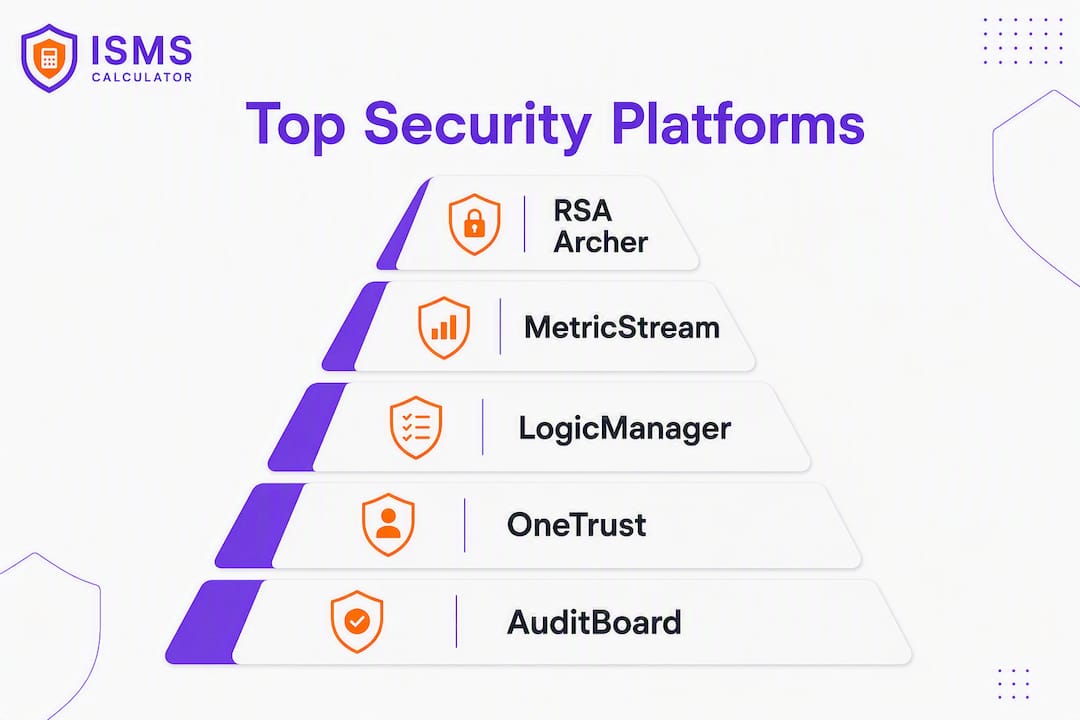
The platforms finance security teams most consistently shortlist are RSA Archer (best for enterprise GRC), MetricStream (best for integrated risk and compliance), LogicManager (best for mid-market GRC), OneTrust (best for TPRM and privacy), Resolver (best for operational risk), AuditBoard (best for audit evidence automation), Riskonnect (best for enterprise resilience), ProcessUnity (best for third-party risk), BitSight (best for continuous cyber risk monitoring), and Cynomi (best for SMB and vCISO-led assessments). For institutional market and credit risk analytics, BlackRock Aladdin, MSCI RiskManager, and Bloomberg MARS serve a distinct but complementary function covered separately below.
TL;DR: The primary decision axis is whether you need cyber risk quantification (CRQ) for CFO reporting, third-party risk management (TPRM) for vendor due diligence, or enterprise GRC for audit and regulatory alignment. Enterprise banks typically need RSA Archer or MetricStream; mid-market firms get faster time-to-value from LogicManager or AuditBoard; TPRM-first buyers should evaluate OneTrust or ProcessUnity. RiskWatch rounds out the list as a strong fit for community banks and credit unions needing a lightweight, framework-aligned assessment tool.

GRC platforms that integrate with real-time workflows are increasingly replacing periodic spreadsheet-based assessments across U.S. financial institutions, shifting risk management from a compliance checkbox into an operational discipline.

Table of Contents
- How do these security risk assessment platforms compare side by side?
- Vendor profiles: what each platform actually delivers for finance teams
- How do you pick the right platform for your firm?
- When should you use Aladdin, MSCI RiskManager, or Bloomberg MARS instead?
- How were these platforms evaluated?
- Key Takeaways
- What finance firms consistently get wrong when selecting these platforms
- ISO 27001 readiness planning gives finance teams a sharper RFP before they ever talk to a vendor
- Useful sources for further research and RFP validation
How do these security risk assessment platforms compare side by side?
The table below maps each platform against the dimensions finance buyers care most about. Sizing signals use three tiers: SMB (under 500 employees), Mid-market (500–5,000), and Enterprise (5,000+).
| Platform | Best for | Core capabilities | Finance-specific features | Key integrations | Deployment | CFO-grade reporting | Pricing model | Impl. time |
|---|---|---|---|---|---|---|---|---|
| RSA Archer | Enterprise GRC | Risk scoring, control testing, policy mgmt, audit workflows | FFIEC, SOX, GLBA, PCI templates; exam-ready evidence packs | Splunk, ServiceNow, Qualys, Tenable, CMDB | On-prem / cloud / hybrid; Enterprise | CRQ modules, financial impact dashboards | Enterprise license | 4–9 months |
| MetricStream | Integrated risk & compliance | Risk register, CRQ, TPRM, continuous monitoring, dashboards | SOX, GLBA, PCI, Basel; prebuilt control libraries | SIEM, Jira, ServiceNow, Tenable | Cloud SaaS; Enterprise | Board-level risk quantification | Enterprise subscription | 4–9 months |
| LogicManager | Mid-market GRC | Risk scoring, framework mapping, evidence mgmt, remediation | FFIEC, SOX, GLBA templates; audit trail automation | REST API, ticketing, SIEM connectors | Cloud SaaS; Mid-market | Risk heat maps, financial exposure reporting | Subscription; Mid-market | 6–12 weeks |
| OneTrust | TPRM & privacy | Vendor risk scoring, privacy impact, consent mgmt, TPRM | GLBA, CCPA, DORA readiness; vendor questionnaire libraries | Jira, Slack, ServiceNow, SIEM | Cloud SaaS; Mid-market / Enterprise | Vendor risk dashboards | Subscription | 6–12 weeks |
| Resolver | Operational risk | Incident mgmt, risk register, control testing, audit | SOX, Basel II/III; operational risk taxonomy | Splunk, ServiceNow, Jira, CMDB | Cloud SaaS; Mid-market / Enterprise | Risk impact modeling | Subscription | 6–12 weeks |
| AuditBoard | Audit evidence automation | SOX compliance, audit mgmt, risk assessment, SOXHUB | SOX, PCAOB; automated evidence collection | Jira, Slack, Workday, Salesforce | Cloud SaaS; Mid-market / Enterprise | Audit risk dashboards | Subscription | 6–12 weeks |
| Riskonnect | Enterprise resilience | ERM, TPRM, incident mgmt, BCM, insurance risk | FFIEC, SOX, GLBA; resilience-linked risk scoring | ServiceNow, Salesforce, SIEM | Cloud SaaS; Enterprise | Enterprise risk quantification | Enterprise subscription | 3–6 months |
| ProcessUnity | Third-party risk | Vendor lifecycle mgmt, questionnaire automation, risk scoring | FFIEC vendor mgmt guidance; prebuilt finance questionnaires | ServiceNow, Archer, SIEM | Cloud SaaS; Mid-market / Enterprise | Vendor risk dashboards | Subscription | 6–12 weeks |
| BitSight | Continuous cyber monitoring | Security ratings, attack surface mgmt, vendor monitoring | FFIEC, GLBA; continuous control monitoring signals | Splunk, ServiceNow, Tenable, Qualys | Cloud SaaS; All sizes | Financial exposure scoring | Subscription | Days to weeks |
| Cynomi | SMB / vCISO assessments | vCISO platform, gap analysis, framework mapping, reporting | NIST CSF, CIS, SOC 2 templates; board-ready reports | API-based; lightweight stack | Cloud SaaS; SMB | Risk prioritization reports | Subscription; SMB | Days to weeks |
| RiskWatch | Community banks / credit unions | Risk assessment, control testing, vendor mgmt | FFIEC CAT, NCUA, GLBA; tiered assessment workflows | REST API, basic SIEM | Cloud SaaS; SMB / Mid-market | Compliance dashboards | Subscription | 2–6 weeks |
How to read this table: “Best for” reflects primary use case, not exclusive capability. A community bank evaluating vendors should start with RiskWatch or BitSight; a regional bank running SOX audits should prioritize AuditBoard or LogicManager; an asset manager needing board-level CRQ should evaluate MetricStream or RSA Archer.
Vendor profiles: what each platform actually delivers for finance teams
RSA Archer
RSA Archer is the incumbent enterprise GRC platform at large U.S. banks and insurers. Its strength is depth: a highly configurable risk register, prebuilt regulatory content for FFIEC, SOX, GLBA, and PCI DSS, and a mature audit evidence workflow that maps directly to examiner expectations. The tradeoff is implementation complexity. Expect 4–9 months for a full deployment, and budget for dedicated configuration resources.
Finance fit:
- Prebuilt FFIEC, SOX, and GLBA content packs reduce template-build time
- Exam-ready evidence packaging for OCC, FDIC, and Fed examinations
- Integration with Splunk, Qualys, and Tenable for vulnerability-driven risk scoring
- CRQ modules available for financial impact modeling at the board level
Typical buyer: CISO or Chief Risk Officer at a bank with $10B+ in assets or a large insurance carrier. Implementation is typically led by a systems integrator.
MetricStream
MetricStream positions itself as a unified risk platform, covering GRC, TPRM, CRQ, and continuous control monitoring in a single environment. Finance teams at regional banks and asset managers use it to connect operational risk registers with real-time control testing, feeding a consolidated risk posture into board dashboards. Its prebuilt control libraries for SOX, Basel, and GLBA reduce the gap-mapping effort that typically consumes the first months of a GRC deployment.
Finance fit:
- CRQ engine translates control gaps into financial exposure estimates for CFO reporting
- Prebuilt Basel II/III and SOX control libraries
- Continuous monitoring feeds that ingest SIEM and vulnerability scanner outputs
- Finance customer references include global banks and asset managers
LogicManager
LogicManager is the platform mid-market finance firms most often cite when they need GRC without the enterprise price tag or implementation runway. Its risk-based approach links business objectives to control gaps, and its evidence management module automates audit trail collection. G2 reviewers consistently highlight its usability and the speed at which teams reach productive use.
Finance fit:
- FFIEC and SOX framework templates available out of the box
- Risk heat maps and financial exposure reporting suitable for audit committees
- REST API connectors for SIEM and ticketing tools
- Typical implementation: 6–12 weeks for a mid-market bank or credit union
OneTrust
OneTrust built its reputation on privacy and data governance, then expanded into TPRM and broader GRC. For finance firms managing GLBA privacy obligations alongside vendor due diligence, that combination is genuinely useful. Its vendor questionnaire library covers FFIEC vendor management guidance, and its DORA readiness module is relevant for U.S. firms with EU operations.
Finance fit:
- Prebuilt GLBA, CCPA, and DORA questionnaire libraries
- Automated vendor risk scoring with continuous monitoring signals
- Integration with ServiceNow and Jira for remediation workflow handoffs
- Typical buyer: Head of Third-Party Risk or Chief Privacy Officer at a regional bank or fintech
Resolver
Resolver focuses on operational risk and incident management, which makes it a natural fit for finance firms that need to connect security incidents to operational risk registers under Basel II/III frameworks. Its risk taxonomy is configurable to banking operational risk categories, and its audit module supports SOX control testing. G2 reviews note strong incident-to-risk linkage as a differentiator.
Finance fit:
- Operational risk taxonomy aligned to Basel II/III categories
- Incident management with direct linkage to risk register entries
- Splunk and ServiceNow integrations for SIEM-driven risk updates
- Typical buyer: Head of Operational Risk at a mid-market or regional bank
AuditBoard
AuditBoard is the platform finance internal audit teams reach for first. Its SOXHUB module automates SOX 302/404 evidence collection, and its risk assessment module feeds directly into the audit plan. For finance firms where the internal audit function drives the GRC platform selection, AuditBoard typically wins on evidence automation and auditor-friendly workflows.
Finance fit:
- SOXHUB automates SOX evidence collection and PCAOB-aligned testing
- Risk assessment module links audit findings to risk register
- Integrations with Workday, Salesforce, and Jira for cross-functional evidence pulls
- Typical implementation: 6–12 weeks; typical buyer is VP of Internal Audit or Chief Audit Executive
Riskonnect
Riskonnect covers enterprise risk management, TPRM, business continuity, and insurance risk in a single platform. Large financial institutions use it when they need resilience-linked risk scoring that connects cyber risk to operational continuity planning. Its FFIEC and GLBA content is prebuilt, and its enterprise architecture supports complex organizational hierarchies common at bank holding companies.
Finance fit:
- Resilience-linked risk scoring connects cyber events to BCM plans
- FFIEC and GLBA prebuilt content
- Salesforce and ServiceNow integrations for enterprise workflow alignment
- Typical buyer: CRO or Head of Enterprise Risk at a bank holding company or large insurer
ProcessUnity
ProcessUnity is purpose-built for third-party risk. Its vendor lifecycle management covers onboarding, ongoing monitoring, and offboarding, with prebuilt questionnaire libraries aligned to FFIEC vendor management guidance. Finance firms with large vendor ecosystems, particularly those managing fintech partnerships and cloud providers, use ProcessUnity to automate the questionnaire-response-review cycle that otherwise consumes analyst time.
Finance fit:
- Prebuilt FFIEC vendor management questionnaire libraries
- Automated questionnaire distribution, response tracking, and risk scoring
- Integration with RSA Archer and ServiceNow for GRC workflow handoffs
- Typical buyer: Third-Party Risk Lead or Vendor Management Officer at a regional or national bank
Pro Tip: During a ProcessUnity PoC, run a full vendor onboarding cycle with a real fintech partner and measure the time from questionnaire send to risk score output. That single test reveals whether the automation actually reduces analyst hours or just digitizes the same manual steps.
BitSight
BitSight delivers continuous, outside-in security ratings for your own organization and your vendor portfolio. Finance firms use it as a continuous monitoring layer that feeds FFIEC vendor management programs and provides board-level security posture reporting without requiring vendor cooperation. Its integration with Tenable and Qualys means internal vulnerability data can be correlated with external ratings for a fuller risk picture.
Finance fit:
- Continuous security ratings aligned to FFIEC vendor management expectations
- Attack surface management for identifying exposed assets
- Financial exposure scoring for CFO-level reporting
- Integration with Splunk, ServiceNow, Tenable, and Qualys
- Fastest time to value on this list: days to weeks from contract to live dashboard
Cynomi
Cynomi is a vCISO platform designed for smaller finance firms, community banks, and credit unions that lack a full-time CISO. It automates gap analysis against NIST CSF, CIS Controls, and SOC 2, generates board-ready risk reports, and supports the kind of lightweight, repeatable assessment cycle that a part-time or outsourced security function needs. G2 reviewers highlight its report generation speed and the clarity of its prioritization output.
Finance fit:
- NIST CSF and CIS Controls gap analysis with board-ready output
- Designed for vCISO or outsourced security function workflows
- Lightweight API-based integrations suitable for smaller tech stacks
- Typical buyer: IT Director or outsourced vCISO at a community bank or credit union with under 200 employees
RiskWatch
RiskWatch targets community banks, credit unions, and smaller financial institutions that need a structured, examiner-ready assessment without enterprise complexity. Its FFIEC Cybersecurity Assessment Tool (CAT) and NCUA alignment make it a natural fit for institutions preparing for regulatory examinations. Switching to a framework-aligned platform like RiskWatch can reduce diagnostic questions from 400+ to roughly 208–318 depending on the tier, cutting the operational hours spent on exam prep.
Finance fit:
- FFIEC CAT and NCUA-aligned assessment workflows
- Tiered assessment approach reduces exam-prep burden
- Vendor management module for basic third-party risk
- Typical buyer: IT Officer or Compliance Manager at a community bank or credit union
How do you pick the right platform for your firm?
The single most important selection criterion is fit to your firm’s primary risk workflow: if your board demands financial quantification of cyber risk, CRQ capability is non-negotiable; if regulators are asking about vendor concentration, TPRM depth matters more than anything else.
Evaluation checklist
- Vulnerability integration: Does it ingest feeds from Tenable, Qualys, or Nessus and apply CVSS and EPSS scoring to prioritize remediation? Confirm the integration is bidirectional.
- Evidence automation: — Can it automatically collect and package audit evidence for examiner requests? Ask for a demo using a sample FDIC or OCC information request.
PoC success criteria
Run a minimum 30-day PoC with real data. The PoC should validate:
- Data ingest from at least one vulnerability scanner and one SIEM source
- End-to-end evidence collection for a sample audit request (pull, package, export)
- CRQ output using your firm’s actual financial parameters
- Regulatory report export in a format your compliance team can use without reformatting
- User role mapping that matches your org chart (CISO, risk analyst, auditor, board member)
- Integration speed: time from connector configuration to live data in the dashboard
- Runtime validation of at least one vulnerability finding to confirm the platform reduces false positives before escalating to remediation
Procurement checklist and timeline estimates
- Mid-market firms (500–5,000 employees): budget 6–12 weeks for SaaS-native platforms (LogicManager, AuditBoard, BitSight); longer for platforms requiring significant configuration (RSA Archer, MetricStream)
- Enterprise firms (5,000+): budget 4–9 months for full deployment, including integration testing, data migration, and user training
- Confirm data residency and cloud provider (AWS, Azure, GCP) before contract signature
- Require a contractual SLA for regulatory template updates when new FFIEC or GLBA guidance is issued
- Include a PoC clause in the contract that allows exit if integration milestones are not met within 60 days
Red flags to watch for
- No prebuilt FFIEC or GLBA templates (means you build from scratch at your cost)
- Opaque risk scoring with no methodology documentation
- No native SIEM or vulnerability scanner integration (API-only workarounds add maintenance burden)
- Evidence export limited to PDF only (examiners increasingly expect structured data)
- Vendor cannot provide a finance-sector customer reference willing to speak on the record
When should you use Aladdin, MSCI RiskManager, or Bloomberg MARS instead?
BlackRock Aladdin, MSCI RiskManager, and Bloomberg MARS are not security risk assessment platforms. They are institutional market and credit risk systems, and conflating them with GRC tools is one of the most common scoping errors finance security teams make.
MSCI RiskManager aggregates data across a very large universe of securities and numerous quality-controlled risk factors, supporting VaR calculations, stress testing, and multi-asset scenario analysis. Bloomberg MARS provides consistent, consolidated risk results across equities, FX, fixed income, and derivatives, used by front office, risk, and collateral teams. BlackRock Aladdin serves a similar function for large asset managers, integrating portfolio analytics with risk factor modeling.
These systems answer the question: what is the financial exposure of our portfolio to a given market scenario? Security risk assessment platforms answer a different question: how effective are our controls, and what is the residual cyber or operational risk to our business?
Finance teams need both when:
- Modeling the financial impact of a cyber incident on portfolio valuations (e.g., a ransomware event that disrupts trading operations)
- Assessing how a critical vendor failure affects both operational continuity and asset positions
- Feeding residual cyber risk scores from a GRC platform into a CRO dashboard alongside market VaR
- Preparing board reports that integrate operational risk (from GRC) with market risk (from Aladdin/MSCI/MARS) under a unified risk appetite framework
- Satisfying FDIC cybersecurity resilience reporting requirements that span both operational and market risk dimensions
The integration workflow typically runs from the security assessment platform outward: control effectiveness scores and residual cyber risk ratings from your GRC tool feed into the CRO’s dashboard, where they sit alongside market risk metrics from Aladdin or MSCI. The teams that need to own this integration are the CISO, the CRO, and Treasury, with the CRO function serving as the natural bridge between the two data streams.
For context on how impact investing risk differs from traditional market risk, the Verdant Institute’s analysis is worth reading alongside your GRC vendor evaluation, particularly if your firm manages ESG-linked portfolios where non-financial risk factors intersect with security posture.
How were these platforms evaluated?
The shortlist was built from four source types: analyst placements (Gartner Magic Quadrant for IT Risk Management, Forrester Wave for GRC, Chartis RiskTech100), vendor documentation and product demonstrations, finance-sector customer references, and integration verification against common finance tech stacks (Splunk, Tenable, ServiceNow, Qualys).
Evaluation weighting
| Criterion | Weight | What was assessed |
|---|---|---|
| Finance fit (templates, regulatory alignment) | 30% | Prebuilt FFIEC, GLBA, SOX, PCI content; examiner-ready evidence packaging |
| CRQ and CFO-grade reporting | — | Financial impact modeling, board-level dashboards, dollar-denominated risk output |
| Integrations (SIEM, vuln scanners, CMDB, ticketing) | — | Native connectors, API quality, bidirectional data flow |
| Security certifications and compliance | 10% | SOC 2 Type II, ISO 27001, data residency options |
| Scalability and performance | 10% | Multi-entity support, performance under enterprise data volumes |
| Finance customer references | 10% | Named finance-sector deployments, case studies, examiner-facing evidence |
Source types and validation notes
- Analyst reports: Gartner, Forrester, and Chartis placements were used to validate market position and finance-sector traction; leader placements in finance-adjacent categories were weighted positively.
- Vendor documentation: Prebuilt template libraries, integration connector lists, and SOC 2 certification status were verified from vendor-published materials.
- Finance customer references: Where vendors provided named finance-sector case studies or reference customers, those were weighted in the finance fit score.
- Integration checks: SIEM and vulnerability scanner integration was verified against vendor connector documentation; bidirectional API support was treated as a positive signal.
GRC platforms that include prebuilt regulatory control libraries for financial services consistently scored higher on finance fit, since building those libraries from scratch adds months to implementation timelines.
Limitation: This evaluation is not a substitute for a formal RFP or PoC. Pricing, contractual terms, and integration performance in your specific environment require direct vendor engagement and legal review before purchase.
Key Takeaways
The most effective security risk assessment strategy for finance firms combines a GRC platform aligned to FFIEC and GLBA with CRQ capability for CFO reporting and continuous monitoring for vendor and attack surface coverage.
| Point | Details |
|---|---|
| Match platform to primary use case | Choose CRQ-capable platforms (MetricStream, RSA Archer) for board quantification; TPRM leaders (OneTrust, ProcessUnity) for vendor coverage. |
| Require prebuilt finance templates | Platforms without FFIEC, GLBA, or SOX templates add months of build time and increase examiner-readiness risk. |
| Run a 30-day PoC with real data | Validate evidence automation, SIEM integration, and CRQ output before committing; a PoC clause in the contract protects your exit option. |
| Separate market risk from security risk | Aladdin, MSCI RiskManager, and Bloomberg MARS serve portfolio analytics; your GRC platform feeds operational and cyber risk into the same CRO dashboard. |
| Ismscalculator accelerates RFP scoping | Use Ismscalculator’s 14-domain maturity assessment and readiness check to define control gaps and evidence requirements before issuing vendor RFPs. |
Next steps:
- Shortlist 2–3 platforms from this article and run a focused 30-day PoC with your actual SIEM and vulnerability scanner data. Target go-live within 12 weeks for mid-market, 9 months for enterprise.
- Validate your shortlist with your internal audit and compliance teams before vendor selection; their evidence requirements should drive the final decision, not the CISO’s integration preferences alone.
What finance firms consistently get wrong when selecting these platforms
The single biggest mistake finance firms make is selecting a platform based on analyst quadrant position rather than fit to their specific regulatory examination workflow. A Gartner Leader placement means the vendor has broad market traction. It does not mean the platform ships with FFIEC CAT templates, produces examiner-ready evidence packages, or integrates with your existing Splunk deployment without a six-month professional services engagement.
The firms that get this right start from the audit evidence requirement and work backward. What does your OCC or FDIC examiner actually ask for? What format do they expect? Which controls need continuous monitoring evidence versus point-in-time testing? Those questions should drive your PoC design, not the vendor’s demo script.
There is also a persistent tendency to underweight integration complexity. A platform that scores well on paper but requires a custom middleware layer to ingest your Tenable feed will cost you more in maintenance than the license savings justify. Finance GRC implementations that treat risk as a living operational discipline rather than a periodic assessment consistently outperform those that treat the platform as a compliance checkbox.
Pro Tip: Bring your internal audit lead and your most demanding examiner-facing compliance analyst into every vendor demo. If they cannot find the evidence they need within five minutes of using the platform, the implementation will be painful regardless of what the vendor promises.
Stakeholder alignment matters more than most buyers expect. The CISO, CRO, and Head of Internal Audit often have different primary requirements from the same platform. Getting all three in the room during vendor evaluation, not just the security team, is what separates a successful deployment from a platform that gets abandoned after 18 months.
ISO 27001 readiness planning gives finance teams a sharper RFP before they ever talk to a vendor
Finance teams that enter a GRC vendor RFP process without a clear picture of their current control gaps and evidence requirements consistently spend the first three months of implementation doing the scoping work they should have done before signing the contract. That is expensive, and it delays the examiner-readiness value the platform was purchased to deliver.
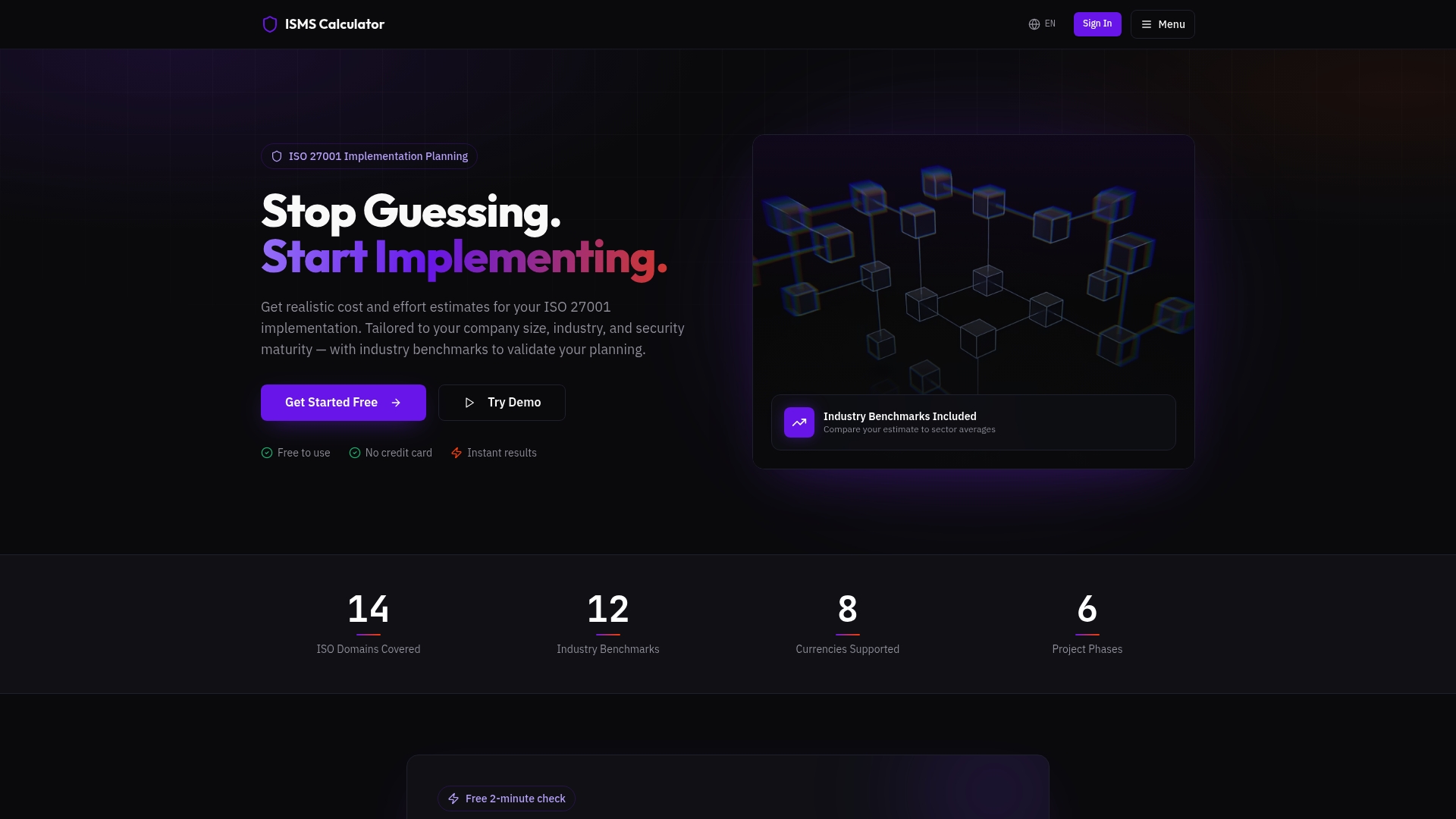
Ismscalculator’s ISO 27001 readiness assessment maps your organization’s maturity across all four ISO/IEC 27001:2022 control themes, produces a gap analysis with model reference comparisons, and generates a customizable Gantt timeline for implementation phases. For finance teams preparing a GRC platform RFP, that output directly informs which control domains need the most evidence automation support, which framework templates are non-negotiable, and what a realistic implementation timeline looks like for your firm’s size and maturity level.
The free 2-minute readiness check gives you a baseline posture score in under five minutes, with no vendor call required. If you need implementation support after the assessment, Ismscalculator’s consultant finder connects you with independent ISO 27001 implementers and lead auditors who specialize in financial services. Start with the readiness check before your next vendor demo, and you will walk into that conversation knowing exactly which gaps you need the platform to close.
Useful sources for further research and RFP validation
- FDIC — Evolution of Bank Information Technology Examinations: Essential background on how FDIC examiners assess IT and cybersecurity risk; use this to align your evidence packaging requirements with examiner expectations.
- NIST SP 800-30 Rev. 1 — Guide for Conducting Risk Assessments: The foundational NIST methodology for risk assessment; use as a framework-alignment reference when evaluating vendor scoring methodologies.
- Bloomberg MARS — Multi-Asset Risk System: Bloomberg’s product page for MARS; use to understand the scope of institutional market risk analytics and where it differs from security GRC platforms.
- Ismscalculator — Data Security Controls for Finance Firms: 2026 Guide: Martin’s finance-specific guide to data security controls and ISO 27001 alignment; use when mapping GRC platform requirements to ISO control domains.
- Ismscalculator — US Financial Data Security Standards Compared: Comparative analysis of FFIEC, GLBA, SOX, and NYDFS; use when building the regulatory template requirements section of your RFP.
- Ismscalculator — ISO 27001 Audit Prep for Finance Companies: Practical audit preparation guidance; use to define evidence automation requirements before vendor evaluation.