
NIST defines a vulnerability as a weakness in an information system, system security procedures, internal controls, or implementation that could be exploited or triggered by a threat source. That definition matters because it covers far more than buggy code. A misconfigured firewall rule, a default admin password left unchanged, or a business process that skips access reviews all qualify.
Three things practitioners should act on immediately:
- Prioritize using CISA KEV and business context first. Raw CVSS scores tell you technical severity; they don’t tell you whether anyone is actively exploiting the flaw against systems like yours. The CISA Known Exploited Vulnerabilities Catalog lists vulnerabilities observed exploited in the wild and is the strongest single filter for urgent remediation decisions.
- Consult the canonical catalogs. The CVE program assigns authoritative identifiers for publicly disclosed vulnerabilities, the NVD enriches those records with CVSS scores and metadata, and CISA KEV flags which ones are actively weaponized.
- Watch your time-to-remediate for public-facing, exploited assets. That single metric, more than any other KPI, reflects whether your program is keeping pace with real-world attacker timelines.
Table of Contents
- What types of vulnerabilities should security teams know about?
- How are vulnerabilities discovered, disclosed, and assigned CVEs?
- CVE, CVSS, NVD, and CISA KEV: what each one does and how to use them
- The vulnerability lifecycle and a practical prioritization workflow
- How teams detect and assess vulnerabilities in practice
- Remediation strategies and when not to patch immediately
- KPIs and governance metrics that show your program is working
- How vulnerability management maps to ISO 27001 and your ISMS
- Key Takeaways
- The gap between vulnerability scores and real-world risk
- Ismscalculator helps you plan and budget vulnerability remediation for ISO 27001
- Authoritative resources and feeds every practitioner should monitor
What types of vulnerabilities should security teams know about?
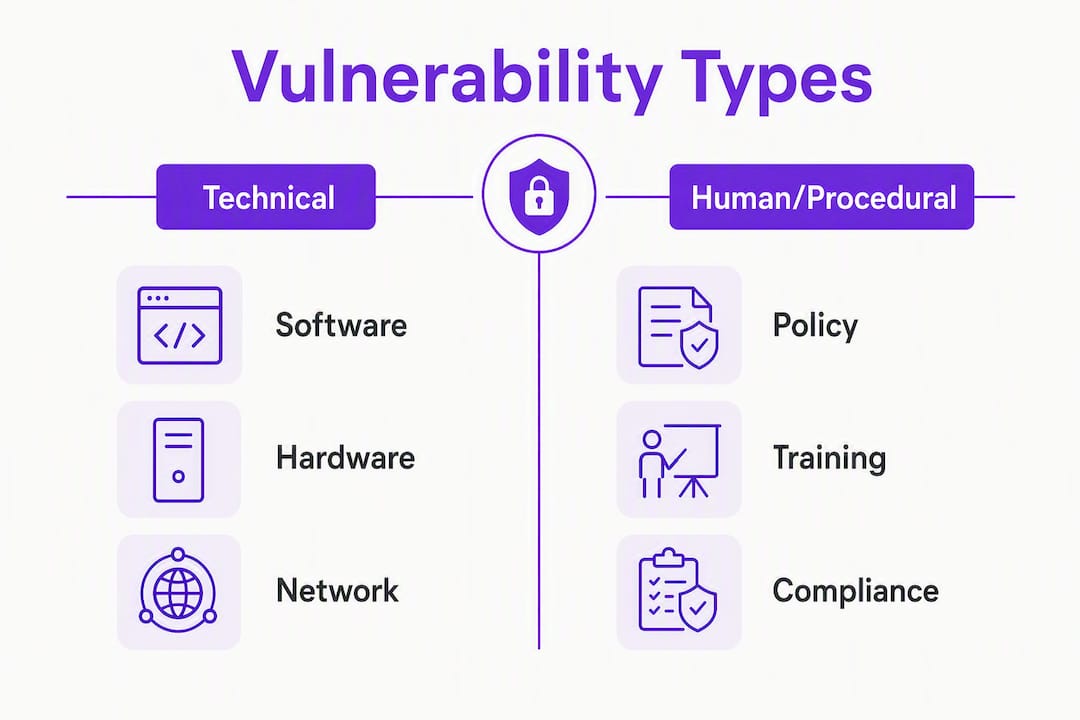
Security teams deal with two broad buckets: technical vulnerabilities and human/procedural ones. The distinction shapes which detection methods apply and which remediations are realistic.
Technical vulnerabilities live in software, hardware, firmware, network infrastructure, and configuration. A memory-corruption bug in a web server, an unpatched firmware version on a network switch, an overly permissive S3 bucket policy — these all fall here. Detection is largely automatable: scanners, SCA tools, and authenticated configuration checks can surface most of them at scale.
Human and procedural vulnerabilities are trickier. NCSC guidance makes a point worth internalizing: a secure implementation can still be vulnerable if default settings or enabled features create exposures. A developer enabling debug mode in production, a help desk team that resets passwords without verifying identity, or an onboarding process that grants excessive permissions by default — none of these show up in a port scan.

| Category | Example | Typical detection method |
|---|---|---|
| Software (memory/logic flaws) | Log4Shell | SAST, SCA, authenticated scanner |
| Hardware/firmware | Unpatched BIOS/UEFI, CPU microcode flaws | Vendor advisories, firmware scanner |
| Network/protocol | Exposed RDP, weak TLS cipher suites | Network scanner, protocol analyzer |
| Configuration | Default credentials, open cloud storage | CIS Benchmark checks, CSPM tools |
| Human/procedural | Weak password-reset process, excessive access grants | Process audits, access reviews, phishing simulations |
| Supply chain/third-party | Vulnerable open-source dependency | SCA (e.g., Dependabot, Snyk) |
The table above is a starting point for classification during triage. The category determines which team owns remediation and which control type closes the gap fastest.
How are vulnerabilities discovered, disclosed, and assigned CVEs?
The path from “someone finds a flaw” to “your scanner flags it” involves several actors and can take anywhere from days to months.
Common discovery sources:
- Independent security researchers and bug bounty hunters reporting to vendors or CVE Numbering Authorities (CNAs)
- Vendor internal security teams and product security incident response teams (PSIRTs)
- Security vendors and threat intelligence firms discovering flaws during incident response or product research
- Internal red teams, penetration testers, and developers during code review or testing
- Automated fuzzing and static analysis pipelines catching edge cases in CI/CD
The standard disclosure workflow:
- Researcher identifies a flaw and contacts the vendor or a CNA privately.
- Vendor validates the report, develops a fix, and coordinates a disclosure timeline (typically 90 days under standard responsible disclosure norms).
- A CVE identifier is assigned by a CNA — either the vendor itself, MITRE, or another authorized organization. The CVE program now catalogs over 354,000 records, reflecting the scale of publicly disclosed vulnerabilities.
- The vendor releases an advisory and patch simultaneously with CVE publication, or shortly after.
- NVD ingests the CVE record and enriches it with CVSS scores, CWE classification, CPE identifiers, and reference links — typically within a few days of CVE publication, though enrichment lag can vary.
- Downstream feeds (SIEM integrations, scanner signature updates, CISA KEV) pick up the record and push it into defender workflows.
Several variables compress or stretch this timeline. A zero-day being actively exploited before a patch exists collapses the coordinated disclosure window entirely. Vendor complexity (a firmware update for embedded hardware takes longer to test than a web app patch) extends it. When exploit code is publicly available before a patch ships, defenders are in a race they didn’t choose to enter.
Practical monitoring approach: Subscribe to CISA advisories and the NVD data feed via API or RSS. Map vendor PSIRTs for your critical software stack and configure alerts. Feed CVE records directly into your ticketing system so new disclosures create triage tasks automatically rather than sitting in someone’s email inbox.

CVE, CVSS, NVD, and CISA KEV: what each one does and how to use them
These four entities are frequently conflated. They serve distinct roles, and confusing them leads to bad prioritization decisions.
CVE is an identifier, nothing more. CVE-2023-44487 (HTTP/2 Rapid Reset) tells you which flaw you’re talking about, not how bad it is or whether anyone is exploiting it. The CVE program, managed through MITRE and a network of CNAs, is the canonical naming system the entire industry uses to avoid ambiguity.
CVSS (Common Vulnerability Scoring System), maintained by FIRST, rates technical severity on a 0–10 scale across three metric groups: Base (intrinsic technical characteristics), Temporal (exploit maturity, remediation availability), and Environmental (your specific deployment context). A CVSS 9.8 means the flaw is technically severe under worst-case assumptions. It does not mean attackers are currently using it against your industry.
NVD (NIST National Vulnerability Database) is the enrichment layer. It takes CVE records and adds CVSS scores, CWE weakness classifications, CPE product identifiers, and reference links. NVD is where most scanner vendors and SIEM platforms pull structured vulnerability metadata.
CISA KEV is the prioritization signal. It lists vulnerabilities that CISA has confirmed are being actively exploited in the wild. KEV membership is the single strongest indicator that a vulnerability needs immediate attention, regardless of CVSS score.
| Entity | What it provides | Primary use in triage |
|---|---|---|
| CVE | Unique identifier for a disclosed vulnerability | Reference ID for tracking, deduplication, and communication |
| CVSS (FIRST) | Technical severity score (0–10), Base/Temporal/Environmental | Initial severity filter; never use alone for prioritization |
| NVD (NIST) | Enriched metadata: CVSS scores, CWE, CPE, references | Structured data feed for scanners, SIEMs, and dashboards |
| CISA KEV | Confirmed active exploitation in the wild | Primary urgency filter; KEV = remediate now |
Pro Tip: Don’t let a CVSS 9.8 automatically jump a vulnerability to the front of your queue. A CVSS 7.2 that appears in CISA KEV and affects a public-facing system your organization runs is more urgent. Treat KEV membership and asset criticality as the primary drivers; use CVSS as a secondary tiebreaker.
The vulnerability lifecycle and a practical prioritization workflow
A vulnerability doesn’t arrive fully formed with a remediation plan attached. It moves through phases, and your program needs a defined response at each one.
Lifecycle phases:
- Introduction — the flaw enters your environment (shipped in code, enabled by configuration, introduced via a third-party component)
- Discovery — found internally (scan, pentest, code review) or externally (CVE publication, threat intel feed)
- Disclosure/CVE issuance — public record created; attacker awareness increases
- Assessment — contextualization against your environment: which assets are affected, what compensating controls exist, what’s the business impact?
- Remediation — patch, mitigate, or accept with documented rationale
- Verification — confirm the fix worked; re-scan or retest
- Monitoring — watch for regression, new variants, or related CVEs
The assessment phase is where most programs lose time. NIST SP 800-40 frames patching as preventive maintenance, not an ad-hoc IT ticket — a framing that forces teams to budget time for contextualization rather than treating every new CVE as a fire drill.
Prioritization criteria (apply in this order):
- KEV membership (active exploitation confirmed)
- Public exploit code availability
- Asset criticality and business impact
- Network exposure (internet-facing vs. internal)
- Compensating controls already in place
- Exploit complexity (local vs. remote, authentication required)
- CVSS Base score as a tiebreaker
Five-step triage workflow:
- Ingest the CVE record; check KEV membership immediately.
- Map affected assets against your inventory; flag internet-facing and critical-business systems.
- Determine whether compensating controls (WAF rule, network segmentation) can reduce exposure while a patch is prepared.
- Assign SLA category and owner; create a tracked remediation ticket.
- After patching, re-scan or retest to verify closure; update the risk register.
Suggested SLA targets:
- Emergency (KEV + public-facing): 48–72 hours
- High (CVSS 7.0+ or active exploit, internal critical system): 7–14 days
- Medium (CVSS 4.0–6.9, no active exploit): 30–90 days
- Low (CVSS below 4.0, compensating controls present): next scheduled maintenance window
When presenting exceptions to leadership, frame them as residual risk with a documented compensating control and a future remediation date. “We can’t patch this week because the system is in a maintenance freeze; we’ve applied a WAF rule and will patch on [date]” is a defensible position. Silence is not.
How teams detect and assess vulnerabilities in practice
No single tool covers the full attack surface. Effective detection programs layer methods and integrate outputs into a unified triage queue.
Detection categories and their trade-offs:
- Network scanners (unauthenticated): Fast, broad coverage; miss vulnerabilities that require authentication to detect. Good for external attack-surface monitoring.
- Authenticated scanning: Logs into systems to check installed software versions and configurations. Higher fidelity, higher credential-management overhead. Run weekly at minimum for critical assets.
- Software composition analysis (SCA): Identifies vulnerable open-source dependencies in application code. Tools like Dependabot, Snyk, or OWASP Dependency-Check integrate directly into CI/CD pipelines for continuous coverage.
- SAST/DAST: Static analysis catches code-level flaws before deployment; dynamic analysis tests running applications for injection, authentication, and logic flaws. Neither replaces the other.
- Fuzzing: Automated input mutation to find crashes and unexpected behavior. Particularly effective for parsers, APIs, and protocol implementations. Requires engineering investment to set up but scales well once instrumented.
- Manual code review and penetration testing: High signal, low frequency. Pentests are episodic (typically annual or after major changes); they surface logic flaws and chained attack paths that automated tools miss.
- Runtime detection (EDR/SIEM): Catches exploitation attempts in progress. Not a prevention tool, but essential for detecting when a vulnerability is being actively targeted in your environment.
The practical challenge is noise. Authenticated scanners on a large network produce thousands of findings per week, many of them false positives or already-mitigated issues. Reducing that noise requires three things: normalizing findings across tools into a single schema, deduplicating by CVE and asset, and correlating with your asset inventory to filter out systems that are already patched or isolated.
Pro Tip: Before pushing a scanner finding straight to a remediation ticket, validate it in a staging environment that mirrors production. A finding that triggers a false positive in staging saves you from a midnight rollback in production. Correlate scanner output with threat intel feeds to separate theoretical exposure from active targeting.
Remediation strategies and when not to patch immediately
Patching immediately is the right answer most of the time. It isn’t always operationally safe, and pretending otherwise leads to either blind rollouts that break production or indefinite deferrals with no compensating control in place.
Decision flow:
- Patch immediately when a safe, tested patch exists, the system can tolerate a maintenance window, and the vulnerability is KEV-listed or CVSS 9.0+.
- Staged rollout when the patch is available but the system is business-critical. Validate in a non-production environment that mirrors production, deploy to a small canary group, measure stability and telemetry, then proceed to broader production. Phased rollout best practice requires rehearsed rollback plans before any canary deployment begins.
- Virtual patching when no patch exists yet or the system cannot be patched without causing unacceptable downtime. A WAF rule or IPS signature that blocks the attack vector buys time. NIST SP 1800-31 documents virtual patching as a legitimate bridge for legacy systems, with one important caveat: virtual fixes must have expiry policies and monitoring so they don’t become permanent, undocumented technical debt.
- Network segmentation/isolation when the affected system can be moved behind a stricter network boundary, reducing the blast radius even if the vulnerability remains unpatched.
- Temporary account disablement or access restriction for vulnerabilities that require authenticated access to exploit.
- Risk acceptance with monitoring as a last resort, documented with a named owner, a compensating control, and a review date.
Compensating controls with implementation notes:
- Network segmentation: Move vulnerable systems to a restricted VLAN; update firewall ACLs to limit inbound connections to required ports and source IPs only.
- WAF rules: Deploy vendor-specific or custom rules targeting the exploit pattern; test in detection-only mode before blocking mode.
- IPS signatures: Enable signatures for known exploit patterns; tune to reduce false positives before production deployment.
- MFA enforcement: For authentication-bypass vulnerabilities, enforcing MFA on the affected service raises the bar for exploitation even without a patch.
- Reduced network exposure: Disable unnecessary services, close unused ports, and remove public-facing access for systems that don’t require it.
Pro Tip: When presenting remediation cost to leadership, frame it against the cost of a breach, not just the engineering hours. A two-day patch window for a KEV-listed vulnerability on a payment-processing system is far cheaper than the incident response, regulatory notification, and reputational cost of exploitation. A one-page remediation brief with three fields — vulnerability, business risk if unpatched, proposed fix and timeline — gets faster approvals than a technical ticket.
KPIs and governance metrics that show your program is working
Metrics matter because they’re how security leaders demonstrate program health to executives and boards, and because they surface where the program is actually failing before an attacker does.
KPIs to track:
- Mean time to remediate (MTTR): Average time from vulnerability discovery to verified closure. Track separately for KEV-listed and non-KEV findings; the aggregate hides the long tail.
- Asset coverage: Percentage of known assets scanned in the last 30 days. Coverage below 90% means you have blind spots.
- KEV remediation rate within SLA: Percentage of CISA KEV-listed vulnerabilities affecting your environment remediated within your emergency SLA window. This is the metric regulators and auditors increasingly ask for.
- Backlog age distribution: How old are your open findings? A large percentage of findings older than 90 days signals a systemic remediation bottleneck, not just a capacity issue.
- False-positive rate: High false-positive rates erode engineer trust in scanner output and slow triage. Track and tune.
- Patch success rate: Percentage of patches applied without rollback or incident. Low rates indicate testing gaps.
NIST SP 800-40 frames vulnerability management as preventive maintenance, which means these metrics belong in operational dashboards alongside uptime and incident counts, not buried in a quarterly security report.
Governance cadence:
- Weekly: remediation review for KEV and emergency-tier findings
- Monthly: backlog review, SLA compliance report, exception log review
- Quarterly: executive dashboard update, program KPI trend analysis, exception approvals for long-running deferrals
Pro Tip: Avoid reporting average MTTR as your headline metric. A mean of 14 days looks healthy until you realize 20% of your findings are 180+ days old. Report MTTR as a distribution or at the 90th percentile. That’s the number that shows whether your program handles the hard cases, not just the easy ones.
How vulnerability management maps to ISO 27001 and your ISMS
Vulnerability management isn’t a standalone program. Under ISO 27001, it maps directly to Annex A controls and feeds the ISMS risk-treatment plan. Getting that mapping right is what turns scanner output into audit evidence.
| Vulnerability activity | ISO 27001 clause/control | Recommended deliverable |
|---|---|---|
| Asset discovery and inventory | — | Maintained asset register with scan coverage evidence |
| Authenticated scanning and configuration checks | — | Scan reports, configuration baseline records |
| Risk-based prioritization decisions | — | Risk register entries with documented prioritization rationale |
| Patch application and verification | — | Change tickets, re-scan results, patch success records |
| Compensating controls and risk acceptance | — | Risk acceptance records with named owner and review date |
| Continuous monitoring and metrics | — | KPI dashboards, exception logs, governance meeting minutes |
ISO 27001 and CISA KEV-informed prioritization align well: both require documented, risk-based prioritization rather than chasing raw CVSS scores. The practical implication is that your remediation tickets need to capture why a vulnerability was prioritized or deferred, not just that it was.
Practical steps for ISMS readiness around vulnerability management:
- Maintain a documented IT asset inventory as the foundation for scan coverage and prioritization.
- Document your prioritization methodology (KEV + asset criticality + compensating controls) so auditors can follow your reasoning.
- Keep remediation evidence: closed tickets, re-scan results, configuration snapshots, and change records.
- Map compensating controls to Annex A controls and include them in the risk-treatment plan.
- Schedule periodic management reviews of the vulnerability backlog as part of ISMS governance.
Budgeting and scheduling this work is where most teams struggle. Estimating the effort to close a 500-item backlog across the four Annex A control themes, while also maintaining continuous scanning and evidence collection, requires more than a spreadsheet. A planning tool that maps your security maturity across ISO domains and produces timeline and cost estimates gives compliance officers and IT managers something concrete to bring to budget conversations.
Key Takeaways
Effective vulnerability management treats active exploitation evidence, specifically CISA KEV membership, as the primary prioritization signal, ahead of CVSS scores, to focus remediation effort where attacker activity is confirmed.
| Point | Details |
|---|---|
| Use KEV as your primary filter | CISA KEV membership signals confirmed active exploitation; remediate KEV-listed, public-facing assets within 48–72 hours. |
| Don’t rely on CVSS alone | CVSS measures technical severity, not active exploitation; combine it with asset criticality and business context for defensible prioritization. |
| Virtual patching buys time, not permanence | WAF/IPS compensating controls are legitimate bridges for legacy systems, but require expiry policies and monitoring to avoid becoming permanent debt. |
| Track MTTR as a distribution | Reporting average MTTR hides long-tail high-risk items; use 90th-percentile metrics to surface systemic remediation bottlenecks. |
| Ismscalculator for ISO 27001 planning | Ismscalculator maps vulnerability management activities to ISO 27001 clauses, estimates effort and cost, and produces audit-ready artifacts across 14 ISMS domains. |
The gap between vulnerability scores and real-world risk
Most organizations I see struggling with vulnerability management share one problem: they’ve built their program around CVSS scores because scores are easy to report. A dashboard full of 9.8s looks like a clear priority list. The problem is that CVSS was designed to measure technical severity under worst-case assumptions, not to reflect what attackers are actually doing in your sector this week.
The shift that changes program outcomes is treating vulnerability management as a continuous risk discipline rather than a patching queue. That means asking different questions: Is this flaw in CISA KEV? Does my threat intel suggest active targeting of this software in my industry? Does the affected system sit behind compensating controls that meaningfully reduce exposure? Those questions require judgment, not just a score threshold.
The other thing practitioners underestimate is the organizational side. A technically sound prioritization framework fails if engineers don’t trust the scanner output, if leadership won’t approve maintenance windows, or if the remediation backlog has no owner. Framing patching as preventive maintenance, the way NIST SP 800-40 recommends, changes the budget conversation. Maintenance has a line item. Emergency response doesn’t, until it does.
For teams preparing for ISO 27001, the vulnerability management compliance guide is worth reading alongside this article. The mapping between daily operational activity and audit evidence is where most programs have gaps, and closing those gaps before an audit is far less painful than discovering them during one.
Ismscalculator helps you plan and budget vulnerability remediation for ISO 27001
Knowing what to fix is one problem. Knowing what it will cost, how long it will take, and what evidence auditors will ask for is a different one entirely.
Ismscalculator is a planning and readiness tool built for compliance officers, IT managers, and executives navigating ISO 27001 implementation. It isn’t a scanner or a remediation vendor. What it does is translate your security maturity across the four Annex A control themes into a scoped cost estimate, a customizable implementation timeline, and the artifact checklist auditors expect. You can benchmark your plan against model reference values, save and compare multiple scenarios, and export a PDF report to bring to a budget meeting.
For teams at the start of this process, the free 2-minute readiness self-assessment gives you an immediate baseline across the ISO 27001 domains most relevant to vulnerability management. If you need external support, the independent consultant directory connects you with ISO 27001 implementers and lead auditors who can scope the work alongside your internal team.
Authoritative resources and feeds every practitioner should monitor
These are the primary sources for vulnerability data, scoring guidance, and compliance frameworks. Each one has a recommended consumption method for teams building automated triage pipelines.
-
NVD (NIST National Vulnerability Database): The authoritative source for enriched CVE records including CVSS scores, CWE classifications, and CPE identifiers. Consume via the NVD REST API (JSON feeds) for SIEM ingestion or scanner enrichment. Rate-limited; use an API key for production integrations.
-
CISA Known Exploited Vulnerabilities Catalog: The primary filter for urgent remediation. Available as a JSON feed updated continuously. Subscribe to CISA alerts and integrate the KEV JSON into your ticketing system to auto-flag KEV-listed CVEs in your environment.
-
CVE Program: The canonical identifier registry. Use CVE IDs as the primary key for deduplication across tools. The CVE program’s data feed is available in JSON format and integrates with most commercial and open-source vulnerability management platforms.
-
FIRST CVSS documentation: FIRST publishes the CVSS specification, scoring calculator, and guidance for applying Environmental metrics to your specific deployment context. Use the Environmental score, not just the Base score, when reporting severity to stakeholders.
-
NIST vulnerability guidance (CSRC): NIST’s Computer Security Resource Center publishes SP 800-40 (patch and vulnerability management), the vulnerability glossary, and framework guidance. Essential reading for program governance and policy documentation.
Integration note: The most effective triage pipelines ingest NVD and KEV feeds via API, normalize CVE records against the asset inventory, and create tickets automatically when a new CVE matches a known asset. Adding a KEV-membership check as a ticket field, with an auto-escalation rule for KEV + internet-facing assets, reduces the time between CVE publication and remediation assignment from days to minutes.