
Patch management is the systematic, documented process of identifying, prioritizing, applying, and verifying software updates to close known security vulnerabilities, and it is a direct requirement under ISO 27001’s risk treatment framework. Without it, your ISMS lacks the evidence chain auditors expect and your systems remain exposed to exploits that attackers actively target. ISO 27001:2022 control A.8.8 makes technical vulnerability management a named obligation, not a best-effort activity. Understanding why patch management matters for ISO 27001 means understanding that patching is both a security control and a compliance artifact generator.
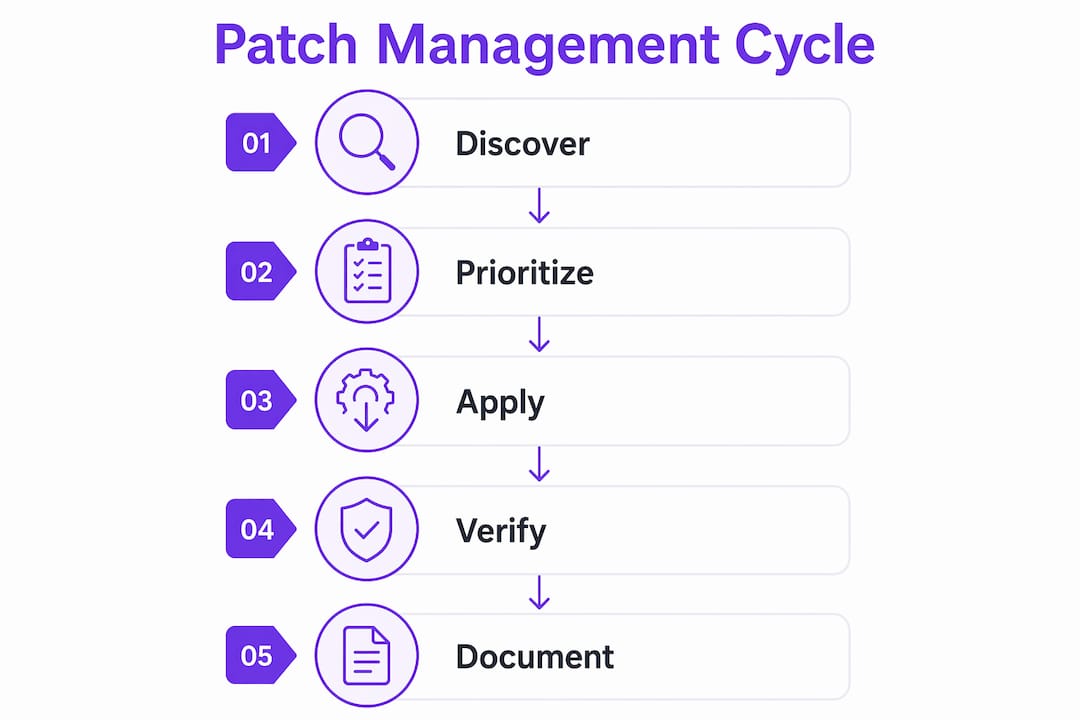
Why patch management matters for ISO 27001 control a.8.8
ISO 27001:2022 Annex A control A.8.8 defines technical vulnerability management as a continuous four-stage cycle: discover, prioritize, remediate, and verify. Each stage must produce documented evidence. Patching is the remediation stage, but it only satisfies the control when the surrounding stages are also documented and traceable.
The discovery and prioritization stage
Discovery starts with an accurate asset inventory. Every device, server, application, and cloud workload in scope must be cataloged before you can assess what needs patching. Prioritization then uses that inventory alongside vulnerability severity scores, exploit availability, and business exposure to rank remediation order. A critical vulnerability on an internet-facing server ranks above a medium-severity finding on an air-gapped test system, even if both appear in the same scan report.

Remediation timeframes under ISO 27001
Regulatory frameworks including ISO 27001 set defined patch remediation timeframes: critical vulnerabilities within 72 hours and high-severity findings within 14 days. These are not suggestions. They are service level agreements that must be documented, enforced, and reported against. If your organization cannot meet a timeframe, you need a formal exception, not a silent delay.
Verification closes the loop
Verification is the stage most teams skip under pressure. After applying a patch, a follow-up scan or configuration check must confirm the vulnerability is closed. Without verification, your patch log shows activity but not outcome. Auditors treat an unverified patch the same as no patch at all.
| Stage | Required Evidence | Typical Artifact |
|---|---|---|
| Discover | Asset inventory, scan results | CMDB export, vulnerability scanner report |
| Prioritize | Risk scoring, exposure assessment | Prioritized vulnerability register |
| Remediate | Patch application record | Change ticket, patch deployment log |
| Verify | Post-patch scan or test result | Verification scan report, closure record |
What does audit-ready patch evidence actually look like?
ISO 27001 requires an end-to-end evidence chain for patch logging that connects asset identification, vulnerability registration, patch decision, application, verification, and exception approval. Weak evidence at any link in that chain is treated as non-compliance, not as partial credit.
Auditors are not checking whether you used a specific tool. Auditors focus on verifiable evidence of patch application, testing, and exception management. The artifacts they request include patch logs, change records, verification results, and management approvals. If you cannot produce those on demand, the audit finding goes against you regardless of how much patching actually happened.
What patch logs must contain
A compliant patch log records the device name, the update applied, the patching date, and the reason for any delay. That last field matters more than most teams realize. A delay without a documented reason looks identical to a missed patch from an auditor’s perspective.
- Device identifier: hostname, IP, or asset tag tied to the CMDB
- Vulnerability reference: CVE number or internal vulnerability ID
- Patch or update applied: version, KB number, or package name
- Date applied: timestamp from the deployment tool
- Verification result: pass or fail from post-patch scan
- Exception record: if patching was deferred, the formal exception reference
Pro Tip: Configure your patch management tool, whether that is Microsoft Endpoint Configuration Manager, Ivanti, or Qualys Patch Management, to export logs automatically in a format your GRC platform can ingest. This turns audit prep from a two-week scramble into a five-minute report pull.
Automated patch management programs generate audit evidence as a byproduct, turning audits into routine reporting rather than forensic investigations. That shift alone is worth the investment in tooling.
What are the most common patch management pitfalls under ISO 27001?
The most damaging patch management failures in ISO 27001 audits are not technical. They are process and documentation failures that make otherwise solid patching programs look unreliable on paper.
Incomplete asset inventories
Incomplete asset inventories undermine patch priority assessments and ISMS scope definition, weakening Annex A.8.8 evidence quality. When your vulnerability scanner finds a device that does not exist in your CMDB, you have a gap in both your asset register and your risk treatment record. Discrepancies between scanner output and the CMDB produce unreliable patch evidence and create audit findings that are difficult to explain away.
The fix is not a one-time reconciliation. Asset inventory accuracy requires a continuous process, ideally with automated discovery feeding directly into the CMDB on a scheduled basis.
Undocumented and informal exceptions
Every production environment has systems that cannot be patched on the standard schedule. Legacy systems, vendor-managed appliances, and operational technology are common examples. The problem is not the exception itself. The problem is when exceptions exist without formal documentation.
Documented exceptions require structured rationale, compensating controls, risk acceptance, and expiration dates to maintain effective risk treatment under ISO 27001. Informal exceptions reduce audit confidence and lower your ISMS maturity score. An exception without an expiration date is an open-ended risk acceptance that auditors will flag every time.
A formal exception is not a workaround. It is a risk treatment decision with an owner, a rationale, a compensating control, and a review date. Treat it with the same rigor you apply to any other risk treatment record.
Emergency patches and change management
Emergency patches require approval, testing, and rollback planning even when the process is expedited. The temptation during a zero-day response is to skip change management steps to move fast. That creates a compliance gap even if the patch itself was applied correctly. Build an expedited change path into your change management process before you need it, not during an incident.
Third-party and outsourced systems
Patching visibility ends at your perimeter only if you let it. ISO 27001 requires you to address vulnerabilities across your ISMS scope, including systems managed by third parties. Contractual obligations must specify patching SLAs, evidence sharing requirements, and audit rights. Without those clauses, you cannot demonstrate control over a significant portion of your attack surface.
Does patch management deliver benefits beyond ISO 27001 compliance?
Effective patching delivers security, operational, and financial benefits that extend well beyond passing an audit. Most cyberattacks exploit unpatched weaknesses, making timely patching one of the most cost-effective defensive controls available. The cost of remediating a breach caused by a known, unpatched vulnerability consistently exceeds the cost of the patching program that would have prevented it.
System stability also improves with disciplined patch management. Unpatched systems accumulate technical debt that manifests as unexpected failures, performance degradation, and compatibility issues. Regular patching, tested through a proper change process, reduces that debt incrementally rather than forcing large, risky update cycles.
Pro Tip: Track your mean time to remediate (MTTR) for critical vulnerabilities as a KPI in your ISMS management review. Showing a downward trend in MTTR is concrete evidence of continuous improvement under ISO 27001 Clause 10.
| Benefit | Patch Management | No Structured Program |
|---|---|---|
| Breach risk | Reduced by closing known exploits promptly | Elevated; unpatched CVEs are active targets |
| Audit readiness | Evidence generated automatically | Manual reconstruction before each audit |
| System stability | Incremental updates reduce failure risk | Accumulated debt increases outage probability |
| Compliance posture | Satisfies A.8.8 and supports NIS2, DORA | Gaps across multiple frameworks simultaneously |
Patch management also supports software patching in IT security at a broader level, contributing to cybersecurity maturity that regulators across NIS2 and DORA also assess. Organizations that build strong patch programs for ISO 27001 find that the same evidence and processes satisfy multiple regulatory requirements with minimal additional effort.
Key takeaways
Patch management is the single most auditable risk treatment control in ISO 27001, and its value compounds across security posture, operational stability, and multi-framework compliance.
| Point | Details |
|---|---|
| A.8.8 is non-negotiable | ISO 27001:2022 requires a documented discover, prioritize, remediate, and verify cycle for all in-scope assets. |
| Evidence chain completeness | Patch logs must include device, update, date, and delay reason; gaps are treated as non-compliance by auditors. |
| Timeframes are SLAs | Critical vulnerabilities require remediation within 72 hours; high-severity findings within 14 days. |
| Exceptions need structure | Every deferred patch needs rationale, compensating controls, risk acceptance, and an expiration date. |
| Automation pays off | Tools that generate patch logs automatically convert audit prep from a manual burden into routine reporting. |
The evidence chain is the control
Most compliance teams treat patch management as a technical task that happens to produce some paperwork. After working with ISO 27001 implementations across multiple industries, I have come to see it the opposite way. The evidence chain is the control. The patch itself is just the technical action that the evidence documents.
Auditors from certification bodies like BSI, Bureau Veritas, and DNV do not re-run your vulnerability scans. They read your logs, your exception records, and your verification results. I have seen organizations with genuinely strong patching programs fail audit findings because their logs were incomplete or their exceptions had no expiration dates. The technical work was done. The compliance work was not.
The other lesson I keep relearning is that asset inventory accuracy is the foundation everything else rests on. You cannot prioritize what you cannot see. Teams that invest in continuous asset discovery, feeding a live CMDB, consistently produce better audit evidence than teams with more sophisticated patching tools but a stale asset register.
Automation is not optional at scale. If your team is manually compiling patch evidence before each audit, you are spending compliance budget on a problem that tools like Ivanti, Qualys, or Tenable can solve as a side effect of normal operations. That time should go toward reviewing exceptions and improving remediation SLAs, not building spreadsheets.
The threat landscape referenced in security best practices for IT professionals makes patch prioritization more demanding each year. Treat your MTTR trend as a management metric, not just an operational one. It tells the story of your ISMS maturity better than almost any other single data point.
— Martin
Assess your ISO 27001 patch management readiness
Knowing the requirements is the first step. Knowing where your organization stands against them is what drives real progress.
Ismscalculator provides a structured ISO 27001 readiness assessment that maps your current patch management practices against all four ISO/IEC 27001:2022 control themes, including A.8.8. The platform generates a maturity score with gap analysis, so your compliance team can see exactly which evidence artifacts are missing and which processes need formalization. You get benchmarks against organizations of similar size and industry, plus a customizable implementation plan. Start with the free 2-minute readiness check to get an immediate baseline before committing to a full assessment.
FAQ
What is ISO 27001 control a.8.8?
A.8.8 is the ISO 27001:2022 technical vulnerability management control. It requires organizations to maintain a continuous cycle of discovering, prioritizing, remediating, and verifying vulnerabilities across all in-scope assets.
How often should patches be applied under ISO 27001?
Critical vulnerabilities must be remediated within 72 hours and high-severity findings within 14 days under risk-based SLAs. These timeframes must be documented in your patch management policy and enforced consistently.
What happens if a system cannot be patched?
A formal exception must be created with documented rationale, compensating controls, a risk acceptance sign-off, and an expiration date. Informal or undocumented exceptions are treated as non-compliance during ISO 27001 audits.
Does patch management evidence need to be automated?
Automation is not mandated, but it is the most reliable way to produce complete, consistent audit evidence. Manual log compilation introduces gaps and errors that auditors will identify. Tools that generate patch logs automatically reduce that risk significantly.
Is patch management required for ISO 27001 certification?
Yes. ISO 27001:2022 Annex A control A.8.8 makes technical vulnerability management, which includes patch management, a required control. Organizations must demonstrate a documented, operating process with verifiable evidence to achieve and maintain certification.