
Wanneer mensen zoeken op "beheersystemen voor bedrijfscontinuïteit" in de context van informatiebeveiliging en compliance, bedoelen ze doorgaans een ISMS, een Information Security Management System dat is opgebouwd conform de ISO 27001-norm. Dit is geen BCMS of ISO 22301-rampherstelplanning. Het is het raamwerk van beleid, risicobeoordelingen en beheersmaatregelen waarmee uw organisatie gecertificeerd raakt en klantgegevens aantoonbaar beveiligd worden gehouden.
De planningsuitkomst: kleine organisaties besteden doorgaans $30.000 tot $60.000 in het eerste jaar, middelgrote bedrijven komen uit tussen $55.000 en $150.000, en ondernemingen met meerdere locaties of gereglementeerde gegevens overschrijden vaak $150.000. De werkelijke cijfers variëren sterk op basis van scope en het gebruik van consultants. Uw volgende stap is eenvoudig.
- Voer een gratis gereedheidscheck uit om te zien waar uw organisatie staat voordat u budget vastlegt
- Of genereer een onderbouwde schatting op basis van uw werkelijke personeelsomvang, sector en volwassenheidsniveau
Belangrijkste inzichten
Een verdedigbaar ISO 27001-budget ontstaat door eerst de scope vast te leggen, initiële en doorlopende kosten te scheiden, en betrouwbaarheidsbandbreedtes toe te passen in plaats van één geschat getal.
| Punt | Details |
|---|---|
| ISMS betekent hier ISO 27001 | Deze gids behandelt information security management systems, niet BCMS/ISO 22301-continuïteitsplanning. |
| Eerste-jaarkosten variëren sterk | Kleine organisaties: $30.000 tot $60.000; middelgroot: $55.000 tot $150.000; enterprise overschrijdt vaak $150.000. |
| Consultantuitgaven zijn de grootste variabele | Gespecialiseerde consultants rekenen doorgaans $15.000 tot $35.000 voor implementaties bij het mkb. |
| Doorlooptijd is 3 tot 18 maanden | Het implementatiewerk, niet de auditdagen, bepaalt hoe snel u gecertificeerd raakt. |
| Testen bewijst dat beheersmaatregelen werken | Tafeloefeningscenario's, toegangsbeoordelingen en back-uptests leveren het bewijsmateriaal dat auditors verwachten. |
| Verkrijg een op maat gemaakt getal | De ISMS Calculator vertaalt gepubliceerde bandbreedtes naar een schatting die specifiek is voor uw scope en volwassenheid. |
Inhoudsopgave
- Wat de kosten en inspanning van een ISMS werkelijk bepaalt
- Realistische kosten- en tijdlijnsmarges voor ISO 27001
- Een stapsgewijze budgetteerchecklist die u daadwerkelijk kunt gebruiken
- Uw implementatiebenadering kiezen
- Een getal krijgen dat u daadwerkelijk kunt verdedigen
- Kerncomponenten en structuur van een beheersysteem voor bedrijfscontinuïteit
- Wet- en regelgeving en compliancevereisten gekoppeld aan uw ISMS
- Veelvoorkomende risico's en dreigingen waartegen een ISMS is gebouwd
- Stappen om uw ISMS in de loop der tijd op te bouwen en te onderhouden
- Uw ISMS integreren met breder risicobeheer
- Testen en oefenen van uw ISMS-beheersmaatregelen
- Wat ervaring leert over ISMS-budgettering
- Vertaal deze marges naar uw werkelijke getal
- Veelgestelde vragen
- Bronnen
Wat de kosten en inspanning van een ISMS werkelijk bepaalt
Uw budget betaalt niet voor een certificaat. Het betaalt voor scope, documentatie en bewijsmateriaal.
Scope is de vermenigvuldiger. Elk extra kantoor, elke bedrijfseenheid of cloudomgeving die u binnen de ISMS-grens brengt, voegt auditdagen en interne interviewuren toe. Een SaaS-bedrijf met één vestiging en 30 medewerkers ziet er op papier heel anders uit dan een fabrikant die in drie landen actief is, maar de norm behandelt ze op exact dezelfde manier: volledig.
De belangrijkste deliverables waarvoor u daadwerkelijk betaalt:
- Een formele risicobeoordeling die activa, dreigingen en behandelplannen omvat
- De Verklaring van Toepasselijkheid (Statement of Applicability), die aangeeft welke van de 93 Annex A-beheersmaatregelen van toepassing zijn en waarom
- Beleidsdocumentatie over toegangscontrole, incidentrespons en leveranciersbeheer
- Interne auditcycli vóór de externe certificeringsaudit
- Bewijsverzameling: logbestanden, tickets, trainingsregistraties, toegangsbeoordelingen
Technische beheersmaatregelen zoals meervoudige authenticatie, gecentraliseerde logging en endpoint-detectie brengen licentiekosten met zich mee. Organisatorische beheersmaatregelen, zoals HR daadwerkelijk achtergrondonderzoeken laten uitvoeren of engineering het wijzigingsbeheer laten documenteren, kosten tijd in plaats van geld. Beide komen ergens in uw budget tot uiting.
Realistische kosten- en tijdlijnsmarges voor ISO 27001
Eerste-jaarcertificeringskosten variëren doorgaans van circa $30.000 tot $400.000, waarbij bedrijfsomvang, beveiligingsvolwassenheid en de mate van consultantinzet bijna het volledige verschil bepalen, volgens een recente kostenanalyse. De certificeringsauditvergoeding zelf vormt slechts een klein deel van dat totaal. Het meeste geld gaat naar consultants, tooling en interne arbeid die nooit op een factuur verschijnt.
De grootste variabele in uw budget zijn de consultantuitgaven. Gespecialiseerde consultants rekenen doorgaans $15.000 tot $35.000 voor implementaties bij kleine en middelgrote organisaties, terwijl grotere adviesbureaus aanzienlijk hogere tarieven hanteren. Een capabele interne beveiligingsverantwoordelijke kan dat bedrag flink drukken, maar alleen als diegene de bandbreedte heeft om het project naast zijn dagelijkse werk te begeleiden — wat zelden realistisch is.
De doorlopende kosten stoppen niet bij certificering. Jaarlijks onderhoud, bestaande uit surveillanceaudits, verlenging van GRC-tools en interne arbeid, bedraagt doorgaans $20.000 tot $70.000, afhankelijk van de omvang en de mate van procesautomatisering.
De tijdlijn volgt een vergelijkbare logica. De meeste organisaties ronden de certificering af in 6 tot 12 maanden, waarbij slagvaardige en volwassen kleine bedrijven dat in 3 maanden halen en grote multiregionale ondernemingen uitlopen tot 18 maanden. Dit is het punt dat mensen vaak over het hoofd zien: de audit zelf duurt slechts enkele dagen. De implementatieperiode — waarin u uw beheersmaatregelen lang genoeg operationeel heeft om echt bewijsmateriaal te genereren — bepaalt de hele planning. U kunt een toegangsbeoordeling over 90 dagen niet inkorten door een betere consultant in te huren.
Een stapsgewijze budgetteerchecklist die u daadwerkelijk kunt gebruiken
Een breed gepubliceerde bandbreedte omzetten naar een verdedigbaar getal vergt vier stappen en één eerlijkheidscheck.
- Definieer scope en basisinputs. Tel het aantal in scope zijnde systemen, het aantal medewerkers dat door het ISMS wordt geraakt, en uw huidige volwassenheid (heeft u al een toegangscontrolepolicy, of begint u vanaf een blanco pagina?).
- Schat voorbereidingskosten. Dit omvat gap-analyse, het opstellen van beleid en personeelstraining — intern of via een consultant.
- Schat certificeringskosten. Auditvergoedingen voor Fase 1 en Fase 2, reiskosten van de auditor indien van toepassing, GRC-toolingabonnementen en eventuele leveranciers- of penetratietestkosten.
- Schat interne arbeidskosten en voeg een contingentie toe. Converteer geraamde uren naar belaste tarieven en voeg 10 tot 20 procent contingentie toe voor scopeverrassingen.
Een budgetteringsmethode die initiële implementatiekosten scheidt van doorlopende operationele kosten, en betrouwbaarheidsbandbreedtes toepast op basis van gegevenskwaliteit, levert aanzienlijk beter verdedigbare cijfers op dan één enkel geschat bedrag, aldus de budgetteringsmethodologie van 27001Academy.
| Kwaliteit van inputs | Betrouwbaarheidsbandbreedte |
|---|---|
| Alleen ruwe modelreferentiewaarden | -25% tot +60% |
| Leveranciersoffertes verzameld, scope opgesteld | -15% tot +25% |
| Ondertekende contracten, vastgelegde scope | -5% tot +10% |
Hoe nauwkeuriger uw inputs, hoe smaller uw bandbreedte. Dat is geen platitude, maar rekenkunde: gissen vergroot de variantie, specificiteit verkleint die.
Uw implementatiebenadering kiezen
Er bestaan drie paden, en het kiezen van het verkeerde verspilt maanden.
- Zelf doen. Werkt wanneer u al een beveiligingsbewuste medewerker heeft met 15 tot 20 uur per week beschikbaar, in een relatief eenvoudige omgeving met één vestiging. Op papier het goedkoopst, maar het langzaamst — en het risico van een gemiste beheersmaatregel of een verkeerde interpretatie van de Annex A-intentie is reëel.
- Een consultant of managed service inschakelen. De standaard aanpak voor eerste implementaties. U betaalt $15.000 tot $35.000 voor begeleide implementatie en krijgt daarvoor iemand die bij tientallen audits aanwezig is geweest en weet welke shortcuts echt standhouden. Consultantuitgaven zijn consequent de grootste variabele post in het totale budget, blijkt uit kostenanalysegegevens.
- Zelf doen met gerichte automatisering. Platforms die bewijsverzameling en beleidsopvolging automatiseren, reduceren het doorlopende onderhoud van ruwweg 550 tot 600 uur per jaar naar circa 75 uur per jaar bij managed delivery, gebaseerd op tijdlijnonderzoek. U heeft nog steeds oordeelsvermogen nodig voor scope en risicobehandeling, maar het handmatige werk neemt drastisch af.
Pro-tip: Als dit uw eerste certificering is, budget dan in ieder geval voor ondersteuning bij de auditvoorbereiding, ook als u het meeste werk zelf doet. Auditors wijzen Verklaringen van Toepasselijkheid vaker af dan technische beheersmaatregelen, en een tweede ervaren blik vangt dat op voordat het u een mislukte auditcyclus kost.
Een getal krijgen dat u daadwerkelijk kunt verdedigen
Brede gepubliceerde bandbreedtes zijn een startpunt, geen budget. Om ze te vertalen naar een getal dat uw CFO zal ondertekenen, heeft u inputs nodig die specifiek zijn voor uw organisatie: personeelsomvang, sector, huidige beheersmaatregel-volwassenheid en beoogde tijdlijn.
De ISMS Calculator is precies gebouwd voor die kloof. Hij genereert een realtime schatting afgestemd op uw bedrijfsomvang, sector en beveiligingsvolwassenheid, ondersteund door modelreferentievergelijkingen zodat u kunt zien of uw geraamde uitgaven boven of onder de modelreferentiewaarden liggen. Belangrijkste inputs die de nauwkeurigheid verbeteren:
- Een volwassenheidsassessment over alle vier de controle-thema's van ISO/IEC 27001:2022
- Huidige beheersmaatregelendekking (wat is er al aanwezig versus wat moet nog worden gebouwd)
- Beoogde certificeringstijdlijn en capaciteit van het interne team
Het doorrekenen geeft u ook een aanpasbaar Gantt-diagram dat de implementatiefasen in kaart brengt, zodat tijdlijn en budget gekoppeld blijven in plaats van in afzonderlijke spreadsheets te leven. Voer voordat u echt budget vastlegt de gratis gereedheidscheck van 2 minuten uit om een basisvolwassenheidsscore te krijgen en te zien waar uw organisatie ongeveer staat.
Kerncomponenten en structuur van een beheersysteem voor bedrijfscontinuïteit
Een ISMS conform ISO 27001 is opgebouwd op een aantal structurele pijlers, en inzicht daarin laat zien waar uw budget werkelijk naartoe gaat. De context- en scopeverklaring definieert de organisatiegrenzen — het onderdeel dat, zoals hierboven beschreven, de meeste kostenvariatie veroorzaakt. De risicobeoordelingsmethodologie documenteert hoe u informatiebeveiligingsrisico's identificeert, beoordeelt en behandelt, en voedt direct de Verklaring van Toepasselijkheid.
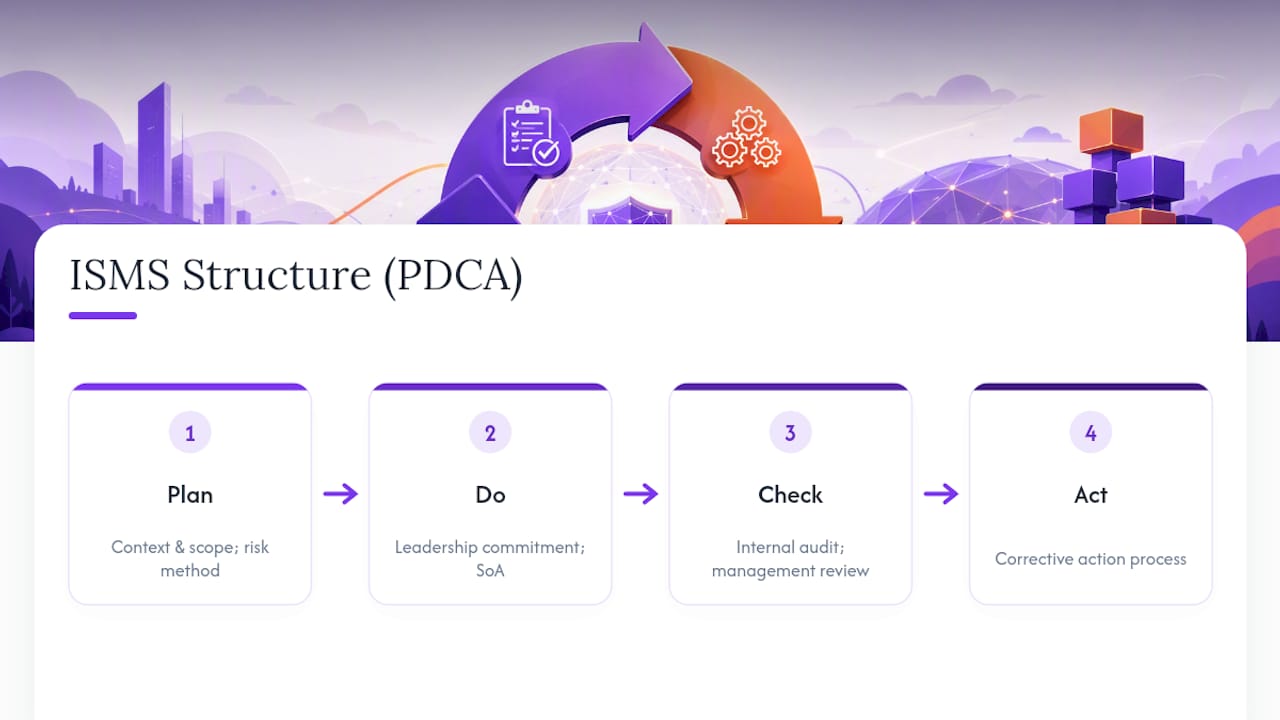
Betrokkenheid van de directie is een formele vereiste, geen beleefdheid. Clausule 5 van de norm vereist gedocumenteerde directiebeoordelingen, wat betekent dat bestuurders beveiligingsdoelstellingen en middelenallocatie goedkeuren — en auditors controleren dit spoor van documentatie specifiek.
De Verklaring van Toepasselijkheid (SoA) koppelt elke van toepassing zijnde Annex A-beheersmaatregel aan een onderbouwing en implementatiestatus. Het is het document waarnaar auditors het meest verwijzen, en tevens de meest onderschatte deliverable in budgetten voor eerste implementaties.
Dit alles wordt ondersteund door een intern auditprogramma, een correctieve maatregelenproces voor wanneer beheersmaatregelen falen, en een directiebeoordelingscyclus — doorgaans kwartaal- of halfjaarlijks — waarbij het management beoordeelt of het gehele systeem nog steeds functioneert. Samen vormen deze onderdelen wat auditors de Plan-Do-Check-Act-cyclus noemen: het structurele skelet dat elk gecertificeerd ISMS deelt, ongeacht sector of omvang.
Wet- en regelgeving en compliancevereisten gekoppeld aan uw ISMS
ISO 27001 zelf is een vrijwillige norm, maar zeer weinig organisaties streven naar certificering zonder een externe druk die hen daartoe aanzet. Enterprise-klanten eisen het steeds vaker als contractuele voorwaarde voordat ze tekenen. Cyberverzekeraars vragen om bewijs van een formeel beveiligingsprogramma voordat ze gunstige premies offreren. En in gereguleerde sectoren — zorg, financiën, overheidscontractering — staat ISO 27001 vaak naast sectorspecifieke kaders zoals HIPAA, GLBA of FedRAMP, in plaats van deze te vervangen.
Die stapeling is relevant voor budgettering. Als uw organisatie al SOC 2-bewijsmateriaal bijhoudt of PCI DSS-beheersmaatregelen heeft, verwacht dan betekenisvolle overlap — maar geen volledige duplicatie. Toegangslogboekregistratie die voldoet aan PCI DSS voldoet doorgaans ook aan Annex A-beheersmaatregel 8.15, maar het documentatieformaat en de beoordelingsfrequentie die auditors verwachten kunnen voldoende verschillen om herwerk te vereisen.
Gegevensbeschermingswetgeving voegt een extra laag toe. Organisaties die persoonsgegevens verwerken onder kaders zoals de CCPA of sectorspecifieke Amerikaanse regelgeving, ontdekken vaak dat de risicobeoordeling en gegevensbehandelingsbeheersmaatregelen van ISO 27001 hen een voorsprong geven op die verplichtingen — hoewel certificering op zichzelf geen juridische naleving van een specifieke privacywet garandeert. Beschouw ISO 27001 als de beveiligingsruggengraat en leg regelgevingsspecifieke vereisten daarboven, in plaats van ervan uit te gaan dat één certificaat elke juridische verplichting van uw organisatie dekt.
Veelvoorkomende risico's en dreigingen waartegen een ISMS is gebouwd
De Annex A-beheersmaatregelenset bestaat omdat specifieke faalpatronen zich herhalen in organisaties van alle groottes. Onbevoegde toegang staat bovenaan de lijst — diefstal van inloggegevens, zwak wachtwoordbeleid en ontbrekende meervoudige authenticatie zijn verantwoordelijk voor een groot deel van de datalekken in de praktijk. Dat is waarom toegangscontrole (Annex A 5.15 t/m 5.18) zo veel documentatiegewicht krijgt.
Risico van derde partijen en leveranciers is de tweede grote categorie. Uw ISMS-grens stopt zelden bij uw eigen servers; hij strekt zich uit tot elke leverancier die uw gegevens aanraakt. Een leveranciersbeheerraamwerk dat leveranciersrisicobeoordelingen en contractuele beveiligingsvereisten documenteert, is inmiddels een standaardverwachting, geen optionele extra.
Naast toegang en leveranciers dwingt het risicobehandelingsproces van de norm organisaties om formeel aandacht te besteden aan interne dreigingen (zowel kwaadwillig als per ongeluk), blootstelling aan malware en ransomware, fysieke beveiligingslacunes op kantoor- of datacentrelocaties, en bedrijfsonderbreking door technisch falen — van een verkeerd geconfigureerde cloudbucket tot een niet-gepatcht systeem. De risicobeoordelingsmethodologie geeft u geen checklist van dreigingen die u moet oplossen. Ze dwingt u te identificeren welke dreigingen werkelijk van toepassing zijn op uw specifieke omgeving en te bewijzen dat u over elk ervan een bewuste beslissing heeft genomen: accepteren, mitigeren, overdragen of vermijden.
Stappen om uw ISMS in de loop der tijd op te bouwen en te onderhouden
Certificering is een mijlpaal, geen eindlijn. De opbouwfase volgt doorgaans een vaste volgorde: scopedefinitie, gap-analyse ten opzichte van huidige beheersmaatregelen, risicobeoordeling, opstellen van beleid en procedures, implementatie van beheersmaatregelen, personeelstraining, interne audit en ten slotte de tweefasige certificeringsaudit zelf.
Onderhoud is waar organisaties hun investering beschermen of zien verwateren. ISO 27001-certificering loopt op een driejaarlijkse cyclus, met surveillanceaudits die doorgaans jaarlijks worden uitgevoerd om te bevestigen dat het ISMS nog steeds functioneert zoals gedocumenteerd. Tussen de audits in is het echte werk continu: toegangslogboeken beoordelen, het risicoregister bijwerken wanneer nieuwe systemen of leveranciers de omgeving betreden, het interne auditprogramma uitvoeren en directiebeoordelingsvergaderingen houden die daadwerkelijk gedocumenteerde beslissingen opleveren.
Organisaties die het in jaar twee moeilijk krijgen, hebben bijna altijd dezelfde fout gemaakt: ze behandelden het ISMS als een project met een einddatum in plaats van als een bedrijfssysteem met een onderhoudsschema. Bewijsverzameling moet continu plaatsvinden, niet gehaast worden samengesteld in de maand voor een surveillanceaudit. Precies hier verdienen beheerde platformen hun kosten — ze reduceren de last van honderden verspreide uren naar een fractie daarvan wanneer het verzamelproces continu op de achtergrond draait.
Uw ISMS integreren met breder risicobeheer
Een ISMS opereert zelden lang in isolatie. De meeste middelgrote en grote organisaties verbinden het uiteindelijk met een breder enterprise risk management (ERM)-programma, waarbij informatiebeveiliging-risico's worden ingevoerd in hetzelfde risicoregister dat financiële, operationele en reputatierisico's bijhoudt. Dit voorkomt het veelvoorkomende faalpatroon waarbij beveiligingsrisico's in een silo leven die bestuurders nooit echt zien tijdens strategische planningssessies.
Waar organisaties ook een formeel bedrijfscontinuïteits- of rampherstelprogramma hebben, is het integratieraakvlak belangrijker dan de meesten verwachten. Uw ISMS-risicobeoordeling en uw continuïteitsplanning zouden moeten verwijzen naar dezelfde activaregistratie en dezelfde lijst van kritieke processen. Dit werk over twee afzonderlijke teams dupliceren verspilt uren en — erger nog — creëert twee documenten die bij de tweede auditcyclus stilzwijgend met elkaar in tegenspraak zijn.
Integratie met kwaliteitsmanagement is de andere veelvoorkomende combinatie, met name voor organisaties die al gecertificeerd zijn volgens ISO 9001. Omdat beide normen dezelfde hoogwaardige structuur delen (context, leiderschap, planning, ondersteuning, uitvoering, evaluatie, verbetering), kan een gedeelde directiebeoordelingskalender en een gedeeld intern auditteam beide systemen bedienen zonder de vergaderbelasting te verdubbelen. Organisaties die hun ISMS van meet af aan bouwen met deze gedeelde architectuur in gedachten — in plaats van die na de certificering toe te voegen — rapporteren consequent lagere doorlopende onderhoudslasten. Het is een scopebeslissing die u beter kunt nemen voordat u uw eerste beleid schrijft, niet na uw tweede surveillanceaudit die de lacune signaleert.
Testen en oefenen van uw ISMS-beheersmaatregelen
Documentatie zonder testen is een aansprakelijkheid, geen beheersmaatregel. ISO 27001 vereist bewijs dat uw beveiligingsmaatregelen daadwerkelijk werken — niet alleen dat ze op papier bestaan — en auditors toetsen dit onderscheid specifiek tijdens Fase 2-audits.
Testen van incidentrespons betekent doorgaans tafeloefeningscenario's: een gesimuleerd inbreukscenario doorlopen met het responsteam om te bevestigen dat rollen, escalatiepaden en communicatieplannen standhouden onder druk. De meeste volwassen programma's voeren deze minimaal jaarlijks uit, vaker voor organisaties die gevoelige gegevens verwerken.
Testen van toegangsbeoordelingen verifieert dat gebruikersmachtigingen overeenkomen met daadwerkelijke functierollen, en vangt de veelvoorkomende drift op waarbij medewerkers bij functiewisselingen toegangsrechten ophopen zonder dat de oude worden ingetrokken. Testen van back-up en herstel bevestigt dat herstelprocessen daadwerkelijk werken — een verrassend groot aantal organisaties ontdekt dat hun back-upproces stilzwijgend is mislukt pas wanneer ze het proberen te gebruiken tijdens een echt incident.

Interne audits dienen als de formele, geplande versie van dit testen — beheersmaatregelen in de hele organisatie steekproefsgewijs controleren om te bevestigen dat ze functioneren zoals gedocumenteerd, voordat een externe auditor hetzelfde doet met veel hogere inzet. Een testkalender van meet af aan in uw ISMS inbouwen — in plaats van in de maand voor uw audit te moeten bewijzen dat beheersmaatregelen effectief zijn — is het verschil tussen een vlotte surveillanceaudit en een scramble die haar eigen nieuwe risico's genereert.
Wat ervaring leert over ISMS-budgettering
De meeste ISMS-budgetten mislukken om dezelfde drie redenen: scope-uitbreiding nadat de schatting is vastgesteld, onderschatting van interne uren omdat men ervan uitgaat dat een consultant al het werk doet, en het weglaten van contingentie omdat het initiële getal al oncomfortabel hoog aanvoelde.
De gewoonte die dit grotendeels oplost: vergrendel de scope en verzamel uw basislijn voordat u ook maar iets schat, voer vervolgens twee scenario's naast elkaar uit — een smal en een breed. Beide cijfers naast elkaar zien maakt scopebeslissingen concreet in plaats van theoretisch.
Vertaal deze marges naar uw werkelijke getal
Elke bandbreedte in deze gids is een startpunt, opgebouwd uit generieke gepubliceerde ranges. Uw organisatie is geen gemiddelde. Ze heeft een specifieke personeelsomvang, een specifieke technologiestack en een specifiek volwassenheidsniveau — en dat is precies waarmee generieke gepubliceerde bandbreedtes geen rekening kunnen houden.
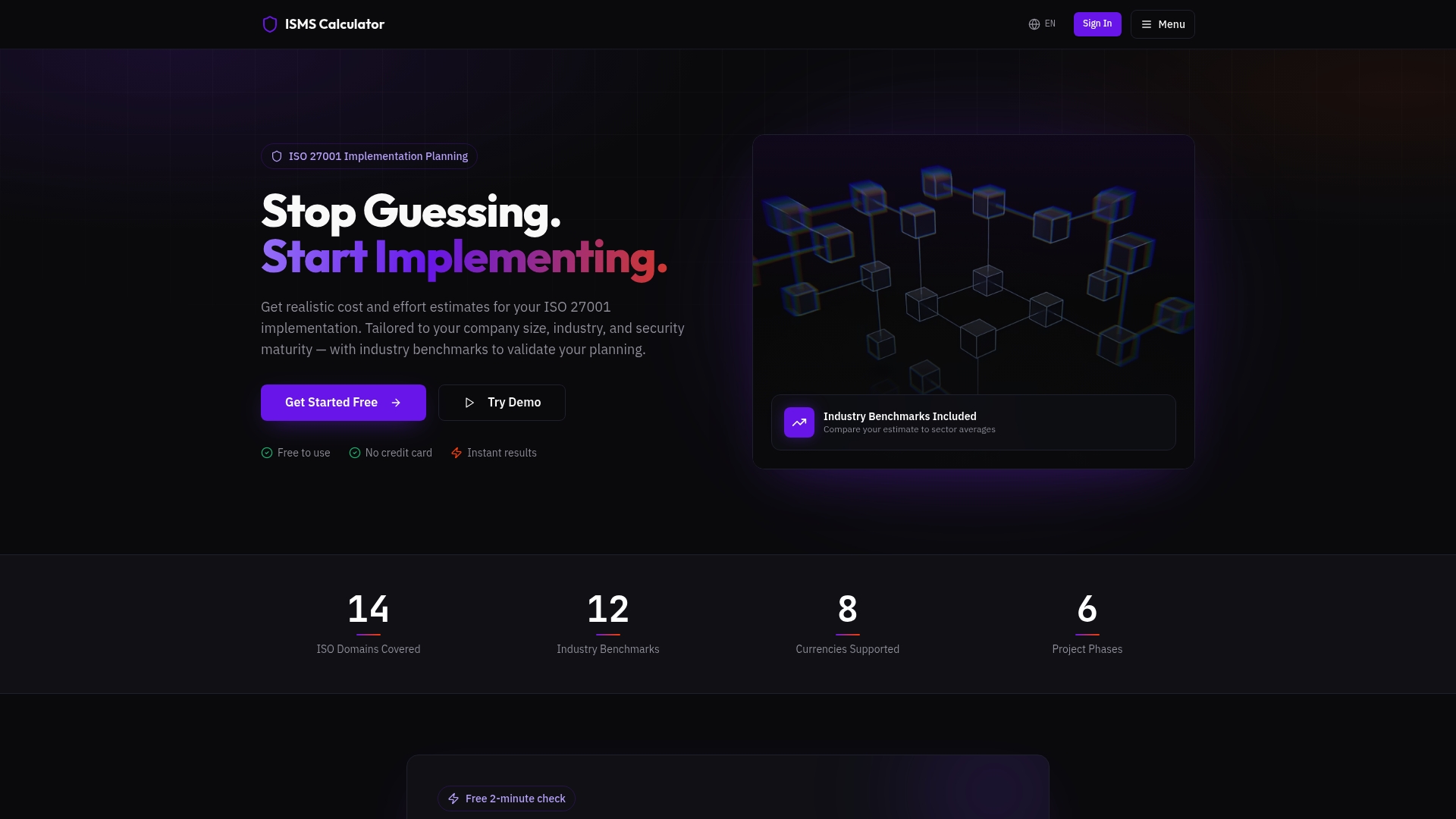
De ISMS Calculator-gereedheidsassessment gebruikt de inputs die specifiek zijn voor uw organisatie — omvang, sector, huidige volwassenheid, beoogde tijdlijn — en produceert een op maat gemaakte kosten- en inspanningsschatting in plaats van een generieke categorie. U krijgt benchmarkvergelijkingen ten opzichte van de modelreferentie, zodat u direct ziet of uw geraamde bedrag redelijk is of een uitschieter. Sla meerdere scenario's naast elkaar op (smalle scope vs. brede scope, zelf doen vs. met consultantondersteuning) en exporteer de resultaten als pdf om direct mee te nemen naar uw volgende budgetgesprek. Als u de cijfers nog niet heeft doorgerekend, begin dan met de gratis gereedheidscheck en zie waar uw organisatie werkelijk staat voordat u een bedrag in een spreadsheet vastlegt.
Veelgestelde vragen
Betekent "beheersystemen voor bedrijfscontinuïteit" hetzelfde als ISO 27001? In de context waarin de meeste compliance officers en IT-managers deze term zoeken, ja — het verwijst naar een information security management system gebouwd conform de ISO 27001-norm, dat risicobeoordeling, Annex A-beheersmaatregelen en certificering omvat, en niet naar een afzonderlijk BCMS/ISO 22301-rampherstelprogramma.
Wat kost een eerste-jaar ISMS-implementatie doorgaans? Kosten variëren doorgaans van circa $30.000 tot $400.000, waarbij het grote verschil hoofdzakelijk wordt bepaald door bedrijfsomvang, bestaande beveiligingsvolwassenheid en de mate van consultantondersteuning.
Hoe lang duurt ISO 27001-certificering gewoonlijk? De meeste organisaties zijn klaar in 6 tot 12 maanden, met een realistische bandbreedte van 3 tot 18 maanden afhankelijk van scope en organisatiecomplexiteit.
Welke kosten blijven bestaan na certificering? Jaarlijks onderhoud — inclusief surveillanceaudits, verlengingen van toolingabonnementen en interne arbeid — bedraagt doorgaans $20.000 tot $70.000 per jaar, waarbij geautomatiseerde platformen de benodigde interne uren aanzienlijk reduceren.
Moet ik een consultant inhuren of ISO 27001 zelf implementeren? Kleine organisaties met een toegewijde beveiligingsbewuste medewerker en een eenvoudige scope kunnen het intern proberen, maar de meeste organisaties die voor het eerst implementeren hebben baat bij ten minste ondersteuning bij de auditvoorbereiding — consultantbegeleiding voorkomt namelijk vaak kostbaar herwerk aan de Verklaring van Toepasselijkheid.
Bronnen
- ISO 27001 Certification Cost: Complete Breakdown for 2026
- How long does ISO 27001 certification take? (2026)
- How to Budget an ISO 27001 Implementation Project (27001Academy paper)