
An ISO 27001 fintech compliance roadmap is the structured path fintech firms follow to build a certified Information Security Management System (ISMS) that satisfies both international security standards and financial regulators. Achieving certification requires aligning ISO 27001 controls with frameworks like DORA, PSD2, and MaRisk from day one. The typical certification timeline runs 10–16 months for most fintech companies, reflecting the added complexity of multi-framework regulatory alignment. Getting this roadmap right means faster audit cycles, stronger customer trust, and a direct competitive advantage in enterprise sales.
What is the ISO 27001 fintech compliance roadmap?
The ISO 27001 fintech compliance roadmap is a phased implementation plan that takes a fintech firm from its current security posture to a fully auditable ISMS. It differs from a generic ISO 27001 implementation guide because it layers financial regulatory requirements on top of standard Annex A controls. DORA mandates digital operational resilience. PSD2 requires strict access controls around payment data. MaRisk sets supervisory expectations for German-regulated entities. A fintech-specific roadmap addresses all three simultaneously rather than treating them as separate workstreams.
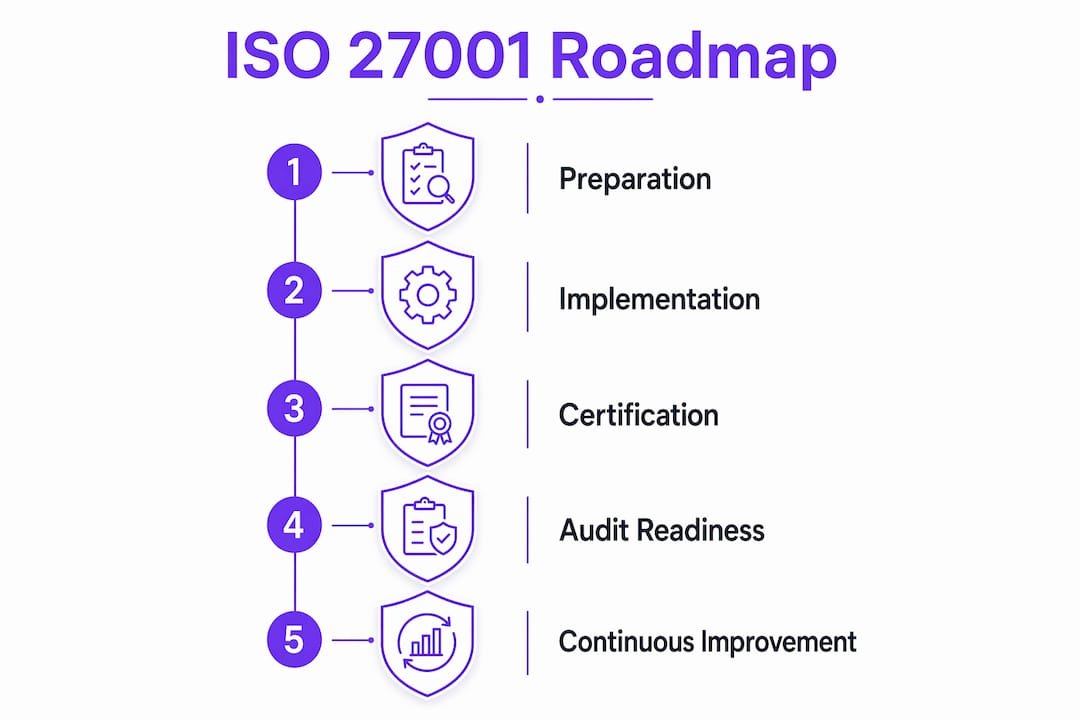
The roadmap typically runs in three phases: preparation, implementation, and certification. Each phase has defined outputs that auditors will examine. Skipping or rushing the preparation phase is the single most common reason fintech firms fail their Stage 1 audit. The sections below walk through each phase in detail.

What prerequisites must fintech firms complete before starting?
Twelve critical preparatory tasks must be completed before a formal gap assessment can begin. Treating these as optional pre-work is a mistake. Auditors check whether your ISMS scope, policies, and risk appetite were defined before controls were selected, not after.
The twelve tasks break into four categories:
- Define your ISMS scope. Map which products, systems, and data flows fall inside the boundary. For a payments fintech, this typically includes the core transaction platform, customer data stores, and any cloud infrastructure processing cardholder data.
- Identify all critical data flows. Document where personal financial data enters, moves, and exits your systems. This feeds directly into your risk assessment and is required under PSD2 and GDPR.
- Map third-party suppliers. List every vendor with access to in-scope systems. Supply chain risk is one of the top audit findings in fintech because firms underestimate how many integrations touch sensitive data.
- Draft information security policies. Policies must reflect your actual risk appetite, not a template downloaded from the internet. Leadership must sign off before the gap assessment starts.
- Assign an ISMS owner. This person coordinates evidence collection, control ownership, and auditor communication. In fintech, this is often the CISO or a dedicated compliance lead.
- Conduct a regulatory overlay review. Identify which ISO 27001 Annex A controls map to DORA, PSD2, or MaRisk obligations. This prevents duplicate work later.
- Establish a risk management framework. Define your risk criteria, risk acceptance thresholds, and treatment options before the formal risk assessment begins.
- Inventory all assets. Hardware, software, cloud services, and data repositories all need to be cataloged. Asset inventory is a Stage 1 audit requirement.
- Review existing access controls. Document current identity and access management practices. Gaps here are common and take time to remediate.
- Set up an incident management process. Even a basic log of security events demonstrates operational maturity to auditors.
- Align leadership on the program. Executive sponsorship determines whether resource requests get approved quickly or stall for weeks.
- Choose your certification body. Accredited certification bodies have different scheduling lead times. Booking early prevents delays at the end of the roadmap.
Pro Tip: Run a free 2-minute readiness check before your gap assessment. It surfaces the biggest gaps in your current posture and helps you prioritize the twelve preparatory tasks.
How to build and execute the ISO 27001 compliance roadmap for fintech
After preparation, the implementation phase begins. This is where most of the work happens and where fintech firms most often lose momentum.
Risk assessment and treatment
Your risk assessment must reflect fintech-specific threats: API abuse, third-party payment processor failures, insider access to transaction data, and cloud misconfiguration. Generic risk libraries miss these. Map each identified risk to one or more Annex A controls and document your treatment decision. Regulators under DORA expect you to demonstrate that your risk treatment choices are proportionate and evidence-based.
Annex A control implementation
ISO 27001:2022 contains 93 controls across four themes. For fintech, the highest-priority controls cluster around:
- Access control and identity management (A.5.15–A.5.18): Critical for PSD2 strong customer authentication requirements.
- Cryptographic controls (A.8.24): Required for protecting payment data at rest and in transit.
- Supplier relationships (A.5.19–A.5.22): Auditors scrutinize third-party contracts and security assessments in fintech more than in other sectors.
- Incident management (A.5.24–A.5.28): DORA requires documented incident classification and reporting timelines.
- Business continuity (A.5.29–A.5.30): Operational resilience is a core DORA requirement, and auditors expect tested recovery procedures.
Mapping Annex A controls to financial regulatory overlays from day one creates a single source of truth that survives both ISO audits and supervisory examinations. Firms that maintain separate compliance matrices for each framework waste significant effort and introduce inconsistencies.
Integration into development workflows
Auditors focus on operational evidence, including incident logs, access reviews, and automated security checks, rather than static policy documents. Fintech firms that integrate security gates into their CI/CD pipelines generate this evidence automatically. Examples include automated dependency scanning in GitHub Actions, secrets detection in pre-commit hooks, and infrastructure-as-code policy checks using tools like Open Policy Agent.
Evidence centralization and audit readiness
Firms that centralize evidence in a single repository reach Stage 2 audit readiness faster. Stage 2 audit readiness is achievable within 90 days after the preparation phase when control ownership is clearly assigned and evidence is collected continuously rather than assembled at the last minute.
| Implementation phase | Key output | Typical duration |
|---|---|---|
| Preparation | Scope, policies, asset inventory | 6–10 weeks |
| Risk assessment | Risk register, treatment plan | 4–6 weeks |
| Control implementation | Evidence repository, control records | 12–20 weeks |
| Internal audit | Nonconformity log, corrective actions | 3–4 weeks |
| Stage 1 audit | Documentation review pass | 1–2 weeks |
| Stage 2 audit | Certification decision | 1–2 weeks |
Pro Tip: Assign a named owner to every Annex A control before implementation begins. Ownership gaps are the leading cause of missing evidence at audit time.
What common mistakes should fintech firms avoid?
The most damaging mistake is treating ISO 27001 as a documentation project. Auditors do not certify binders of policies. They certify operating systems with evidence of continuous security management. Fintech firms that produce policies without changing how they operate fail their Stage 2 audit regardless of how thorough the paperwork looks.
“The gap between having a policy and operating a control is exactly where most fintech ISO 27001 programs break down. Auditors are trained to find that gap.”
Other frequent pitfalls include:
- Undefined risk appetite. If leadership cannot articulate what level of risk is acceptable, risk treatment decisions become arbitrary. Auditors will challenge every treatment choice that lacks a documented rationale.
- Weak supplier management. Fintech firms rely on more third parties than most industries. Failing to assess and contractually bind suppliers to security requirements is a recurring major nonconformity.
- Incident handling gaps. Many fintechs have an incident response plan but no evidence of it being tested or used. Auditors ask for incident logs, post-incident reviews, and evidence of lessons learned.
- Late executive engagement. Compliance programs that lack a senior sponsor stall when resource decisions need to be made. The CISO’s role in securing that sponsorship is critical.
- Underestimating timeline. Firms that plan for six months and hit regulatory complexity often run out of budget before certification. Build in buffer for corrective actions after the internal audit.
Reviewing common implementation mistakes specific to financial services before you start saves significant remediation time later.
How does ISO 27001 certification benefit fintech beyond compliance?
ISO 27001 certification is a prerequisite in vendor onboarding by major banks and insurers. Lack of certification causes longer sales cycles or lost deals when enterprise customers require it as a condition of contract. For fintechs targeting financial institutions as customers, certification is not a nice-to-have. It is a commercial gatekeeper.
The benefits extend well beyond the sales process:
- Operational improvements. ISO 27001 implementation acts as a technological catalyst, improving system stability and incident response. Many firms report that the certification process pays for itself within 12 months through reduced incident costs and faster recovery times.
- Regulatory efficiency. ISO 27001 is the most effective way to prove compliance to supervisors under DORA, PSD2, and MaRisk. A single ISMS audit produces evidence that satisfies multiple regulatory examinations simultaneously.
- Faster innovation. Successful fintechs use ISO 27001 to establish security guardrails that enable rapid product development without regulatory risk. The shift is from “move fast and break things” to “move fast with a secure foundation.”
- FiDA readiness. The EU Financial Data Access regulation is expected to impose new open finance security requirements. Firms already certified under ISO 27001 will adapt faster than those starting from scratch.
- Customer trust. Certification signals to retail and institutional customers that their financial data is managed to an internationally recognized standard.
The benefits of early ISO 27001 adoption compound over time. Firms that certify early build security into their culture before scale makes it harder to change.
Key takeaways
A fintech firm that maps ISO 27001 Annex A controls to DORA, PSD2, and MaRisk from day one and centralizes evidence continuously will reach Stage 2 audit readiness faster and sustain certification with less effort than firms that treat compliance as a one-time project.
| Point | Details |
|---|---|
| Start with prerequisites | Complete all 12 preparatory tasks before the gap assessment to avoid Stage 1 failures. |
| Map regulatory overlays early | Align Annex A controls to DORA, PSD2, and MaRisk from the start to avoid duplicate compliance work. |
| Integrate security into development | Embed security checks into CI/CD pipelines to generate continuous audit evidence automatically. |
| Assign control ownership | Name a responsible owner for every Annex A control before implementation begins. |
| Treat certification as a business asset | ISO 27001 directly removes barriers in enterprise sales and reduces regulatory examination burden. |
Why I think most fintech firms approach ISO 27001 backwards
Most fintech compliance teams I have seen start with the controls and work backwards to the policies. That is the wrong order. Auditors read your risk assessment first. If your controls do not trace directly to documented risks with a clear treatment rationale, the entire program looks like a checkbox exercise. And auditors are very good at spotting checkbox exercises.
The firms that get the most out of ISO 27001 treat it as an operating model change, not a certification project. They assign control ownership to the people who actually run the systems, not to a compliance team that writes policies in isolation. They integrate security reviews into sprint cycles so that evidence accumulates naturally rather than being assembled in a panic before the audit.
Executive sponsorship is non-negotiable. Every stalled ISO 27001 program I have seen shares one trait: the CISO or compliance lead could not get a decision made at the board level when it mattered. Start the program with a signed mandate from the CEO or CFO. It changes every conversation that follows.
My practical advice: use a tool that maps your current maturity across all four ISO/IEC 27001:2022 control themes and gives you a realistic cost and timeline estimate before you commit resources. That single step prevents the most common failure mode, which is underestimating the effort and running out of budget before certification.
— Martin
How Ismscalculator supports your fintech compliance roadmap
Fintech compliance teams need more than a checklist. They need a clear picture of what certification will cost, how long it will take, and where their biggest gaps are before committing to a program.
Ismscalculator provides a real-time readiness assessment tailored to your company size, industry, and current security maturity. The platform maps your posture across all four ISO/IEC 27001:2022 control themes, generates customizable Gantt charts for each implementation phase, and benchmarks your estimates against fintech model reference values. For teams that need expert guidance, Ismscalculator connects you with independent ISO 27001 consultants who specialize in financial services and regulatory overlay mapping. Start with a free 2-minute readiness check and get a clear baseline before your first planning meeting.
FAQ
How long does ISO 27001 certification take for a fintech company?
ISO 27001 certification typically takes 10–16 months for fintech firms due to regulatory complexity and multi-framework alignment requirements. Firms that complete all preparatory tasks before the gap assessment reach Stage 2 audit readiness faster.
What is the difference between Stage 1 and Stage 2 ISO 27001 audits?
Stage 1 is a documentation review where auditors confirm your ISMS scope, policies, and risk assessment are complete. Stage 2 is an operational audit where auditors verify that controls are actually working through evidence such as incident logs, access reviews, and training records.
Does ISO 27001 satisfy DORA requirements for fintech?
ISO 27001 is the most direct path to demonstrating digital operational resilience under DORA. The standard’s controls map closely to DORA’s requirements, and a certified ISMS significantly reduces the burden of supervisory examinations.
What Annex A controls matter most for fintech?
Access control, cryptographic controls, supplier relationship management, and incident management are the highest-priority Annex A control groups for fintech. These directly address PSD2 authentication requirements, payment data protection, third-party risk, and DORA incident reporting obligations.
Can a fintech startup achieve ISO 27001 certification?
Yes. Fintech startups can achieve certification by completing the 12 prerequisite tasks, focusing on proportionate controls for their size, and integrating security into their development workflows from the start. Smaller scope means faster implementation when the preparation phase is done correctly.