
Een ISO 27001 scope statement is één auditklare alinea die de grens van het ISMS benoemt: de producten, diensten, locaties en teams die zijn opgenomen, plus eventuele expliciete uitsluitingen met onderbouwing. Het beantwoordt Clause 4.3 rechtstreeks, staat op uw certificaat en vertelt auditors precies wat zij zullen toetsen. Maak er een fout in, en elke volgende stap richting certificering wordt duurder.
Samenvatting:
- Brede scopegrenzen verhogen de auditinspanning, controlevereisten en kosten, terwijl nauw gedefinieerde, goed onderbouwde scopes snellere certificering mogelijk maken.
- Het betrekken van senior management, IT, juridische zaken, product, operations en belangrijke leveranciers zorgt ervoor dat de scope alle relevante risico's en afhankelijkheden omvat, waardoor latere vragen worden verminderd.
- Het starten van de scopedefinitie door uitsluitingen op te sommen en deze te onderbouwen verbetert de duidelijkheid en verkleint het risico op scope creep tijdens de certificering.
- Het scope statement dient beknopt te zijn, gericht op producten, locaties en teams, met uitsluitingen die goed worden uitgelegd, bij voorkeur in één alinea.
- Een scope-modelleringstool helpt bij het vergelijken van verschillende grensmogelijkheden, het inschatten van hun impact op de auditinspanning en het vermijden van kostbare inschattingsfouten voordat de scope wordt vastgesteld.
Inhoudsopgave
- Waarom de ISO 27001-scope van uw ISMS zo belangrijk is
- Wie een plek aan tafel nodig heeft bij het bepalen van de grens
- Hoe u het scope statement stap voor stap schrijft
- Een scope statement template en vier praktijkvoorbeelden
- De scopefouten die certificering daadwerkelijk vertragen
- Scope statement versus verklaring van toepasselijkheid: wat is het verschil
- Wat auditors controleren voordat zij aftekenen
- Wat scopefouten teams in de praktijk daadwerkelijk kosten
- Test uw scopekeuzes voordat u ze vastlegt
- Waar u de norm zelf en aanverwante richtlijnen kunt vinden
- Bronnen
Waarom de ISO 27001-scope van uw ISMS zo belangrijk is
Clause 4.3 vereist dat u de grenzen en toepasselijkheid van uw ISMS vaststelt en documenteert, en die vereiste is bedrieglijk kort voor het gewicht dat hij draagt. Scope is geen formaliteit die u afhandelt vóór het 'echte werk' begint. Het is de beslissing die alles wat volgt bepaalt.
In de praktijk omvat de scope fysieke locaties, organisatorische eenheden, informatiemiddelen, bedrijfsprocessen, de technologiestack en eventuele interfaces met derden die raken aan wat u beveiligt. De scope van een betaalverwerker kan één AWS-omgeving zijn en het engineeringteam dat dit beheert. De scope van een ziekenhuissysteem kan drie gebouwen, een patiëntendossierplatform en een dozijn leveranciersintegraties omvatten.
Dit is het gedeelte dat mensen onderschatten: scopekeuzes werken rechtstreeks door in kosten en tijd. Bredere scopes vereisen meer auditinspanning, meer te verantwoorden beheersmaatregelen en meer te verzamelen bewijsmateriaal, terwijl nauwere, goed onderbouwde scopes u sneller en goedkoper tot een certificaat brengen. Een gecertificeerde scope bepaalt ook welke beheersmaatregelen worden geaudit en welke delen van uw organisatie het certificaat daadwerkelijk dekt — een klant die vraagt "valt uw factureringssysteem hieronder?" verdient een scope statement dat dit zonder twijfel beantwoordt. Scope is niet slechts een documentatieoefening. Het is een budgetbeslissing vermomd als een complianceclausule.
Wie een plek aan tafel nodig heeft bij het bepalen van de grens
Scope bepalen in isolatie is hoe u eindigt met een statement dat u drie keer herschrijft vóór de audit. Betrek de mensen die werkelijk weten waar de risico's en afhankelijkheden zich bevinden:
- Senior management om te bevestigen welke bedrijfsonderdelen het certificaat commercieel moet ondersteunen.
- IT- en engineingleads die de werkelijke infrastructuurkaart kennen, niet de organogramversie.
- Juridische zaken en compliance voor wettelijke verplichtingen die mogelijk de opname (of uitsluiting) van specifieke gegevenstypen vereisen.
- Producteigenaren die begrijpen welke diensten klanten daadwerkelijk gecertificeerd willen zien.
- Operations- en faciliteitsmanagers voor fysieke locaties en gedeelde infrastructuur.
- Belangrijke leveranciers wier systemen in contact komen met uw in-scope gegevens of processen.
Afhankelijkheidsmapping is waar de meeste teams slordig worden. Als een out-of-scope systeem een in-scope dienst wezenlijk beïnvloedt — zoals een CI/CD-pijplijn of een gedeeld back-upsysteem — brengt u dit in scope of documenteert u de compenserende beheersmaatregelen die een auditor daadwerkelijk kan toetsen. Arbitraire uitsluitingen zijn een waarschuwingssignaal dat later tot strengere ondervragingen leidt.
Beschrijf voor remote-first of hybride organisaties de operationele realiteit (cloudregio's, beleid voor thuiswerken, gedistribueerde teams) zonder IP-bereiken of netwerkdiagrammen in het statement zelf op te nemen. Auditors moeten beheersmaatregelen kunnen herleiden naar activiteiten, niet uw infrastructuurblauwdruk lezen.
Hoe u het scope statement stap voor stap schrijft
Zodra u input heeft verzameld, is het opstellen zelf mechanisch als u een vaste volgorde aanhoudt. Stappen overslaan is precies hoe teams eindigen met een scope die intern goed klinkt maar instort voor een auditor.
- Verzamel context en verkrijg akkoord. Documenteer eerst uw organisatiecontext (Clause 4.1) en belanghebbenden (Clause 4.2). De scope moet beide dienen, niet alleen wat IT wil beveiligen.
- Breng elk middel, proces, elke locatie en interface in kaart. Maak een lijst van fysieke locaties, applicaties, gegevensstromen en verbindingen met derden. Dit wordt later uw bewijsspoor.
- Bepaal uw grenzen en noteer waarom iets is uitgesloten. "HR-salarisadministratie is uitgesloten omdat het op een afzonderlijk, niet-gerelateerd systeem draait zonder gegevensstroom naar het ISMS" is verdedigbaar. "HR valt buiten de scope" zonder uitleg is dat niet.
- Schrijf één alinea met verwijzing naar Clause 4.3. Weerstaat de neiging om twee pagina's te schrijven. Een scope statement dient duidelijk, beknopt en bij voorkeur één alinea te zijn, kort genoeg om op het daadwerkelijke certificaat te passen.
- Test het tegen de verwachtingen van auditors en klanten. Lees het alsof u het beveiligingsteam van een potentiële klant bent. Beantwoordt het "wat is er precies gedekt" zonder een vervolggesprek?
Pro tip: Stel de lijst met uitsluitingen op vóórdat u de insluitingen opstelt. Het opschrijven van wat er buiten valt en waarom dwingt u elke grensbeslissing te onderbouwen in plaats van alleen te beschrijven wat uitgebreid aanvoelt.
De meeste teams stellen scope omgekeerd op, beginnend breed en vervolgens insnijdend. Beginnen vanuit uw klantgerichte diensten en kernactiviteiten op IT-gebied, en alleen uitbreiden waar het bewijsmateriaal dat vereist, levert een strakker en beter verdedigbaar resultaat op. Beginnen met kernactiviteiten en klantgerichte diensten en uitbreiden bij hercertificering is een bewezen aanpak: het houdt het eerste jaar beheersbaar.
Een scope statement template en vier praktijkvoorbeelden
Een bruikbaar template heeft vier onderdelen, waarvan slechts twee echt verplicht zijn.
Template: "Het Information Security Management System omvat [naam product/dienst], inclusief [kernactiviteiten/processen], uitgevoerd vanuit [locatie(s)] door [team/bedrijfsonderdeel]. Het sluit [specifieke uitsluitingen] uit, omdat [onderbouwing]."
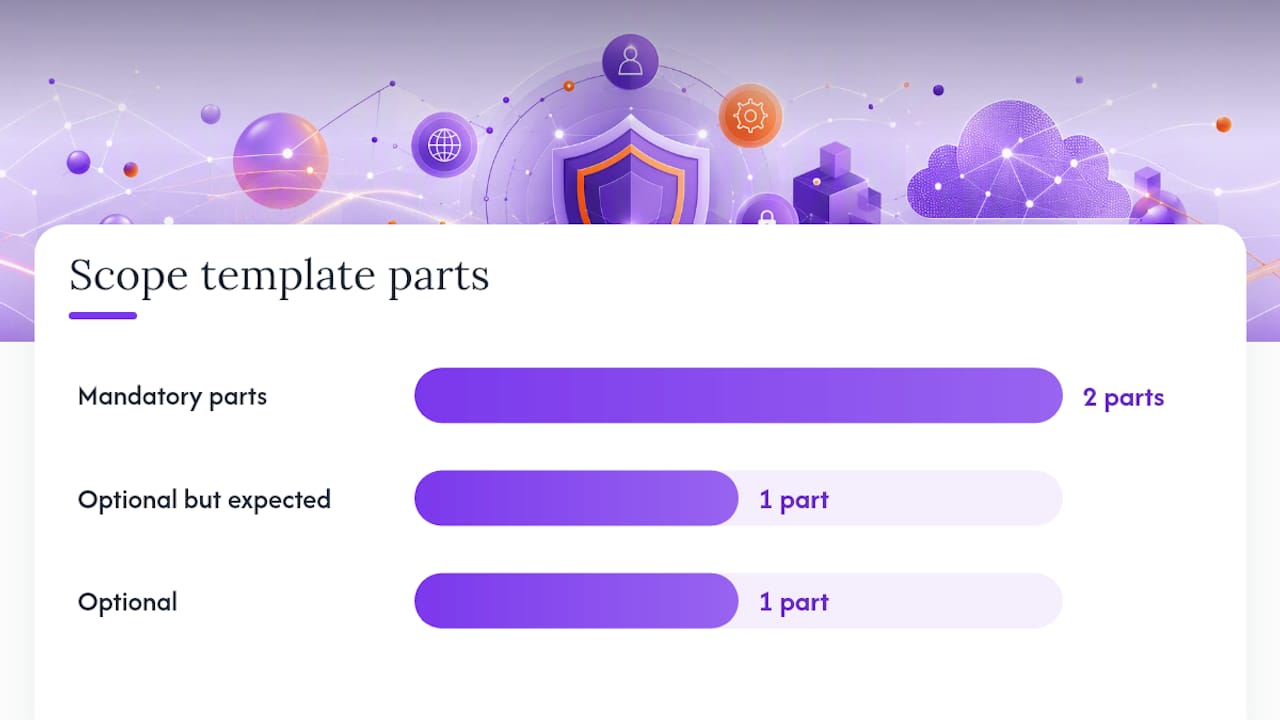
De beschrijving van het product/de dienst en de locaties/teams zijn verplicht. De uitsluitingsclausule is technisch gezien optioneel, maar wordt verwacht door elke auditor die het geld waard is. Het weglaten ervan maakt uw scope niet breder; het maakt hem vaag, en vaagheid is wat wordt aangemerkt.
Vier korte voorbeelden voor gangbare organisatietypen:
- SaaS-platform: "Het ISMS omvat de productie-infrastructuur, applicatiecode en verwerking van klantgegevens voor [Productnaam], gehost op AWS in de regio US East en beheerd door de teams Platform Engineering en Security. Het sluit de HR- en salarisadministratiesystemen uit, die op een afzonderlijk, geïsoleerd netwerk draaien zonder gegevensstroom naar de productieomgeving."
- Enterprise managed service: "Het ISMS omvat de levering van beheerde IT-ondersteuningsdiensten aan zakelijke klanten, inclusief de servicedesk, tools voor externe monitoring en klantgegevens die worden verwerkt onder actieve ondersteuningscontracten, uitgevoerd vanuit onze kantoren in Amsterdam en Rotterdam. Het sluit interne marketingsystemen uit, die geen klant- of operationele gegevens bevatten."
- Remote-first organisatie: "Het ISMS omvat alle in de cloud gehoste infrastructuur, medewerkerseindpunten die vallen onder het beheer van bedrijfsapparaten en klantenondersteuningsactiviteiten voor [Bedrijf], ongeacht de locatie van medewerkers, beheerd door een volledig gedistribueerd engineering- en operationsteam. Het sluit persoonlijke apparaten uit die niet zijn ingeschreven in apparaatbeheer."
- Organisatie met één vestiging: "Het ISMS omvat alle informatiemiddelen, processen en medewerkers op het hoofdkantoor van [Bedrijf] op [adres], inclusief de afdelingen Finance, Operations en Klantenservice. Het sluit de offsite opslag van gearchiveerde papieren dossiers uit, die worden beheerd onder een afzonderlijke overeenkomst voor fysieke beveiliging."
Geen van deze loopt langer dan drie zinnen. Die beknoptheid is het doel, geen stilistische keuze die u kunt overslaan als u wilt uitweiden.
De scopefouten die certificering daadwerkelijk vertragen
Een scope van de "gehele organisatie" klinkt indrukwekkend totdat u degene bent die bewijsmateriaal verzamelt voor elke afdeling, inclusief afdelingen die niets met informatiebeveiliging te maken hebben. Dit kan gerechtvaardigd zijn voor kleine, enkelvoudige bedrijven waarbij alles werkelijk hetzelfde systeem raakt. Voor alles groter betekent het doorgaans meer audit-uren en een langere doorlooptijd zonder enig werkelijk beveiligingsvoordeel.
De omgekeerde fout is een te nauwe scope om lastige beheersmaatregelen te omzeilen. Als u een systeem uitsluit dat duidelijk in-scope gegevens raakt, verwacht dan dat de auditor vraagt waarom, en verwacht dat "het was eenvoudiger" geen stand houdt.
- Vermijd vage termen zoals "relevante IT-systemen" die niets concreets benoemen.
- Documenteer elke uitsluiting met een specifieke, controleerbare reden, geen algemene verklaring.
- Herzie de scope bij hercertificering in plaats van deze stilzwijgend halverwege de cyclus uit te breiden zonder uw risicoanalyse bij te werken.
- Let op scope creep wanneer een nieuw product wordt gelanceerd binnen een ISMS dat bedoeld was als nauw begrensd.
Pro tip: Als een nieuw team of product steeds wordt genoemd in scopegesprekken maar nooit in de oorspronkelijke verklaring stond, is dat scope creep in real time. Los dit op via een formele update, niet door de tekst stilletjes te laten verschuiven.
Scope uitbreiden is op zichzelf niet slecht. Het is vaak de juiste stap naarmate uw ISMS volwassener wordt. Het probleem is dit doen zonder documentatie, risicoanalyses en de verklaring van toepasselijkheid dienovereenkomstig bij te werken.
Scope statement versus verklaring van toepasselijkheid: wat is het verschil
Deze twee worden voortdurend verward, en die verwarring is precies wat audits vertraagt. Het scope statement (Clause 4.3) definieert de grens: wat er in zit en wat er buiten valt. De verklaring van toepasselijkheid is een afzonderlijk document dat elke Annex A-beheersmaatregel opsomt, aangeeft of deze van toepassing is binnen die grens, en onderbouwt waarom deze is opgenomen of uitgesloten.
Beschouw de scope als het tekenen van de kaart en de verklaring van toepasselijkheid als het bepalen welke wegen op die kaart worden gepatrouilleerd. Auditors verwachten dat de verklaring van toepasselijkheid intern consistent is met het scope statement. Als uw scope de verwerking van klantgegevens benoemt maar uw verklaring van toepasselijkheid de onderbouwing van toegangsbeheersmaatregelen uitsluit, is dat een onmiddellijke inconsistentie die een auditor zal signaleren.
Een praktijkvoorbeeld: een bedrijf met de scope "SaaS-productie-infrastructuur en het engineeringteam dat deze beheert" zou in zijn verklaring van toepasselijkheid doorgaans beheersmaatregelen rondom toegangsbeheer, cryptografie en leveranciersrelaties onderbouwen, terwijl beheersmaatregelen gerelateerd aan fysieke media mogelijk als niet van toepassing worden gemarkeerd omdat er geen fysieke media binnen die grens bestaan. Scope bepaalt het universum van wat relevant is. De verklaring van toepasselijkheid verzorgt de maatregel-voor-maatregel onderbouwing daarbinnen. De twee door elkaar halen, of de verklaring van toepasselijkheid behandelen als een uitbreiding van de scopealinea, is een van de meest voorkomende hiaten die auditors herhaaldelijk zien.
Wat auditors controleren voordat zij aftekenen
Auditors die de scope beoordelen lezen de alinea niet geïsoleerd. Ze controleren of deze wordt ondersteund door bewijsmateriaal en consistent is met alle overige ISMS-documentatie.
- Het scope statement zelf, vergeleken met de certificaattekst.
- Context- en belanghebbendenanalyse (Clause 4.1 en 4.2) die onderbouwt waarom de grens daar is getrokken.
- Risicoanalyseresultaten die alles dekken wat in de scope wordt genoemd.
- De verklaring van toepasselijkheid, kruiselings gecontroleerd op consistentie met de scopegrenzen.
- Afhankelijkheidskaarten die tonen hoe in-scope systemen verbonden zijn met uitgesloten onderdelen.
- Leveranciersbewijsmateriaal voor elke derde partij die in contact komt met in-scope gegevens of processen.
- Configuratie- en middelenbewijsmateriaal specifiek voor in-scope systemen, niet het gehele IT-landschap.
Geef bij het presenteren van uitsluitingen de onderbouwing voorrang boven de uitsluiting zelf. "We hebben X uitgesloten omdat Y" leest als gecontroleerd en doordacht. Een kale lijst van uitsluitingen zonder uitleg leest als een scope die is getekend om werk te vermijden, en dat is de indruk die tijdens de audit leidt tot vervolgvragen. Een gedetailleerde certificeringschecklist helpt bevestigen dat u elk artefact gereed heeft voordat de auditor erom vraagt.
Wat scopefouten teams in de praktijk daadwerkelijk kosten
De scope statements die de meeste problemen veroorzaken zijn niet de slecht geschreven exemplaren. Het zijn de exemplaren die in isolatie zijn geschreven door één enkele security lead die de mensen die de uitgesloten systemen daadwerkelijk beheren niet heeft betrokken. Ik heb gezien dat scope tijdens fase één-audits twee keer herschreven werd omdat "sluit salarisverwerking door derden uit" bleek te betekenen dat salarisgegevens door een gedeelde database stroomden die het beveiligingsteam niet kende. Dat is geen schrijfprobleem. Dat is een ontdekkingsprobleem dat zich manifesteert als een schrijfsymptoom.

De nauwe, dienstniveau-scope wint doorgaans voor de meeste organisaties, met name SaaS-bedrijven die certificeren om aan de eisen van zakelijke klanten te voldoen in plaats van een wettelijke verplichting. Een brede organisatiescope is alleen zinvol wanneer uw bedrijf werkelijk één functie, één systeem en één team heeft. Anders auditeert u afdelingen die kosten toevoegen zonder iemands werkelijke risico te verminderen.
Gereedheidstools verdienen hun waarde in de schattingsfase, vóórdat u zich aan een grens heeft vastgelegd. Modelleren hoe een bredere scope de audit-uren, het aantal beheersmaatregelen en de doorlooptijd verandert ten opzichte van een smaller alternatief maakt van scope een vergelijking die u daadwerkelijk kunt verdedigen naar de directie.
— Martin
Test uw scopekeuzes voordat u ze vastlegt
De grens bepalen tussen "in scope" en "buiten scope" is een kostenbeslissing even goed als een beveiligingsbeslissing, en een verkeerde inschatting betekent later betalen in audit-uren. De ISMS Calculator gereedheidsanalyse modelleert hoe verschillende scopegrenzen uw implementatie-inspanning veranderen, op basis van bedrijfsomvang, sector en huidige beveiligingsvolwassenheid, zodat u een nauwe dienstniveau-scope kunt vergelijken met een bredere organisatiescope voordat u ook maar één zin van de definitieve verklaring schrijft.
De tool verdeelt scope-gedreven werk in een domein-voor-domein volwassenheidsanalyse over alle vier ISO/IEC 27001:2022 beheersmaatregelthema's, en vertaalt die grenzen vervolgens in een aanpasbare Gantt-tijdlijn die u kunt overhandigen aan degene die de implementatie beheert. Elke schatting wordt opgeslagen en geëxporteerd als PDF, waardoor het eenvoudig is om conceptscopeaannames te delen met een auditor of directieteam voordat u vastzit aan een certificeringstijdlijn. Voer de gratis gereedheidscheck van twee minuten nu uit, test een aantal scopescenario's en sla de vergelijking op vóór uw volgende planningsvergadering.
Waar u de norm zelf en aanverwante richtlijnen kunt vinden
Raadpleeg voor de formele clausuletekst ISO/IEC 27001 rechtstreeks in plaats van uitsluitend op samenvattingen te vertrouwen. Voor diepgaandere lectuur over hoe scopebeslissingen doorwerken in de selectie van beheersmaatregelen, legt de gids van Ismscalculator over Annex A-beheersmaatregelen uit hoe grensbeslissingen zich vertalen naar specifieke beheersvereisten, en de implementatiegids voor SaaS en techbedrijven behandelt scopebeslissingen specifiek voor in de cloud gehoste producten. Teams in gereguleerde sectoren die gevoelige gegevens verwerken tijdens fusies en overnames of leveranciersbeoordelingen kunnen ook baat hebben bij due diligence-praktijken voor healthcare SaaS als nuttige context voor het correct scoperen van gegevensverwerking door derden.
Bronnen
- How to Define Your ISO 27001 Scope and Write Your Scope Statement
- ISO 27001 Certification: Complete Guide
- ISO 27001 Implementation: Information Security Management System | ECOSIRE
- The benefits of the Statement of Applicability in ISMS projects
- ISMS Implementation: ISO 27001 Step by Step | ADVISORI