
Privileged access management (PAM) is defined as the set of controls, technologies, and policies within an information security management system (ISMS) that governs who can access critical systems, administrative accounts, and sensitive data at elevated permission levels. PAM sits inside the broader ISMS framework as a specialized control subset, addressing the accounts that carry the most risk: domain administrators, database owners, and root-level service accounts. Technologies like credential vaulting, session recording, and just-in-time (JIT) access provisioning form the technical backbone of any PAM program. ISO 27001, the international standard for ISMS, treats privileged account security as a direct requirement under its access control domain. Understanding what is privileged access management ISMS means recognizing that PAM is not a standalone product but a governance discipline embedded in a living security framework.
What is privileged access management in an ISMS?
PAM within an ISMS is the specialized control set focused on credential vaulting, session recording, and just-in-time access that protects the administrative accounts general identity and access management (IAM) tools do not fully address. These accounts are sometimes called the “keys to the kingdom” because a compromised administrator credential gives an attacker unrestricted movement across systems. The ISMS provides the governance wrapper: policies, risk assessments, and documented controls that tell auditors how those keys are protected.

An ISMS is not a software product. It is an ongoing governance framework requiring PAM implementations to link directly to documented policies and the Statement of Applicability (SoA) for ISO 27001 certification. The SoA is the master document that lists every applicable control and justifies its inclusion or exclusion. PAM controls must appear there with clear ownership and evidence of operation. Without that linkage, even a technically sound PAM deployment will fail an audit.
Building a compliant ISMS spans a 6-phase process over 24 weeks with at least 15 mandatory documents, including scope, security policy, and the SoA. PAM documentation, such as privileged account inventories and session review logs, feeds directly into several of those mandatory documents. Security teams that treat PAM as a separate IT project rather than an ISMS control will create gaps that auditors find quickly.
How does PAM support ISMS objectives and compliance?
PAM enforces the least privilege principle, which is the requirement that every user and system account holds only the permissions needed for a specific task and nothing more. Effective PAM reduces risk by limiting privileges and providing detailed audit trails that satisfy both internal governance and external certification requirements. Auditors reviewing an ISO 27001 certification look for evidence that privileged access is controlled, monitored, and reviewed on a defined schedule.
PAM also integrates with adjacent security systems to strengthen the overall ISMS posture:
- SIEM integration: PAM session logs feed into security information and event management (SIEM) platforms like Microsoft Sentinel or Splunk, enabling real-time alerting on anomalous privileged activity.
- IDPS coordination: Intrusion detection and prevention systems (IDPS) can trigger PAM session termination when a threat signature is detected during an active privileged session.
- SoA alignment: Every PAM control, from password rotation schedules to session recording retention periods, must map to a specific ISO 27001 control reference in the SoA.
- Audit trail completeness: PAM generates the timestamped, tamper-evident logs that auditors require to verify that privileged access events were reviewed and acted upon.
Pro Tip: Map each PAM control to its ISO 27001 Annex A reference before your first internal audit. Auditors will ask for that mapping, and building it retroactively under audit pressure is far harder than maintaining it from day one.
Many organizations fail ISO 27001 audits by treating their ISMS as a software tool rather than a governance framework. PAM tools must map to specific ISMS controls documented in the SoA, with named owners and evidence of regular review. That documentation discipline is what separates a certifiable ISMS from a collection of security products.
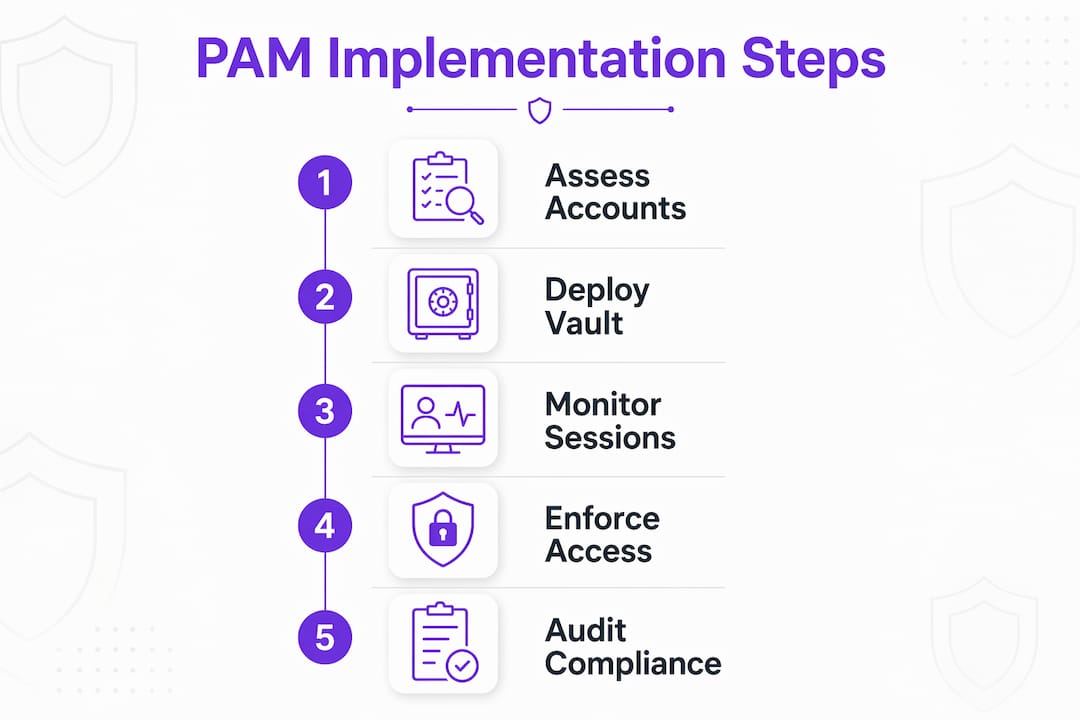
What are the key components of PAM within an ISMS?
A mature PAM program inside an ISMS combines several technical and procedural layers. Each layer addresses a distinct risk vector tied to privileged accounts.
-
Credential vaulting and password management. A privileged access vault stores administrative passwords in an encrypted repository, rotates them automatically after each use, and prevents users from ever seeing the actual credential. Tools like CyberArk Privileged Access Manager and BeyondTrust Password Safe implement this model. Vaulting eliminates shared passwords and the risk of credential reuse across systems.
-
Just-in-time (JIT) access provisioning. JIT access reduces audit complexity by granting temporary elevated rights only when a specific task requires them, then revoking those rights automatically. A database administrator who needs elevated access for a maintenance window receives it for 60 minutes and loses it when the window closes. This prevents privilege accumulation over time, which is one of the most common audit failure points.
-
Session recording and real-time monitoring. Every privileged session is recorded as a video-like audit trail, with keystroke logging and command capture. Security teams can replay sessions during incident investigations or present recordings to auditors as evidence of oversight. Real-time monitoring allows a security operations center (SOC) to terminate a session if suspicious commands are detected.
-
Multi-factor authentication (MFA) for privileged accounts. MFA adds a second verification layer before any privileged session begins. Even if a credential is stolen, an attacker cannot initiate a session without the second factor. ISO 27001 access control requirements strongly support MFA for all elevated accounts.
-
Access reviews to prevent privilege creep. Privilege creep occurs when users accumulate permissions over time through role changes, project assignments, or administrative shortcuts. Quarterly or semi-annual access reviews, supported by PAM reporting, identify and revoke unnecessary elevated rights before they become audit findings.
| PAM Component | Primary Risk Addressed | ISMS Control Alignment |
|---|---|---|
| Credential vaulting | Credential theft and reuse | ISO 27001 A.9.2 |
| JIT access | Privilege accumulation | ISO 27001 A.9.2.3 |
| Session recording | Insider threat and accountability | ISO 27001 A.12.4 |
| MFA for privileged accounts | Unauthorized access | ISO 27001 A.9.4.2 |
| Access reviews | Privilege creep | ISO 27001 A.9.2.5 |
Pro Tip: Run a privileged account discovery scan before deploying any PAM tool. Organizations routinely find 30–50% more privileged accounts than their IT asset register shows. You cannot protect accounts you do not know exist.
What are the common challenges in implementing PAM in an ISMS?
Implementing PAM inside an ISMS is operationally demanding. The most common failure points are predictable and avoidable.
-
Privilege creep goes unmanaged. Without a defined review cadence, privileged accounts accumulate permissions silently. Just-in-time access combined with quarterly reviews is the most effective countermeasure. Assign a named owner to every privileged account and make that owner accountable for the review outcome.
-
PAM is treated as a one-time project. The ISMS PDCA lifecycle (Plan, Do, Check, Act) requires continuous improvement. PAM controls must feed into the ISMS management review cycle, with metrics on session anomalies, access review completion rates, and vault usage reported to leadership quarterly.
-
Cloud and hybrid environments create blind spots. PAM controls must extend to cloud platforms like AWS IAM roles, Azure Privileged Identity Management, and Google Cloud’s IAM policies. Traditional on-premises PAM tools often miss cloud-native privileged roles entirely, leaving a gap that auditors and attackers both exploit.
-
Documentation lags behind deployment. Security teams deploy PAM tools quickly but update the SoA and risk register slowly. Auditors require documented alignment between what the tool does and what the ISMS policy says it should do. Maintaining audit-ready ISMS documentation in parallel with technical deployment is non-negotiable for certification.
-
User productivity suffers without careful design. Overly restrictive PAM controls create workarounds. Administrators who find the vault process too slow will share credentials outside it. Designing JIT workflows that match real operational patterns reduces friction and keeps the PAM program effective.
How does PAM differ from IAM within an ISMS?
Identity and access management (IAM) and privileged access management (PAM) are related but distinct disciplines. IAM governs all user identities across an organization, including standard employees, contractors, and service accounts. PAM focuses exclusively on the subset of accounts that carry elevated permissions and pose the highest risk if compromised.
| Dimension | IAM | PAM |
|---|---|---|
| Scope | All user identities | Privileged and administrative accounts only |
| Risk level addressed | Low to medium | High to critical |
| Primary controls | Provisioning, SSO, MFA | Vaulting, JIT, session recording |
| Audit focus | Access lifecycle | Privileged session activity |
| ISMS integration | Broad access policy | Specific high-risk control set |
Within an ISMS, IAM provides the foundation and PAM provides the reinforcement for the highest-risk accounts. A mature ISMS maturity assessment will evaluate both layers separately, because gaps in either one create distinct audit findings. IAM without PAM leaves administrative accounts unmonitored. PAM without IAM creates an island of privileged control disconnected from the broader identity governance program.
The integration point between PAM and IAM is the privileged account lifecycle. When IAM provisions a new administrator account, PAM should automatically enroll that account in the vault and apply session recording policies. When IAM deprovisions the account, PAM should revoke vault access and archive session logs. That automated handoff is the mark of a mature, coordinated access control program within an ISMS.
Key Takeaways
Privileged access management is the highest-risk control domain within an ISMS, and its success depends on direct documentation linkage to the Statement of Applicability, continuous review cycles, and coverage across cloud and on-premises environments.
| Point | Details |
|---|---|
| PAM is an ISMS control subset | PAM must link to specific ISO 27001 controls in the Statement of Applicability to pass certification audits. |
| Least privilege requires JIT access | Just-in-time provisioning prevents privilege creep and satisfies auditors’ requirements for temporary elevated rights. |
| Session recording is mandatory evidence | Timestamped session logs are the primary audit evidence that privileged access was monitored and reviewed. |
| Cloud environments need explicit PAM coverage | On-premises PAM tools miss cloud-native privileged roles; extend controls to AWS, Azure, and Google Cloud explicitly. |
| PDCA integration sustains compliance | Embedding PAM metrics into the ISMS management review cycle turns a one-time deployment into ongoing compliance practice. |
Why PAM is the control that defines ISMS maturity
Security teams often ask me which single control most reliably predicts whether an organization will pass an ISO 27001 audit. My answer is always PAM. Not because it is the most complex control, but because it is the one that exposes whether an organization actually governs its security or just documents it.
I have seen organizations with beautifully written ISMS policies fail certification because their privileged accounts were unvaulted, shared among three administrators, and never reviewed. The policy said least privilege. The reality was unlimited access with no oversight. Auditors find that gap in the first hour.
The trend I watch most closely is the intersection of PAM and cyber insurance requirements. Insurers now treat PAM as a mandatory discipline, not a nice-to-have. Organizations without demonstrable PAM controls face higher premiums or outright coverage denial. That external pressure is accelerating PAM adoption faster than any internal security initiative I have observed.
Zero trust architecture is reshaping how PAM fits inside an ISMS. The zero trust model assumes no account is inherently trusted, which means every privileged session must be verified, monitored, and time-limited. JIT access is the PAM mechanism that operationalizes zero trust for administrative accounts. Teams that embed JIT into their ISMS controls now are building the architecture that will define compliance requirements for the next decade.
My advice to security teams: do not wait for an audit finding to drive PAM investment. Map your privileged accounts, enroll them in a vault, and connect PAM metrics to your ISMS management review. That sequence, done in order, is the fastest path from reactive security to a certifiable, mature ISMS.
— Martin
How Ismscalculator supports your PAM and ISMS readiness
Knowing what privileged access management requires inside an ISMS is one thing. Knowing whether your current controls actually meet ISO 27001 certification standards is another.
Ismscalculator gives IT and security teams a structured way to evaluate exactly that. The platform’s ISO 27001 readiness assessment covers all four ISO/IEC 27001:2022 control themes, including access control and privileged account security, and delivers tailored estimates based on your organization’s size, industry, and current security maturity. If you need expert support translating PAM gaps into a remediation plan, Ismscalculator also connects you with independent ISO 27001 consultants who specialize in ISMS implementation. Start with the free 2-minute readiness check to get an immediate baseline before your next audit cycle.
FAQ
What is privileged access management in an ISMS?
Privileged access management (PAM) is the specialized control set within an information security management system (ISMS) that governs elevated accounts through credential vaulting, session recording, and just-in-time access. It protects administrative accounts that carry the highest risk of compromise within an ISO 27001 framework.
How does PAM relate to ISO 27001 compliance?
PAM controls must map directly to ISO 27001 Annex A access control requirements and appear in the Statement of Applicability with documented owners and evidence of operation. Organizations that fail to document this alignment routinely fail ISO 27001 certification audits.
What is the difference between PAM and IAM?
IAM governs all user identities across an organization, while PAM focuses exclusively on privileged and administrative accounts that carry elevated permissions and critical-level risk. Both are required within a mature ISMS, and they must integrate so that privileged account provisioning and deprovisioning are handled automatically.
What is privilege creep and why does it matter for ISMS?
Privilege creep is the gradual accumulation of unnecessary permissions by user accounts over time, often through role changes or project assignments. It is a common ISO 27001 audit failure point because it violates the least privilege principle that ISMS access control policies require.
Does PAM apply to cloud environments within an ISMS?
PAM controls must extend to cloud platforms including AWS, Azure, and Google Cloud, where privileged roles span multiple services. Traditional on-premises PAM tools often miss cloud-native privileged accounts, creating gaps that both auditors and attackers exploit.