
A pre-audit assessment in ISMS is a structured, proactive evaluation that identifies control gaps and readiness issues before the formal ISO 27001 certification audit. The role of pre-audit assessment in ISMS goes far beyond a simple checklist review. It simulates real audit conditions, surfaces nonconformances privately, and gives your team time to remediate before findings become official. Organizations that complete a formal readiness assessment experience 58% fewer material audit findings and reduce remediation costs by 60%. That single data point explains why compliance professionals treat pre-audit work as a non-negotiable phase, not an optional warm-up.
What are the key components of a pre-audit assessment in ISMS?
A pre-audit assessment covers four core areas: ISMS framework governance, policy and procedure adequacy, technical control effectiveness, and documentation completeness. Each area maps directly to the four control themes defined in ISO 27001 Annex A. Skipping any one of them leaves a blind spot that a certification auditor will find.
Governance and policy review checks whether your information security policy, risk treatment plan, and Statement of Applicability are current, approved, and accessible. Auditors will ask for version histories and sign-off records. If those documents exist but are not formally approved, they fail the evidence test.

Technical control evaluation goes deeper than policy. This is where vulnerability assessments and penetration testing (VAPT) belong. VAPT should be performed 30–60 days before the formal audit to leave enough time to remediate findings without rushing. Running VAPT the week before an audit creates more problems than it solves.
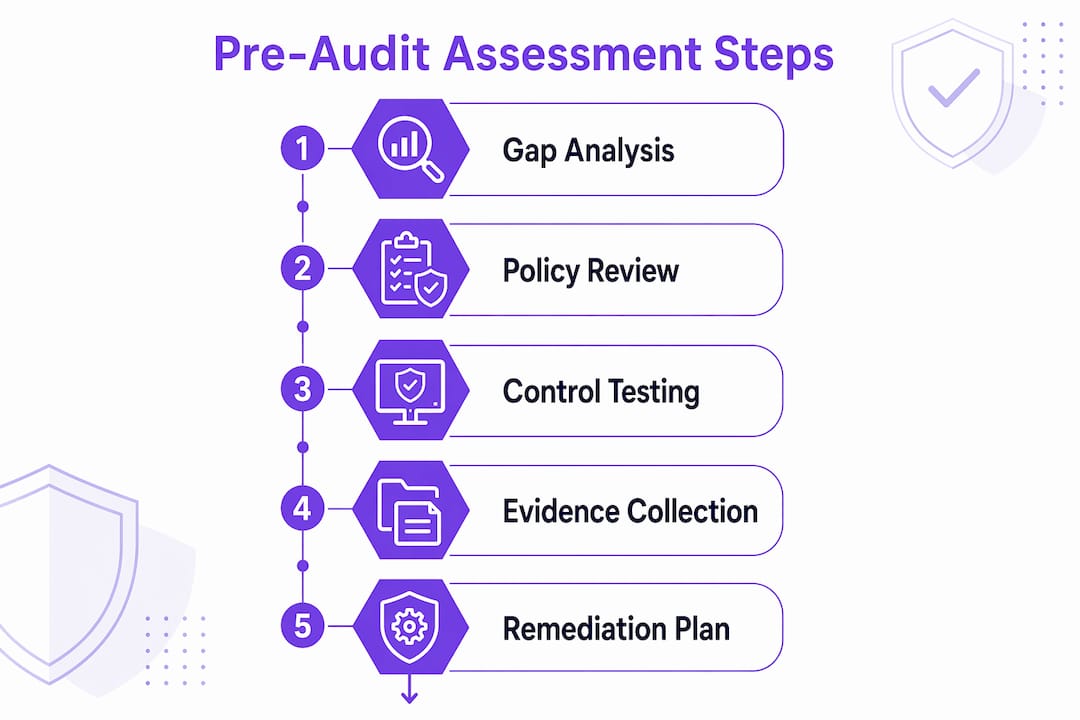
Documentation and evidence mapping is the area most teams underestimate. Documentation must clearly map ISO requirements to policies, evidence locations, and control owners. Without that mapping, auditors spend their time hunting for proof instead of confirming compliance. That wastes everyone’s time and raises auditor skepticism.
The typical pre-audit assessment for a mid-size organization takes two to four weeks. First-time certifications or organizations with complex IT environments should plan for a longer runway.
- ISMS scope and boundary documentation
- Risk assessment and risk treatment plan currency
- Annex A control applicability and justification
- Evidence packages: logs, reports, and access records
- Internal audit records and management review minutes
- Incident response and business continuity test results
Pro Tip: Map every control to its ISO clause number, the governing policy, the evidence location, and the named control owner in a single spreadsheet. Auditors can verify your entire control set in hours instead of days.
How do pre-audit assessments reduce audit risk?
Pre-audit assessments reduce audit risk by turning potential formal nonconformances into private remediation tasks. A pre-audit simulates audit conditions, so any gap your team finds stays internal. That is the core advantage. A gap found during a certification audit becomes an official finding that can delay or block certification. The same gap found during a pre-audit is just a task on your remediation list.
Organizations that treat the pre-audit as a dress rehearsal consistently report shorter certification timelines and lower auditor-identified findings. The pre-audit does not just prepare your documentation. It prepares your people to answer auditor questions with confidence, which changes the entire tone of the formal review.
The financial case is equally clear. Pre-audit VAPT alone reduces post-audit remediation costs by 60% and builds auditor confidence in your vulnerability management program. Remediation after a formal finding is always more expensive than remediation before one. You pay for external consultants, re-audit fees, and the internal time cost of emergency fixes.
Pre-audit assessments also demonstrate a functioning Plan-Do-Check-Act (PDCA) cycle. Pre-audit assessments function as proof of adopting the PDCA cycle, signaling a mature security culture to auditors. Certification auditors are not just checking whether controls exist. They are evaluating whether your organization treats information security as an ongoing management discipline. A well-documented pre-audit process is direct evidence of that discipline.
Audit readiness assessments transform audits from surprise events into managed engagements. That shift in control reduces operational disruption, keeps staff focused on their normal work, and prevents the last-minute scramble that derails so many first-time certifications.
What are best practices for conducting a pre-audit assessment?
Timing is the single most controllable variable in pre-audit success. Starting 8–12 weeks before the formal audit is the standard recommendation for organizations with an established ISMS. First-time certifications or organizations with significant control gaps should begin 3–6 months out. Starting too late forces rushed remediation, which auditors recognize and distrust.
Common mistakes that undermine pre-audit readiness
-
Treating evidence as a snapshot. Auditors evaluate control effectiveness over time and require logs, reports, and records spanning months. A firewall log from last week does not prove continuous monitoring. Start collecting and organizing evidence well before the pre-audit begins.
-
Poor control-to-requirement mapping. If your documentation does not connect each control to its ISO 27001 clause, the governing policy, and the evidence location, auditors will flag it. The critical documentation strategy maps controls directly to ISO clause numbers, policy references, evidence locations, and named control owners.
-
Rushing all remediation before the audit. Not all remediation needs to be complete before the audit. A phased remediation plan with documented milestones often impresses auditors more than a rushed, incomplete fix. It shows organizational maturity and a realistic approach to continuous improvement.
-
Skipping the narrative. Controls, policies, and evidence need a connecting story. An auditor should be able to follow a thread from an ISO clause to your policy, to your implemented control, to your evidence, without asking you to explain it. If that thread breaks anywhere, you have a gap.
-
Ignoring control operation timelines. Some controls require months of operational history to satisfy auditors. Access reviews, patch management cycles, and security awareness training records all need documented histories. Identifying these gaps during a pre-audit gives you time to build that history before the formal review.
Pro Tip: Run a gap analysis against ISO 27001 as the first step of your pre-audit. It gives you a prioritized list of what to fix and how long each item will realistically take.
How does pre-audit fit into the ISO 27001 certification cycle?
The pre-audit assessment sits between your internal audit and the formal Stage 2 certification audit. Internal audits establish baseline ISMS status, but pre-audit assessments add the objectivity and external perspective that better identify formal audit risks. Internal auditors know your environment too well to spot every gap. A pre-audit assessment, especially one conducted with external support, sees your ISMS the way a certification auditor will.
The outputs of a pre-audit feed directly into your remediation roadmap, your management review agenda, and your continuous improvement register. That connection is what makes the pre-audit a genuine part of the ISMS lifecycle, not just a one-time preparation exercise.
| ISMS phase | Pre-audit role | Output |
|---|---|---|
| Internal audit | Baseline control status check | Audit findings register |
| Pre-audit assessment | Gap identification and evidence review | Remediation roadmap |
| Stage 1 certification audit | Documentation and scope review | Readiness confirmation |
| Stage 2 certification audit | Full control effectiveness review | Certification decision |
| Surveillance audits | Ongoing compliance verification | Continuous improvement evidence |
For surveillance audits, the pre-audit habit pays compounding dividends. Organizations that build pre-audit assessments into their annual ISMS calendar maintain higher compliance maturity scores and face fewer findings at each successive audit. The ISO 27001 certification checklist covers all 80 steps from initial scoping through surveillance, and the pre-audit phase appears as a distinct, required milestone in that process.
The pre-audit also integrates with risk management. Gaps identified during the assessment feed back into your risk register, triggering formal risk treatment decisions. That loop is exactly what ISO 27001 requires. It is also what auditors look for when they evaluate whether your ISMS is a living system or a paper exercise.
Key Takeaways
A pre-audit assessment is the single most effective action a compliance team can take to reduce formal audit findings, cut remediation costs, and demonstrate ISMS maturity to certification auditors.
| Point | Details |
|---|---|
| Start early | Begin pre-audit work 8–12 weeks before the audit, or 3–6 months for first-time certifications. |
| Map controls to evidence | Link every ISO 27001 clause to its policy, evidence location, and control owner in one document. |
| Run VAPT in advance | Complete vulnerability assessments 30–60 days before the audit to allow time for technical remediation. |
| Use phased remediation | A documented remediation plan with milestones signals maturity more than rushed last-minute fixes. |
| Embed pre-audits annually | Organizations that pre-audit every year maintain higher compliance maturity and face fewer findings over time. |
Why most teams underestimate the pre-audit until it’s too late
I have seen compliance teams treat the pre-audit as a formality. They schedule it two weeks before the certification audit, run through a checklist, and call it done. Then the Stage 2 audit surfaces three major nonconformances that were entirely predictable. The cost is not just the re-audit fee. It is the six weeks of emergency remediation, the management attention diverted from other priorities, and the credibility hit with the certification body.
The mindset shift that actually works is treating the pre-audit as a performance readiness check, not a paperwork review. Your controls need to be operating, not just documented. Your evidence needs to show months of consistent behavior, not a snapshot from last Tuesday. Audit failure is often caused by missing documented evidence, not lacking controls. That distinction matters enormously. You can have every control in place and still fail because you cannot prove it.
The organizations I have seen succeed at first-time ISO 27001 certification share one habit. They treat the pre-audit as the real audit and the certification audit as the confirmation. That mental model changes how they prepare, how they document, and how they present to auditors. It is the difference between being ready and hoping you are ready.
— Martin
Ismscalculator’s readiness tools for pre-audit success
Knowing where your ISMS stands before the formal audit is the hardest part of pre-audit preparation. Ismscalculator’s ISO 27001 readiness assessment covers all four ISO/IEC 27001:2022 control themes, maps your current maturity against model reference comparisons, and generates a prioritized gap list you can act on immediately.

The platform’s maturity assessment gives compliance professionals and IT managers a structured view of control gaps, evidence requirements, and remediation priorities. You can save and compare multiple assessment snapshots to track progress over time. If you want a faster starting point, the free 2-minute readiness check gives you an immediate read on your ISMS status before you commit to a full assessment cycle.
FAQ
What is a pre-audit assessment in ISMS?
A pre-audit assessment is a structured evaluation conducted before the formal ISO 27001 certification audit. Its purpose is to identify control gaps, evidence deficiencies, and documentation weaknesses while there is still time to remediate them privately.
How long before the audit should a pre-audit assessment start?
The standard recommendation is 8–12 weeks before the formal audit for established ISMS programs. First-time certifications or organizations with significant gaps should start 3–6 months in advance.
What is the difference between an internal audit and a pre-audit assessment?
Internal audits establish baseline ISMS status using your own team. A pre-audit assessment adds external objectivity and simulates the perspective of a certification auditor, identifying risks that internal familiarity can miss.
Does all remediation need to be complete before the certification audit?
No. A phased remediation plan with documented milestones often demonstrates more organizational maturity to auditors than rushed, incomplete fixes completed at the last minute.
Why do organizations fail ISO 27001 audits despite having controls in place?
Audit failure most often results from missing documented evidence, not absent controls. Auditors require proof of consistent control operation over time, including logs, reports, and records spanning multiple months.