
ISMS project management means treating information security requirements as project deliverables, not compliance afterthoughts. Under ISO/IEC 27001, an ISMS (Information Security Management System) requires documented risk assessment and treatment, and those requirements map directly onto standard PMBOK process groups: initiation, planning, execution, monitoring, and closure. Get this mapping right early and security stops feeling like a separate track bolted onto your schedule.
Before you touch your project plan, confirm these five things:
- Define the ISMS scope for this specific project (which systems, data, and processes are in bounds)
- Run a focused risk assessment on new or changed assets
- Draft a risk treatment plan and matching Statement of Applicability (SoA) entries
- Assign a named information security owner, not a shared responsibility
- Schedule security testing and a formal handover point before go-live
Key Takeaways
Integrating ISMS requirements into standard project phases, rather than treating certification as a separate track, is what keeps ISO 27001 work on schedule and audit-ready.
| Point | Details |
|---|---|
| Scope first, always | Define the ISMS scope for the project during initiation, before any risk assessment begins. |
| Build the SoA incrementally | Add Statement of Applicability entries as each control becomes relevant, not in one end-of-project push. |
| Name a security owner | Assign a distinct information security owner separate from the project manager to avoid responsibility gaps. |
| Gate each phase | Run short security checks at phase boundaries instead of a single audit rush before closure. |
| Size effort with real numbers | Tools like the ISMS Calculator readiness assessment turn company size and maturity into concrete hour estimates rather than guesswork. |
Table of Contents
- ISMS Project Management Basics: What ISO/IEC 27001 Actually Requires
- Why Integrate Security Requirements Into the Project Plan?
- What Should Happen at Each Project Phase?
- What Documents and Evidence Does an ISMS Project Need?
- Who Owns What in an ISMS Project?
- How Long Does ISMS Work Actually Add to a Project?
- What Mistakes Derail ISMS Projects Most Often?
- A Pragmatic Approach to Leading ISMS-Aligned Projects
- Size Your ISMS Effort Before You Commit a Schedule
- Where to Read Further on ISMS and Project Standards
- Frequently Asked Questions
- Sources
ISMS Project Management Basics: What ISO/IEC 27001 Actually Requires
An ISMS is the set of policies, risk processes, and controls an organization uses to protect information assets on an ongoing basis. ISO/IEC 27001 is the international standard that certifies that system, and it requires documented risk assessment, a risk treatment plan, and evidence that chosen controls are actually operating.
Inside a project, that translates into specific obligations tied to specific clauses: your risk assessment has to cover new assets the project introduces, your SoA has to be updated when the project changes which controls apply, and any supplier brought in during the project needs a documented security check.
Say your team adds a third-party payment integration mid-project. That single decision triggers a supplier security review, a new SoA entry for supplier relationship controls, and probably a fresh risk assessment line for data in transit. None of that is optional paperwork. It is what an auditor will ask to see later.
One caution worth flagging here: the acronym “ISM” shows up in other bodies of literature meaning “Interpretive Structural Modeling,” a completely unrelated systems technique. If you are researching this topic and land on a paper about structural modeling, you have the wrong ISM.
Why Integrate Security Requirements Into the Project Plan?
Bolting security on at the end costs more than building it in from day one. Integration during planning, not after delivery, is what keeps a project on schedule instead of stuck in remediation.
- Less rework, because controls get designed alongside features instead of retrofitted
- Faster certification readiness, since evidence accumulates naturally as you build
- Clearer acceptance criteria, so “done” includes a security sign-off, not just a demo
- Lower operational risk after handover, because gaps get caught during testing, not in production
- An audit trail that already exists instead of one you have to reconstruct
For a sponsor weighing time, cost, and quality, this is a straightforward pitch: security tasks done in parallel with delivery rarely add net schedule time, but security tasks done after delivery almost always do. One factor matters more than any checklist here: visible management support. Projects where a sponsor actively backs the risk treatment plan and reviews SoA entries tend to move through certification with far fewer surprises.
What Should Happen at Each Project Phase?
Standard project management balances time, cost, and quality across initiation, planning, execution, monitoring, and closing. ISMS work slots into that same structure. Here is what belongs where.
Initiation
- Define the ISMS scope for the project: which assets, systems, and data flows are actually affected
- Identify the information assets involved and who currently owns them
- Nominate a project sponsor and a named information security owner, separate from the PM role
- Add ISMS acceptance criteria to the project charter so security sign-off is a defined deliverable, not a late addition
Planning
- Run a focused risk assessment scoped to what this project changes, not a full organizational review
- Produce a risk treatment plan and draft the relevant SoA entries
- Schedule security testing windows directly in the project timeline, not as a buffer at the end
- Add supplier security requirements into procurement documents before contracts are signed
- Build in training and awareness tasks for anyone who will operate the new system
Execution
- Implement the controls defined in planning
- Run security testing at the component level and again at integration
- Record evidence as you go: test logs, scan results, configuration screenshots
- Track supplier deliverables against the security requirements written into their contracts
Monitoring and controlling
- Maintain a live risk register, not a static document written once and forgotten
- Track remediation actions against controls that fail testing
- Feed a short security status update into steering committee dashboards alongside cost and schedule metrics
- Route any scope change through formal change control, with a security-impact assessment attached
Closure and handover
- Finalize the evidence pack: completed SoA entries, test reports, training attendance records
- Capture lessons learned specific to security work, not just delivery lessons
- Transfer operational ownership to the information security or operations team, with a named receiving owner
- Schedule the first follow-up audit or improvement review before the project team disbands
Pro Tip: Build the SoA incrementally, one entry per control as it becomes relevant, and run a short security gate check at each phase boundary instead of one audit sprint at the end. Projects that wait until closure to reconcile the SoA almost always find gaps that require reopening finished work.
What Documents and Evidence Does an ISMS Project Need?
Auditors do not take your word for it. They want a paper trail, and a lot of that trail gets built during the project itself, not handed down from the organization’s existing ISMS.
Some documents belong to the organization already, like the overarching ISMS policy and the top-level SoA. Your project’s job is to produce the specific entries and evidence that plug into that structure: a scoped risk assessment, a risk treatment plan for changes this project introduces, updated SoA lines for any new or modified controls, security test reports, supplier security evidence, and training completion records.
For a single delivered feature, an auditor typically expects to see:
- The risk assessment entry covering that feature’s data flows
- The SoA line showing which control applies and why
- Test evidence confirming the control works as designed
- Supplier documentation, if any third party touched the feature
- A signed acceptance record showing security sign-off happened before release
Our certification checklist breaks this down into a fuller step-by-step list if you want to map these against a live project.
Who Owns What in an ISMS Project?
Confusion over ownership is one of the most common reasons ISMS tasks stall inside a project. Six roles typically carry responsibility: the project sponsor (funds and champions the work), the project manager (schedules and tracks it), the information security owner or domain owner (defines what “compliant” means for this scope), the technical lead (implements controls), supplier owners (manage third-party security obligations), and the steering committee (reviews status and approves scope changes with security impact).
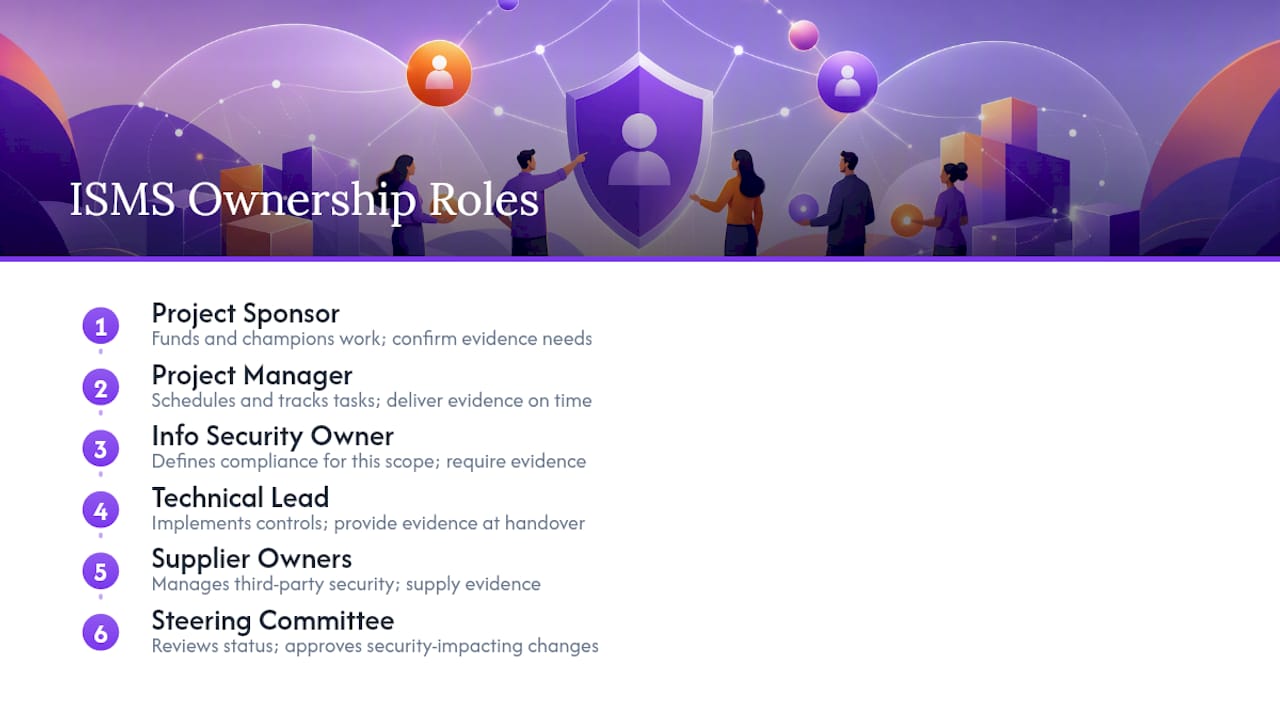
Governance in practice means running security gates at defined checkpoints, routing any security-impacting scope change through formal change control, keeping a regular reporting cadence to steering, and getting explicit sign-off on evidence before closure. Before you finalize the plan, ask each role holder directly: what evidence do you need from me, when do you need it, and who receives this work at handover? Skipping that conversation is how responsibility gaps surface three weeks before go-live. Our guide to IT manager ownership covers how this typically breaks down in practice.
How Long Does ISMS Work Actually Add to a Project?
Effort scales with a handful of concrete factors: how many information assets the project touches, how many suppliers are involved, how mature the organization’s existing ISMS already is, how much testing and evidence the scope requires, and whether any regulatory constraints apply on top of ISO 27001 itself.
As a rough sizing guide, a small, focused feature with one or two new controls usually adds a day or two of dedicated security work. A medium integration, like adding a new SaaS vendor or a payment processor, typically needs two to three weeks across assessment, testing, and remediation. Large projects, where ISMS work runs as its own parallel track alongside delivery, need a proper estimator or organizational benchmark rather than a rule of thumb.
Pro Tip: Run a lightweight gap analysis in the first week of planning. Finding a missing control early costs a schedule adjustment. Finding it during closure costs a reopened sprint and a sponsor conversation nobody wants to have.
What Mistakes Derail ISMS Projects Most Often?
The same failures show up across most first-time ISMS projects, and nearly all of them are avoidable with earlier planning rather than more effort.
Treating the SoA as a document you write once at the end is the biggest one. Close behind it: missing supplier evidence because procurement signed a contract before security requirements were written into it, skipping formal change control when scope shifts, and closing the project without capturing lessons learned, which means the next team repeats the same mistakes.
The fix is mostly sequencing. Stagger security activities alongside development instead of stacking them at the end, sign off SoA entries as each control lands, run testing regularly instead of one big pass, and get operational teams trained before handover, not after.
Pro Tip: Treat the SoA as a living document and run small security gates at each phase boundary rather than one audit rush at the finish line. A project that reconciles evidence weekly rarely finds a nasty surprise in week eleven.
A Pragmatic Approach to Leading ISMS-Aligned Projects
Most first-time ISMS project leads over-invest in documentation and under-invest in discovery. The scope workshop in week one matters more than any template you download, because a wrong scope boundary means every risk assessment built on top of it needs redoing later.
Three things come first, in this order: a scope workshop with the information security owner and sponsor in the room together, a quick risk scan of the assets actually touched by this project (not the whole organization), and security gates scheduled into the calendar before planning finishes, not added once execution starts.
The real trade-off is speed against auditability. Moving fast without evidence capture saves weeks upfront and costs them back at certification. When that tension gets sharp, that is exactly when it belongs in front of the sponsor, not buried in a status report they will skim.
Size Your ISMS Effort Before You Commit a Schedule
Most of the guesswork in ISMS project planning comes down to one question: how many hours is this actually going to take? A readiness calculator answers that by converting your company size, industry, and current security maturity into a concrete estimate and a prioritized task list, instead of leaving you to guess at scope from a generic checklist.
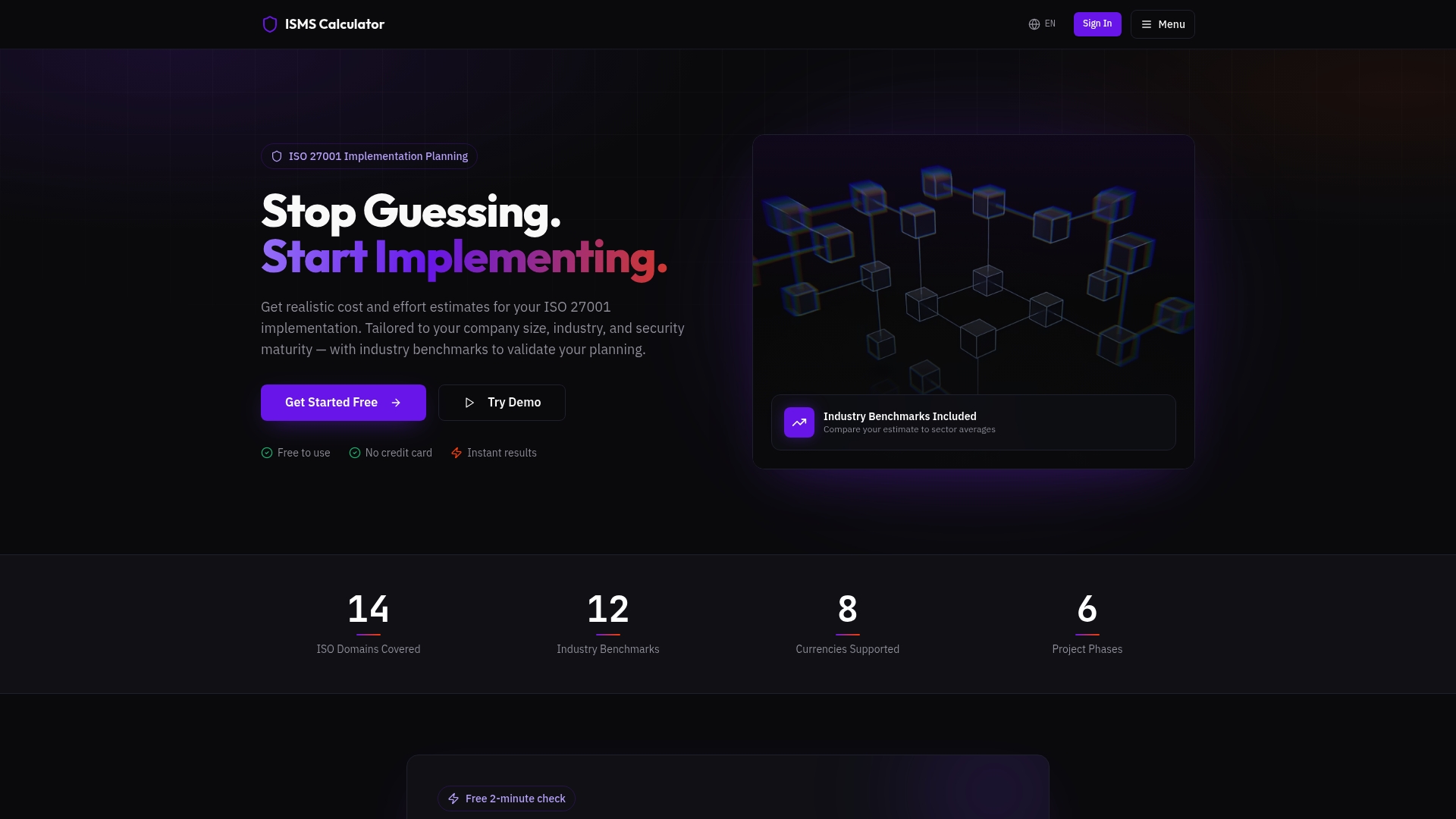
The lowest-effort place to start is a free, two-minute readiness check, which gives you a snapshot of where your gaps sit before you write a single project task. For a fuller breakdown, the ISO 27001 readiness assessment produces estimated hours by domain and a prioritized list of SoA items to tackle first, which you can drop directly into your project schedule. If you are still mapping out the full implementation timeline, run the assessment now and build your Gantt chart around real numbers instead of a rough guess.
Where to Read Further on ISMS and Project Standards
For exact clause language, consult the ISO/IEC 27001 standard directly. For lifecycle alignment, the PMBOK Guide covers process groups and governance in depth, and the SANS white paper on tackling ISO 27001 as a project walks through practical implementation mapping. For sizing your own timeline, see our implementation timeline guide and gap analysis walkthrough.
Frequently Asked Questions
What is ISMS in project management? It means treating information security requirements, like risk assessment, control implementation, and evidence capture, as scheduled project deliverables rather than a separate compliance activity handled after delivery.
Do I need ISO 27001 certification to use these basics? No. The practices here, scoping, risk assessment, SoA entries, and phase gates, apply whether you are pursuing formal certification or simply improving how your organization handles information security within projects.
Who should own ISMS tasks inside a project? A named information security owner, distinct from the project manager, typically owns the risk treatment plan and SoA entries, while the PM owns scheduling and integration with the broader project plan.
How much extra time does adding ISMS work take? It depends heavily on scope. A small feature might add a day or two per control, while a larger integration touching multiple suppliers can add two to three weeks of assessment and testing, which is why an early gap analysis matters.
What is the single most common ISMS project mistake? Treating the Statement of Applicability as a document to finish at the end rather than building it incrementally as controls become relevant during execution.
Sources
- Project management 2nd edition — Chapter 1.3 Project constraints
- ISO/IEC 27001 — Information security, cybersecurity and privacy protection — ISO
- Tackling ISO 27001: A Project to Build an ISMS — SANS Institute
- Knowledge management in project management: An ISM approach