
ISO 27001 resource planning means deciding, before you start, who will do the work, how many hours they can give it, what tools and outside help you will pay for, and how long the project will run. Clause 7.1 of the standard requires exactly this, and auditors look for evidence of it. The practical approach is to scope first, list the work by gap, assign every item a named owner with protected hours, and price the plan against a benchmark for your size and industry. You then review it on a schedule, because it will change.
This guide walks through that process for compliance officers, IT managers, startups and finance teams who need a plan they can defend to a CFO and an auditor.
TL;DR
- Clause 7.1 requires you to determine and provide the resources for setting up, running, maintaining and improving your ISMS (information security management system). A plan that funds only the audit does not meet it.
- Start from scope. Scope sets the effort, and effort sets the budget, so estimates built before scoping are guesses.
- Give each task an owner and allocated hours. An action with an owner but no time is the most common resource finding.
- Budget for three years, not one: implementation, the certification audit, annual surveillance audits and recertification.
- Check your plan against a benchmark for your size and industry, then update it after each phase.
Table of Contents
- What ISO 27001 actually requires you to resource
- Step 1: Fix the scope before you size anything
- Step 2: Measure where you are and list the work by gap
- Step 3: Assign roles and protect the hours
- Step 4: Price the plan across three years
- Step 5: Build the timeline with dependencies
- A worked example: a 60-person SaaS startup
- Step 6: Validate the numbers against a benchmark
- Step 7: Review the plan on a schedule
- Build your own resource estimate
- FAQ
- Sources
What ISO 27001 actually requires you to resource
The standard is short on this point and specific in its wording. Clause 7.1 of ISO/IEC 27001:2022 says the organization shall determine and provide the resources needed for the establishment, implementation, maintenance and continual improvement of the ISMS. Four verbs matter here:
- Establish the system: scoping, risk assessment, policies, the statement of applicability.
- Implement it: rolling out controls, training, evidence collection.
- Maintain it: running the processes day to day, internal audits, management reviews.
- Continually improve it: fixing findings and raising maturity over time.
Most first-time teams budget for the first verb and part of the second. Practitioners who write about the clause describe the typical gaps: named roles without allocated time, training that is not funded, tooling without licenses, and a treatment plan with no budget behind it. Their internal test is simple. Take your risk treatment plan and ask, item by item, who is doing it and when. If the answer is “someone in IT, eventually,” the resource plan is not finished.
The same source argues that withdrawing people and money after the certificate arrives is the failure the wording is written against. Plan for the years after certification from day one.
What counts as a resource
Four categories cover almost everything an auditor will ask about:
- People and time. Named staff with a share of their week set aside, plus executive time for reviews and decisions.
- Competence. Training and awareness programs, which connect Clause 7.1 to the competence requirements that follow it. DQS Global’s guide to Clauses 7.1 to 7.4 names competent staff and time as the crucial categories to build into the daily routine.
- Technology. Logging, vulnerability scanning, endpoint management, document control, evidence tooling.
- External services. Penetration testing, independent internal audit, consultants, and the accredited certification body.
Step 1: Fix the scope before you size anything
The ISACA implementation guide for ISO/IEC 27001:2022 calls scope definition the first decisive step. It also says that understanding the organization’s context is a prerequisite for judging the feasibility and effort of the ISMS, including resources, budget and time.
In practice, four scope decisions move your resource needs more than any others:
- Headcount in scope. Every person in scope needs awareness training and policy acknowledgment.
- Locations and environments. Each office, data center or cloud environment adds evidence to gather and audit time.
- Systems and data. A SaaS product handling customer data carries more controls than a back-office function.
- Existing controls. If you already run access reviews, change management or incident response, you are extending them rather than building them.
A startup scoping one product and one office can plan for a small core team. A financial services firm with several regulated systems should expect a larger scope, more risk assessment work and a longer evidence trail. The same standard produces very different plans.
Step 2: Measure where you are and list the work by gap
A resource plan is a list of work with a price on it. The list comes from a gap analysis: compare what you do today to what the standard requires, then record what is missing.
Good gap records are specific. AlertMedia’s maturity assessment guidance recommends documenting, for each gap, the current state, the desired state, the evidence, the risk, and the people, processes, technology or resources needed to close it. It also warns against sizing a team to an arbitrary headcount. Instead, map roles to security functions and look for single points of failure and duties nobody owns. Compare “no dedicated owner for threat monitoring outside business hours” with “we need more analysts”: the first can be costed, the second cannot.
The ISACA article on the 2022 transition goes further on method. In its 90-day plan, the gap assessment sits in weeks three and four. Teams assess current practice, then categorize gaps by effort, impact and cost. That last step is what turns a gap list into a plan: high-impact, low-effort gaps go first, and expensive items get scheduled and funded deliberately.
Our own step-by-step gap analysis guide covers the method in more depth. If you want a quick starting point, the free 2-minute readiness check gives you an instant read on where you stand before you commit to a full assessment.
Step 3: Assign roles and protect the hours
The most common resource finding is an action with an owner and no time. Avoid it by writing the role, the person and the weekly hours for each part of the project.
A workable division of responsibility looks like this:
| Role | What they own | Resource note |
|---|---|---|
| Executive sponsor | Approves budget, sets policy, runs management review | Needs scheduled time for reviews, not just a signature |
| ISMS lead or compliance officer | Plan, risk assessment, documentation, audit liaison | Usually the largest time commitment |
| IT and security staff | Technical controls, logging, access, vulnerability management | Must have hours carved out of operational work |
| Process owners (HR, legal, facilities, engineering) | Controls in their own area | Often forgotten in the plan |
| Internal auditor | Independent review of the ISMS | Must be independent of what they audit |
The ISACA Journal’s planning article makes two points that still hold. Internal audit should be involved from the initial planning phase, helping shape the implementation strategy and supporting later management review. And the IT department must dedicate resources and time and inventory its existing compliance work, policies and control maturity to see how they align with ISO 27001.
We go through the three role mistakes that most often turn into audit findings in our guide to ISO 27001 roles for implementers, and the IT team’s part in the project is worth reading if you are the one who will absorb most of the technical work.
Step 4: Price the plan across three years
Certification is not a one-off purchase. The certificate runs for three years, with annual surveillance audits in between and a recertification audit at the end. Your budget needs four lines:
- Implementation. Internal time, tooling, training, any consultant support and independent testing.
- Certification audit. The accredited certification body’s fees for the initial audit.
- Surveillance audits. Years two and three.
- Recertification and ongoing upkeep. Internal audits, management reviews, awareness refreshers and tool renewals.
The ISACA journal authors observe that implementation costs are driven by how risk is perceived and how much of it the organization is prepared to accept. They also note that experienced outside consultants can save a great deal of time and cost while smoothing the path to certification. A risk-averse company that wants every control formalized will spend more than one that accepts more residual risk.
For figures, we have published ranges drawn from our own cost model. For a mid-sized organization, our effort estimate puts implementation at $15,000 to $45,000 over roughly 6 to 9 months. Our three-year TCO analysis puts maintenance at $8,000 to $50,000. These are ranges, not quotes: they move with scope, maturity and industry, which is the reason to model your own. Our audit cost breakdown shows what you pay for at the certification stage, and the broader certification cost guide shows how the pieces add up. The methodology page explains how the model arrives at its numbers.
A few budget lines get missed regularly:
- Business continuity work, which may need its own budget. See our business continuity budget guide.
- Licenses for tooling that must stay active after the audit.
- Training time for all in-scope staff, not only the security team.
- Remediation costs that surface after the internal audit.
Step 5: Build the timeline with dependencies
The ISACA transition article describes a “90-day challenge” but is explicit that there is no strict time limit. Duration depends on management commitment, scope, organization size, number of locations and budget. Treat any quoted timeline as a starting hypothesis.
What holds across organizations is the order of work:
- Scope and context. Nothing else can be sized without it.
- Gap assessment. Sorts work by effort, impact and cost.
- Risk assessment and treatment plan. Drives which controls you implement and which you justify excluding.
- Control implementation and documentation. Usually the longest phase and the one that most depends on staff availability.
- Training and awareness. Must land before the audit, and can run alongside the previous step.
- Internal audit and management review. Both must happen before the certification audit.
- Certification audit. Stage 1 reviews documentation and readiness, and Stage 2 tests whether controls operate.
The dependencies that cause delay are people-related. If the ISMS lead is also running a product launch, or the engineer who owns logging is on leave during the evidence-gathering window, the plan slips. Build slack in. The ISACA article advises including flexibility in the action plan for unforeseen challenges and reassessing it regularly. Our implementation timeline guide shows what typically happens in each phase.
A worked example: a 60-person SaaS startup
This is an illustration of how to structure the plan, not a quote or a benchmark.
A 60-person software company sells to enterprise customers who now ask for ISO 27001. It has one office, cloud hosting, and basic controls such as single sign-on and laptop encryption, but no formal risk assessment or policy set.
Scope: the production platform, the engineering and support teams, and the single office.
Gap findings (illustrative): no documented risk register, access reviews done ad hoc, no supplier assessment process, no security awareness program, incident response unwritten.
Resource plan:
| Work item | Owner | Weekly time during implementation | Other resource |
|---|---|---|---|
| Risk assessment and treatment plan | Head of security (ISMS lead) | 1.5 days | Template or tool |
| Access review process | Engineering manager | 0.5 day | Identity platform license |
| Supplier assessments | Operations lead | 0.5 day | Questionnaire tool |
| Awareness training | HR manager | 0.25 day | Training platform |
| Incident response procedure and test | IT lead | 0.5 day | Tabletop exercise |
| Management review | CEO | 2 hours per month | None |
| Independent internal audit | External or independent staff | Fixed engagement | Fee |
It is easy to see why the ISMS lead is the bottleneck: the biggest line is theirs. If that person also carries a full operational workload, the plan should either reduce their other duties or add support. The point of the table is that every row has a name and a number of hours, which is what Clause 7.1 evidence looks like.
Then add the money lines: tooling, training, independent audit, certification audit fees and three years of surveillance. Compare the total against a benchmark for a company of your size and industry. If you are far outside the range, find out why before you ask for budget.

Step 6: Validate the numbers against a benchmark
A plan built only from your own assumptions has no outside check. A CFO will ask whether the figure is reasonable, and an auditor will ask whether the resources are adequate. Both questions are easier to answer if you can show how your estimate compares to organizations of similar size and sector.
Financial firms have a different baseline from startups, because existing regulatory controls shorten some work and add scrutiny elsewhere. Companies with higher security maturity need less remediation. Compare like with like, and write down your assumptions so they can be revisited when the scope changes.
Step 7: Review the plan on a schedule

The resource plan is a living document. Review it at three points: after the gap assessment, after the risk treatment plan is approved, and after the internal audit. At each review, check actual hours against planned hours, confirm owners are still in post, and update cost lines. The ISACA transition article suggests tracking KPIs such as the share of employees acknowledging the security policy, reductions in high-risk vulnerabilities, time to detect and respond to incidents, and training completion. Those also work as evidence that resources were provided and used.
After certification, keep an annual resource review in the management review agenda. That is the practical answer to the failure mode of drawing resources down once the certificate is on the wall.
Our view: plan resources as a model, not a one-time quote
We built ISMS Calculator because the same question kept coming up in ISO 27001 projects: what will this actually take for a company like ours? Most answers are either a vague range or a consultant’s proposal that arrives after you have already committed.
Our view is that resource planning works best when it is a model you can change. Size, industry and security maturity should drive the estimate, and every assumption should be visible and editable. That is why our methodology is traceable and versioned, and why you can challenge any figure in it rather than accept it on trust.
The second point is that a plan should be compared, not just calculated. Saving several scenarios, such as a narrow scope versus a broad one, shows what each decision costs in time and money. A maturity assessment across the four Annex A control themes then turns the abstract question of readiness into a list of work you can assign to named people.
Finally, the plan should survive contact with a CFO and an auditor. A benchmark for your sector, a timeline you can export and a report you can share make the conversation about decisions rather than guesses.
Martin
Build your own resource estimate
If you want to turn the steps above into numbers, our ISO 27001 cost calculator produces an estimate from your company size, industry and security maturity. You do not need to sign up for the initial calculation. Assumptions are editable, model reference comparisons let you check your plan against that reference, and you can save and compare multiple estimates, export a PDF report, share a link with colleagues and lay out implementation phases on a customizable Gantt timeline.
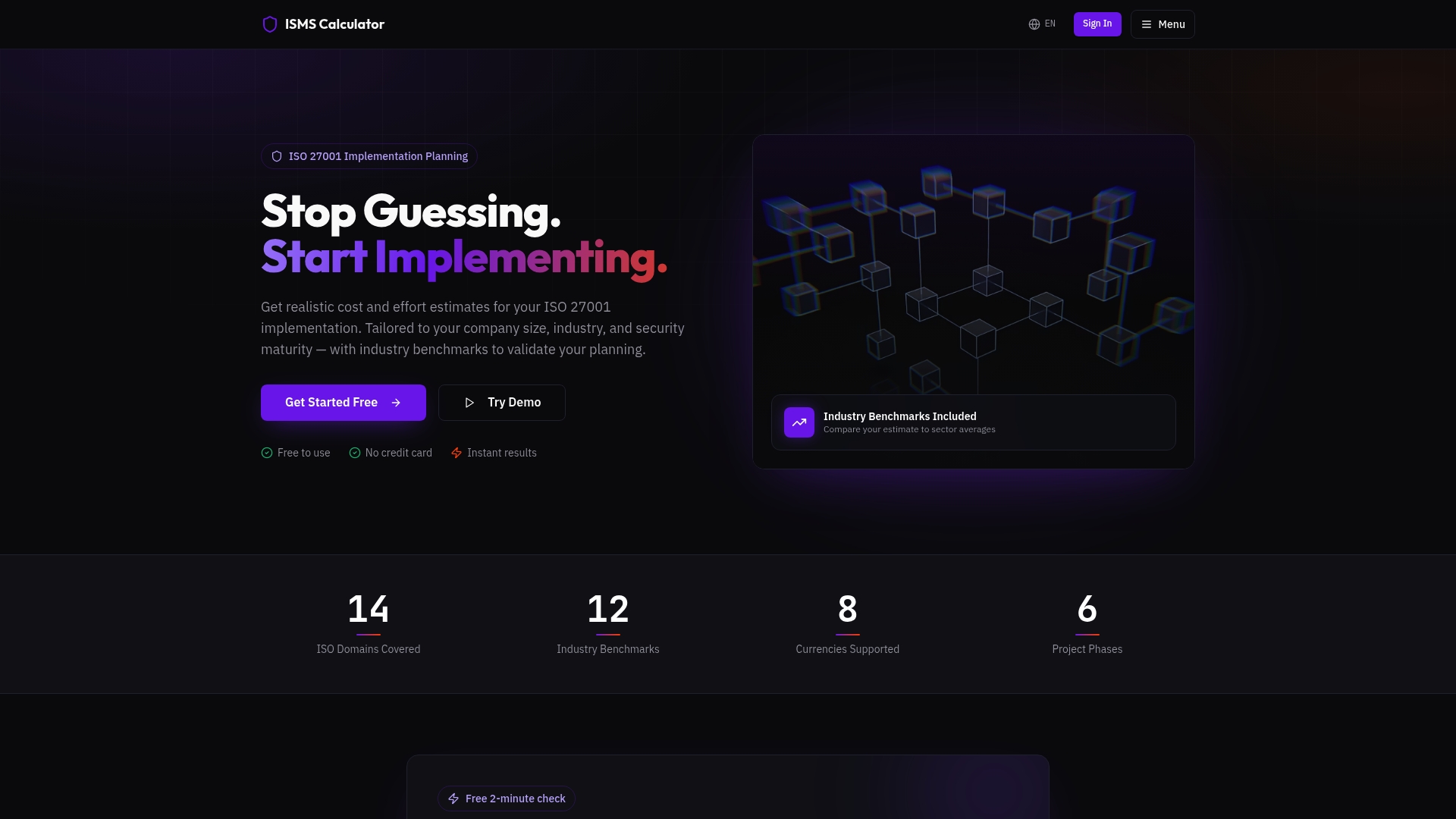
If you would rather start with where you stand, the readiness assessment covers maturity across the four Annex A control themes, and the free 2-minute check gives a first read in minutes. When you are ready for outside help, you can also request an introduction to independent ISO 27001 consultants.
FAQ
How much staff time does ISO 27001 take?
It depends on scope, size, locations, existing controls and budget, and no single figure applies to every organization. The ISACA transition article stresses that duration varies with management commitment, scope, organization size, number of locations and budget. Build the figure bottom-up: list each gap, assign an owner, and estimate hours per week for the length of the project.
Is ISO 27001 mandatory in the United States?
There is no direct federal mandate for ISO/IEC 27001. It is a voluntary standard, though customers, partners and some contracting requirements may ask for it. Whether you need it is usually a commercial decision driven by who you sell to.
What does Clause 7.1 mean in plain terms?
It means you must decide what people, money, tools and time your ISMS needs, and then actually supply them. The requirement covers setting up the system, running it, maintaining it and improving it. Auditors typically look for owners with allocated time, funded training, working tooling and a budget behind the risk treatment plan.
What should I budget beyond the certification audit?
Plan for internal staff time, tooling and licenses, training for in-scope staff, independent internal audit, penetration testing where your risks call for it, annual surveillance audits and the recertification audit at the end of the three-year cycle. Our three-year cost analysis shows how these add up over time.
Which version of ISO 27001 should I plan for?
Plan for ISO/IEC 27001:2022, the current edition referenced in the standard’s text. Clause 7.1 applies to it as described above, and your gap assessment and treatment plan should be built against that edition.
Sources
- ISO/IEC 27001:2022, Clause 7.1 text
- ISO 27001 Clause 7.1: Resources for the ISMS
- Resources, Competence, Awareness, Communication: Clauses 7.1 to 7.4
- ISACA: ISO/IEC 27001:2022 implementation guide
- AlertMedia: How to Conduct a Security Maturity Assessment
- ISACA Journal: Navigating the ISO/IEC 27001:2022 Transition, a 90-Day Challenge
- ISACA Journal: Planning for and Implementing ISO 27001