
What a CISO actually does for startup security planning
A Chief Information Security Officer is the executive responsible for building, leading, and communicating an organization’s security program. In a startup context, that definition barely scratches the surface. The CISO’s real job is to make security a business asset, not a tax on engineering velocity.
Most founders think of security leadership as a technical function. It is not, or at least not primarily. The role of CISO in startup security planning sits at the intersection of risk management, governance, and business strategy. A CISO decides which risks are worth accepting, which compliance frameworks unlock new customers, and how to communicate security posture to investors who increasingly treat it as a due-diligence checkpoint.
Here is what that looks like in practice for a startup:
- Strategic governance: Owning the security roadmap and aligning it with funding milestones, product launches, and enterprise sales cycles
- Risk management: Identifying and prioritizing threats based on the startup’s specific attack surface, not a generic enterprise checklist
- Executive communication: Translating technical exposure into financial and reputational risk language that boards and investors understand
- Compliance ownership: Driving frameworks like SOC 2, ISO 27001, HIPAA, or PCI-DSS depending on the startup’s market and customer requirements
- Cultural leadership: Setting the expectation that security is everyone’s responsibility, not just the security team’s
The reporting line matters more than most founders realize. A CISO reporting to the CEO carries organizational authority to push back on engineering shortcuts. One buried under the CTO often gets overruled when shipping speed conflicts with security controls. For early-stage companies that cannot yet justify a full-time CISO, a virtual CISO (vCISO) or a senior security engineer can fill portions of this role, a distinction covered in detail later.
Table of Contents
- Core responsibilities that define a startup CISO’s day-to-day
- How a CISO aligns security with business goals and builds a security culture
- When should your startup hire a CISO, and what are the alternatives?
- Scalable security leadership models that actually work for startups
- Key Takeaways
- See where your startup stands on security readiness
Core responsibilities that define a startup CISO’s day-to-day
The gap between a CISO’s job description and their actual calendar is wide in startups. There is no large team to delegate to, no mature process to inherit. The startup CISO is simultaneously the architect and the builder.
The practical responsibilities break down across several domains:
- Policy and standards development: Writing security policies that are actually usable, not 80-page documents nobody reads. Startup policies need to be lean, enforceable, and tied to real controls.
- Compliance program management: Managing audit readiness for SOC 2 Type II, ISO 27001, or HIPAA. This includes evidence collection, vendor assessments, and coordinating with external auditors.
- Risk assessment and threat management: Running periodic risk assessments, maintaining a risk register, and updating incident response playbooks as the product and infrastructure evolve.
- Incident response leadership: Owning the plan for when something goes wrong, including communication protocols, containment procedures, and post-incident reviews.
- Security awareness programs: Running training that actually changes behavior, not checkbox compliance videos. Phishing simulations, secure coding workshops, and onboarding security modules all fall here.
- Board and investor reporting: Preparing security metrics and status updates for executive audiences. This is where many technically strong CISOs struggle, and where the best ones differentiate themselves.
- Engineering and product collaboration: Embedding security into the development lifecycle through threat modeling, code review participation, and security requirements in sprint planning.
One thing worth noting about CISO responsibilities in startups: the ratio of strategic to tactical work shifts constantly. At Series A, a CISO might spend 60% of their time on hands-on work. By Series C, that should flip toward governance, vendor management, and team leadership. A candidate who cannot operate in both modes is a poor fit for a startup environment.
How a CISO aligns security with business goals and builds a security culture

Security that does not support the business will eventually get defunded or ignored. The best startup CISOs understand this instinctively. They frame every security initiative in terms of what it enables, not just what it prevents.

Effective CISOs act as business enablers, using security as a competitive advantage rather than a cost center. In enterprise sales, a completed SOC 2 audit can be the difference between winning and losing a deal. A clear security posture page on your website reduces friction in procurement reviews. These are revenue outcomes, and a CISO who can connect them to specific security investments earns a seat at the growth table.
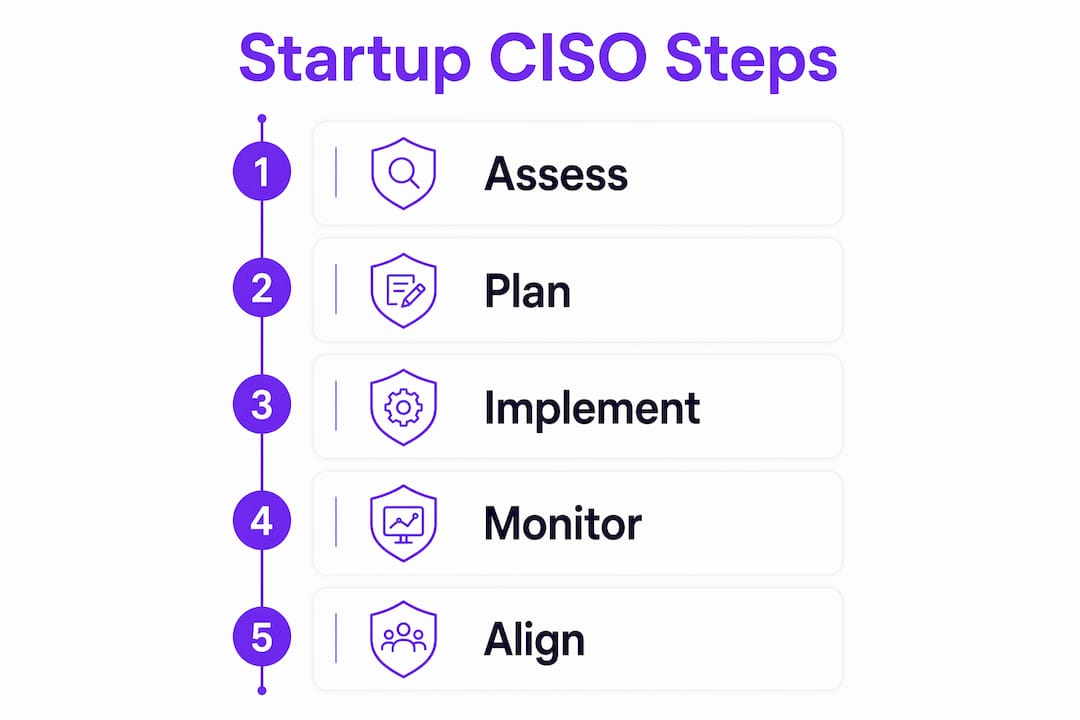
The cultural side is equally important, and harder to measure. Security culture is not a training program. It is the accumulated result of how leadership responds when security conflicts with speed, how developers are rewarded for finding vulnerabilities, and whether the CISO is seen as a partner or a gatekeeper.
Practical approaches that work in startup environments:
- Make secure defaults the path of least resistance. If developers have to jump through hoops to do the insecure thing, most will not bother.
- Celebrate security wins publicly. When an engineer catches a misconfiguration before it ships, recognize it in the same channel where product launches get announced.
- Tie security metrics to business outcomes. Mean time to detect, number of open critical vulnerabilities, and compliance coverage percentage all tell a story investors and customers care about.
Pro Tip: Frame your first security metrics report around customer trust and sales enablement, not technical controls. Show the board how many enterprise deals required security documentation, and what completing SOC 2 or ISO 27001 would unlock. That framing gets budget approved faster than any risk matrix.
Executive sponsorship is not optional. A CISO without visible CEO or board backing will lose every cross-functional conflict. The security program needs the same organizational authority as finance or legal, and that authority comes from the top. The CISO’s role in financial ISO 27001 compliance illustrates how this governance structure plays out in regulated environments, where the stakes of misalignment are highest.
Useful KPIs for measuring CISO effectiveness in a startup:
- Percentage of critical vulnerabilities remediated within SLA
- Time to achieve and maintain compliance certifications
- Security review completion rate in the product development cycle
- Number of security-related sales blockers resolved per quarter
- Employee phishing simulation click rates over time
When should your startup hire a CISO, and what are the alternatives?
Timing a CISO hire wrongly in either direction is expensive. Hire too early and you are paying a six-figure executive salary to write policies for a five-person team with no infrastructure to govern. Hiring a full-time CISO too early generally leads to underutilization and technical gaps, because early-stage startups need hands-on security execution more than executive policy writing.
Hire too late and you are scrambling to pass a SOC 2 audit while a major enterprise deal sits in procurement limbo, or worse, responding to a breach without a plan.
The signals that indicate it is time to bring in dedicated security leadership:
- Stalled sales deals: Enterprise customers are sending security questionnaires and your engineering team is spending days answering them
- Compliance deadlines: A customer or regulatory requirement is forcing a specific certification within a defined timeline
- Recurring security work: Security tasks are consuming more than 20% of an engineer’s time consistently
- Funding milestones: Series B investors and above routinely conduct security due diligence; having a credible security leader matters
For most startups, the right sequence is not “hire a CISO.” It is:
-
Security engineer first (Seed to Series A): A senior engineer with cloud security depth, SOC 2 experience, and incident response skills handles the hands-on work. The ideal first security leader for Series A combines AWS or GCP expertise with compliance execution and executive communication ability.
-
Fractional or virtual CISO (Series A to Series B): A vCISO provides strategic program leadership, policy development, compliance oversight, vendor management, and incident response leadership at a fraction of full-time cost. vCISO engagements typically cost $60K–$180K per year versus $250K–$400K in total compensation for a full-time CISO. That gap is significant for a startup managing runway.
-
Full-time CISO (Series B and beyond): Once the security program has enough complexity, a dedicated team to manage, and board-level visibility requirements, a full-time hire makes sense.
The transition from engineering-owned security to dedicated security leadership is usually marked by a spike in recurring compliance work, stalled sales due to security reviews, and growing audit burdens. Those three signals together are a reliable trigger.
One model that works well at mid-growth stages: pair a full-time senior security engineer for daily technical execution with a fractional CISO for strategic governance and roadmap direction. You get coverage at both layers without the full-time executive overhead.
On reporting structure, security leadership in startups typically reports to the CEO or CTO. CEO reporting gives the CISO broader organizational authority and independence from engineering priorities. CTO reporting works when the CTO is genuinely security-minded and the startup’s risk profile is primarily technical. Either way, direct executive access is not negotiable. Cybersecurity as a business priority is increasingly the expectation from enterprise customers and investors alike, and a CISO buried in the org chart cannot deliver on that expectation.
Scalable security leadership models that actually work for startups
The research on startup security is consistent on one point: focused action before a full security team exists still moves the needle significantly. Implementing key security practices like MFA, least-privilege access, and incident playbooks can reduce median detection time from weeks to hours, even before a CISO is in place. That is not an argument against hiring security leadership. It is an argument for not waiting until you have a CISO to start.
The scalable model most aligned with how successful startups actually build security programs looks like this:
Seed stage: No dedicated security hire. Founders and engineers implement baseline controls: MFA everywhere, secrets management, basic logging, and a simple incident response checklist.
Series A: Hire a senior security engineer. Begin SOC 2 Type I preparation. Engage a vCISO for strategic direction, compliance roadmapping, and investor-facing security communication.
Series B: The vCISO relationship deepens or transitions to a part-time fractional CISO. Security engineer headcount grows. Formal risk management program launches.
Series C and beyond: Full-time CISO hire. Dedicated security team. Mature governance, risk, and compliance program with board-level reporting cadence.
The cost argument for this phased approach is straightforward. A startup that moves from a $0 security budget to a vCISO engagement at Series A spends a fraction of what a full-time CISO would cost, while still getting executive-level governance. The savings fund the hands-on engineering work that actually reduces risk day to day.
Key insight: The CISO role in startup security planning is not a single hire at a single moment. It is a function that evolves with the company, starting as a part-time strategic overlay and maturing into a full executive position as the program grows.
Common challenges startups face in this progression:
- Founder resistance to security investment before a breach: The cost of prevention is visible; the cost of a breach is hypothetical until it is not.
- Engineering culture conflicts: Developers who view security reviews as blockers rather than quality gates. A skilled CISO or vCISO reframes this through developer-friendly tooling and clear SLAs on security reviews.
- Compliance fatigue: Pursuing SOC 2, ISO 27001, and HIPAA simultaneously without a prioritized roadmap. The right security leader sequences these based on customer demand and revenue impact, not theoretical completeness.
- Hiring the wrong profile: Bringing in a large-enterprise CISO who has never worked without a team, a budget, or established processes. Startup CISOs need to be comfortable building from scratch.
The skills that matter most for a startup security leader at any stage: cloud-native security depth (AWS, GCP, or Azure), hands-on compliance execution, clear executive communication, and the judgment to know which risks to accept versus which to remediate immediately. ISACA’s CISM and CISSP certifications signal foundational knowledge, but practical startup experience outweighs credentials in most early-stage hiring decisions.
Key Takeaways
The CISO’s role in startup security planning is most effective when it scales with the company’s stage, starting with hands-on security engineering and evolving toward strategic governance as complexity and compliance demands grow.
| Point | Details |
|---|---|
| Stage-appropriate hiring | Start with a security engineer at Seed/Series A before investing in a full-time CISO. |
| vCISO cost advantage | vCISO engagements typically cost $60K–$180K per year versus $250K–$400K in total compensation for a full-time CISO. |
| Security as a business enabler | CISOs who frame security around sales enablement and customer trust unlock budget and board support faster. |
| Early action reduces risk | Implementing MFA, least-privilege access, and incident playbooks can reduce detection time from weeks to hours. |
| Reporting line determines authority | Security leadership reporting directly to the CEO or CTO gains the organizational authority needed to enforce cross-functional policy. |
See where your startup stands on security readiness
If your startup is working through compliance requirements or preparing for a security audit, Ismscalculator’s ISO 27001 readiness assessment gives you a tailored estimate of cost and effort based on your company size, industry, and current security maturity. The platform covers all four ISO/IEC 27001:2022 control themes, includes customizable implementation timelines, and lets you benchmark your plan against model reference values. You can also run a free 2-minute readiness check to get an immediate sense of where your gaps are before committing to a full assessment.