
Un ISMS (système de management de la sécurité de l'information) est le système structuré et fondé sur les risques qu'une organisation utilise pour protéger ses actifs informationnels et satisfaire aux exigences de la norme ISO/IEC 27001. Que vous planifiiez une certification, budgétiez vos dépenses de conformité ou cherchiez simplement à comprendre ce que doit comporter votre programme de sécurité, ce guide est la référence qu'il vous faut.
Le résultat concret : un ISMS bien construit réduit votre exposition aux violations de données, satisfait les régulateurs et les clients, et vous fournit un enregistrement certifiable et auditable prouvant que vos contrôles fonctionnent réellement.
- Les personnes, les processus et la technologie travaillent ensemble au sein d'une structure de gouvernance documentée
- Réduction des risques et continuité d'activité grâce à l'identification et au traitement systématiques des menaces
- Confiance des clients et alignement réglementaire soutenus par une certification indépendante conforme à ISO/IEC 27001:2022
Table des matières
- Qu'est-ce qu'un ISMS et quel est son lien avec ISO 27001 ?
- Quelles sont les composantes essentielles d'un ISMS ?
- Comment un ISMS fonctionne-t-il concrètement au quotidien ?
- Qui a réellement besoin d'un ISMS et qu'en retire-t-on ?
- Comment mettre en œuvre un ISMS étape par étape ?
- Quel est le coût réel de la mise en œuvre et combien de temps cela prend-il ?
- Comment un ISMS s'aligne-t-il avec le GDPR, HIPAA, SOC 2 et NIST CSF ?
- Qui est responsable de quoi au sein d'un ISMS ?
- À quoi ressemblent les contrôles ISMS en pratique ?
- Quelle est la différence entre la certification ISO 27001 et la conformité continue ?
- Quelles sont les meilleures pratiques ISMS et les pièges à éviter ?
- Points clés à retenir
- Pourquoi une approche outillée et fondée sur les risques change la donne en matière de planification
- Sources utiles et lectures complémentaires
Qu'est-ce qu'un ISMS et quel est son lien avec ISO 27001 ?
Un ISMS n'est ni un produit que l'on achète ni une liste de contrôle que l'on remplit une fois pour toutes. C'est un système de management vivant : l'ensemble des politiques, procédures, enregistrements et pratiques documentés que votre organisation maintient pour gouverner la sécurité de l'information en permanence.
ISO/IEC 27001:2022 est la norme internationale qui définit ce que votre ISMS doit accomplir. Elle spécifie les exigences pour établir, mettre en œuvre, maintenir et améliorer continuellement le système. ISO/IEC 27002 est le document d'orientation associé qui explique comment mettre en œuvre des contrôles de sécurité spécifiques. En résumé : ISO 27001 = les exigences ; ISO 27002 = le guide de mise en œuvre.
S'appuyer sur l'une sans l'autre est un piège courant. Les organisations qui mettent en œuvre les exigences d'ISO 27001 sans consulter ISO 27002 se retrouvent souvent avec une conformité de façade, correcte sur le papier mais dépourvue de profondeur opérationnelle. Les contrôles sont techniquement sélectionnés, mais personne ne sait comment les opérer au quotidien.
La certification confirme qu'un auditeur tiers accrédité a vérifié que votre ISMS satisfait aux exigences d'ISO 27001 au moment de l'audit. Elle ne garantit pas l'absence d'incidents. Ce qu'elle signale, de manière crédible et publique, c'est que votre organisation dispose d'un système de management de la sécurité fonctionnel et fondé sur les risques.
Quelles sont les composantes essentielles d'un ISMS ?
Tout ISMS, quelle que soit la taille ou le secteur de l'organisation, requiert les mêmes éléments fondamentaux. Les composantes du cadre ISMS couvrent généralement les quatre thèmes de contrôle de l'Annex A, notamment la gestion des actifs, le contrôle d'accès, la sécurité des ressources humaines et la gestion des incidents. Voici ce que vous devez construire et maintenir :
- Définition du périmètre : La frontière documentée de votre ISMS, précisant quels systèmes, sites et unités opérationnelles sont couverts. Exemple d'artefact : une déclaration de périmètre signée par la direction générale.
- Politique de sécurité de l'information : Une politique de haut niveau énonçant l'engagement et les orientations de la direction. Exemple : un document d'une page approuvé par le PDG.
- Inventaire des actifs : Un registre de tous les actifs informationnels (données, systèmes, personnes, installations) dans le périmètre. Exemple : un tableur ou un outil GRC listant les actifs avec leurs propriétaires et leur classification.
- Appréciation des risques : Un processus systématique pour identifier les menaces, les vulnérabilités et leur impact potentiel. Exemple : un registre des risques avec des scores de vraisemblance et d'impact.
- Plan de traitement des risques : Les décisions documentées sur la manière dont chaque risque est traité (accepter, éviter, transférer ou réduire). Exemple : un plan de traitement des risques lié à des contrôles spécifiques.
- Déclaration d'applicabilité (DdA) : Un document recensant les contrôles de l'Annex A applicables à votre organisation et les raisons pour lesquelles. C'est l'un des documents les plus scrutés lors d'un audit de certification.
- Contrôles : Les mesures de protection techniques, organisationnelles et physiques sélectionnées pour traiter les risques. Exemple : authentification multifacteur, politique de chiffrement, règle du bureau propre.
- Surveillance et mesure : Les métriques et journaux qui prouvent que les contrôles fonctionnent. Exemple : rapports mensuels de revue des accès, journaux de détection d'intrusion.
- Documentation et enregistrements : Politiques, procédures et fichiers de preuves maintenus pour démontrer la conformité.
- Formation et sensibilisation : Les enregistrements démontrant que le personnel comprend ses responsabilités en matière de sécurité.
- Réponse aux incidents : Un processus documenté pour détecter, signaler et se remettre des incidents de sécurité.
- Audit interne : Revue indépendante périodique du ISMS au regard des exigences.
- Revue de direction : Réunion formelle de la direction pour évaluer les performances du ISMS et piloter l'amélioration.
Conseil d'expert : Définissez votre périmètre avant de toucher à quoi que ce soit d'autre. Un périmètre trop large gonfle les coûts et les délais ; un périmètre trop étroit crée des lacunes que les auditeurs signaleront. Ancrez d'abord le périmètre à une unité opérationnelle, une gamme de produits ou un environnement de données spécifique, puis élargissez lors des cycles suivants.
Comment un ISMS fonctionne-t-il concrètement au quotidien ?
Le ISMS fonctionne comme un système de management cyclique et fondé sur les risques, en utilisant le cycle Planifier-Déployer-Contrôler-Agir (PDCA). Ce n'est pas un projet ponctuel. C'est une boucle continue qui maintient votre posture de sécurité alignée sur l'évolution des menaces et des conditions métier.

Planifier : Définir le périmètre, mener l'appréciation des risques, sélectionner les contrôles et documenter le plan de traitement des risques. Cette phase produit votre DdA et établit la référence pour tout ce qui suit.
Déployer : Mettre en œuvre les contrôles sélectionnés, dispenser les formations et déployer les mesures techniques et organisationnelles documentées dans le plan de traitement. C'est là que les politiques passent du papier à la pratique.
Contrôler : Surveiller l'efficacité des contrôles à l'aide de métriques, de journaux et d'audits internes. Cette phase fait apparaître les écarts entre ce que la politique stipule et ce qui se passe réellement. Une revue trimestrielle des accès, par exemple, révèle souvent des comptes qui auraient dû être désactivés des mois auparavant.
Agir : Intégrer les conclusions de la phase Contrôler dans la revue de direction. Approuver les actions correctives, mettre à jour le registre des risques, réviser les contrôles et réinjecter les améliorations dans le prochain cycle Planifier.
Le flux concret se présente ainsi : le registre des risques alimente le plan de traitement, le plan de traitement oriente la sélection des contrôles, les contrôles génèrent des métriques, les métriques alimentent l'audit interne, et l'audit informe la revue de direction. Chaque boucle renforce le système.
Conseil d'expert : Commencez à collecter des preuves dès le premier jour de la mise en œuvre, et non la semaine précédant votre audit. Les auditeurs veulent constater que les contrôles ont fonctionné dans la durée. Une seule entrée de journal datant du mardi précédent ne démontre pas un contrôle opérationnel.
Qui a réellement besoin d'un ISMS et qu'en retire-t-on ?
Toute organisation qui traite des données sensibles, opère dans un secteur réglementé ou fait face à des exigences de sécurité de la part de ses clients devrait disposer d'un ISMS formel. La norme ISO/IEC 27001 s'applique aux organisations de toute taille et de tout secteur, et l'argumentation économique est claire dès lors que vous mappez les bénéfices à votre exposition réelle.
Profils types qui en bénéficient le plus :
- Les éditeurs SaaS et les entreprises technologiques qui stockent des données clients et font face à des exigences de sécurité contractuelles de la part d'acheteurs grands comptes
- Les établissements de services financiers soumis aux règles de protection des données de la SEC, de la FINRA ou d'autorités locales
- Les établissements de santé gérant des informations de santé protégées au titre de HIPAA
- Les participants à la chaîne d'approvisionnement dont les clients grands comptes exigent la certification ISO 27001 comme condition de qualification fournisseur
- Les cabinets de services professionnels (juridique, comptable, conseil) traitant des données confidentielles de clients
Les principaux avantages de la mise en place d'un cadre de management ISMS :
- Réduction des risques : Identification et traitement systématiques des menaces avant qu'elles ne deviennent des incidents
- Continuité d'activité : Procédures documentées de réponse et de reprise qui réduisent les temps d'arrêt en cas d'incident
- Confiance des clients : La certification signale aux prospects et aux clients que la sécurité est gérée, non improvisée
- Alignement réglementaire : Un seul ISMS satisfait souvent des exigences croisées provenant du GDPR, de HIPAA et de SOC 2
- Avantage concurrentiel : La certification ISO 27001 est de plus en plus une exigence dans les appels d'offres, et non un simple différenciateur
Pour les PME, le calcul est particulièrement clair. Adopter un socle fondé sur les risques et ne mapper que les contrôles applicables permet de maintenir l'investissement à un niveau proportionné. Vouloir mettre en œuvre intégralement un cadre conçu pour les grandes entreprises gonfle les coûts et les délais sans bénéfice de sécurité proportionnel.
Comment mettre en œuvre un ISMS étape par étape ?
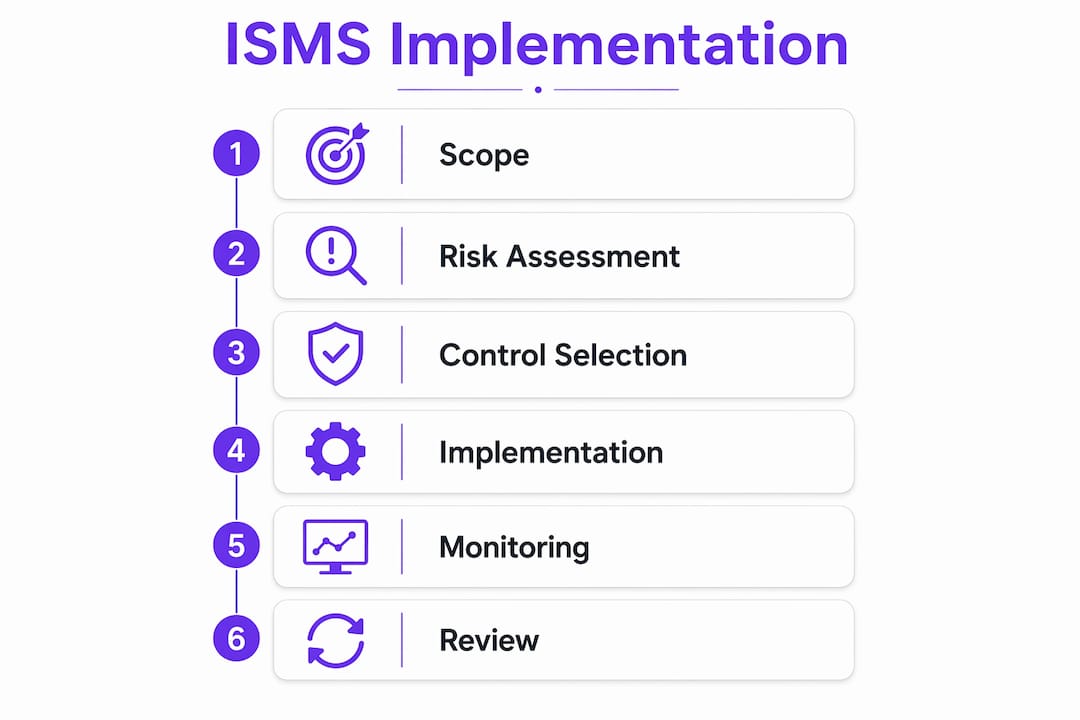
Une feuille de route pratique de mise en œuvre d'ISO 27001 suit neuf phases ordonnées. Chaque phase comporte des livrables et des dépendances clairs ; en ignorer une entraîne généralement des reprises en aval.
-
Définir le périmètre et obtenir l'engagement de la direction. Identifier la frontière organisationnelle, obtenir le parrainage de la direction générale et désigner un responsable du ISMS. Livrable : déclaration de périmètre, mandat de la direction. Sans un soutien visible de la direction, la coopération interfonctionnelle s'enraye.
-
Constituer l'inventaire des actifs. Recenser tous les actifs informationnels dans le périmètre : données, systèmes, applications, sites physiques et personnes. Livrable : registre des actifs avec propriétaires et classification. Ce registre alimente directement l'appréciation des risques.
-
Mener l'appréciation des risques. Identifier les menaces et vulnérabilités pour chaque actif, évaluer la vraisemblance et l'impact, et produire un registre des risques hiérarchisé. Livrable : registre des risques complété. Utilisez une méthodologie cohérente (qualitative ou quantitative) et documentez-la.
-
Élaborer le plan de traitement des risques et la DdA. Pour chaque risque, décider d'accepter, d'éviter, de transférer ou de réduire. Sélectionner les contrôles de l'Annex A / ISO 27002 pour traiter les risques à réduire. Livrable : plan de traitement des risques et Déclaration d'applicabilité. La DdA doit justifier chaque inclusion et exclusion.
-
Documenter les contrôles et les procédures. Rédiger les politiques, procédures et instructions de travail qui opérationnalisent chaque contrôle sélectionné. Livrable : bibliothèque de politiques. Gardez les documents concis ; une politique de contrôle d'accès de 40 pages que personne ne lit est pire qu'une version de 3 pages que les collaborateurs respectent.
-
Mettre en œuvre les contrôles et former le personnel. Déployer les contrôles techniques, dispenser les formations de sensibilisation et communiquer les responsabilités aux propriétaires d'actifs. Livrable : registres de formation, preuves de configuration, journaux de déploiement.
-
Surveiller et réaliser les audits internes. Activer la collecte de métriques, examiner les journaux et mener au moins un cycle complet d'audit interne avant l'audit externe. Livrable : rapport d'audit, journal des non-conformités. Pour les éditeurs SaaS et entreprises technologiques, les outils de collecte automatisée de preuves réduisent considérablement la charge manuelle à cette étape.
-
Conduire la revue de direction. Présenter les données de performance du ISMS à la direction générale, examiner l'efficacité du traitement des risques et approuver les actions correctives. Livrable : compte rendu de revue de direction. Il s'agit d'une exigence formelle d'ISO 27001, non d'une réunion d'état facultative.
-
Se préparer à l'audit externe. Clôturer les non-conformités ouvertes, organiser les dossiers de preuves et informer l'équipe d'audit sur le périmètre et les frontières du système. Livrable : dossier de preuves prêt pour l'audit, analyse des écarts préalable à l'audit.
Pour les petites organisations, les phases 1 à 4 peuvent souvent être menées en parallèle. Les grandes entreprises aux environnements complexes doivent généralement déployer les contrôles par unités opérationnelles, en faisant tourner le cycle par vagues plutôt qu'en tentant un déploiement unique à l'échelle de l'organisation.
Conseil d'expert : Effectuez un diagnostic de préparation gratuit en 2 minutes avant de vous engager sur un calendrier. Connaître votre niveau de maturité actuel dans les domaines ISO vous indique où se situent les lacunes et quelles phases prendront le plus de temps.
Quel est le coût réel de la mise en œuvre et combien de temps cela prend-il ?
Le calendrier et les coûts varient considérablement selon la taille de l'organisation, la complexité du périmètre et la maturité actuelle en matière de sécurité. Voici des fourchettes de planification réalistes :
| Taille de l'organisation | Calendrier type | Principaux facteurs de coût |
|---|---|---|
| Petite (quelques collaborateurs) | 3 à 6 mois | Temps interne, consultant externe, frais d'audit |
| Moyenne (effectif intermédiaire) | 6 à 12 mois | Consultant, outillage, remédiation, formation |
| Grande / complexe (effectif important) | 12 mois et plus | Plusieurs unités opérationnelles, systèmes legacy, contrats fournisseurs |
Principaux facteurs de coût à budgéter :
- Temps interne : Souvent le coût caché le plus important. Les appréciations des risques, la documentation et la collecte de preuves mobilisent les collaborateurs loin de leurs autres activités pendant des mois.
- Honoraires de conseil : Les consultants ISO 27001 externes accélèrent la livraison mais représentent un coût supplémentaire. Les honoraires varient largement selon le cabinet et le périmètre de la mission.
- Outillage : Plateformes GRC, scanners de vulnérabilités et outils de surveillance. Les coûts vont de quasiment nul pour les approches tableur à des abonnements annuels significatifs pour les plateformes d'entreprise.
- Travaux de remédiation : La correction des lacunes identifiées lors de l'appréciation des risques. Les systèmes legacy, l'absence de chiffrement et les processus non documentés sont des facteurs de coût courants.
- Frais d'audit externe : Frais de l'organisme certificateur pour les audits de Phase 1 et Phase 2, ainsi que les audits de surveillance annuels.
- Coût d'opportunité : L'attention managériale et les cycles d'ingénierie détournés des activités produit ou commerciales.
Surveillez les coûts cachés liés aux revues de contrats fournisseurs (les clauses de sécurité prestataires prennent du temps à négocier), à l'infrastructure de collecte de preuves (les outils de journalisation et de surveillance doivent être configurés) et à la remédiation des systèmes legacy (les systèmes anciens manquent souvent de journaux d'audit natifs).
Pour les petites entreprises, l'investissement total est souvent inférieur aux attentes lorsque le périmètre est bien défini. La plateforme Ismscalculator vous permet de saisir la taille de votre organisation, votre secteur et votre niveau de maturité actuel pour obtenir une estimation de coût et d'effort personnalisée — un point de départ plus rapide qu'un tableur générique.
Comment un ISMS s'aligne-t-il avec le GDPR, HIPAA, SOC 2 et NIST CSF ?
ISO 27001 est largement compatible avec NIST CSF, SOC 2, GDPR et HIPAA, mais chaque référentiel a ses propres priorités. Comprendre les recoupements permet d'éviter les doublons ; comprendre les écarts permet d'éviter les mauvaises surprises en matière de conformité.
-
NIST Cybersecurity Framework (NIST CSF) : Fort alignement conceptuel avec l'approche fondée sur les risques d'ISO 27001. Les deux reposent sur la logique identifier-protéger-détecter-répondre-récupérer. Cependant, NIST SP 800-53 est conçu pour les systèmes fédéraux et peut s'avérer excessivement prescriptif pour les organisations commerciales de plus petite taille. Pour une comparaison détaillée, consultez ISO 27001 vs NIST CSF.
-
SOC 2 : Les critères des services de confiance SOC 2 correspondent étroitement aux contrôles de l'Annex A d'ISO 27001, notamment dans les domaines du contrôle d'accès, de la disponibilité et de la réponse aux incidents. De nombreuses organisations poursuivent les deux ; la DdA et le plan de traitement des risques d'ISO 27001 constituent une base solide pour les preuves SOC 2. Pour une analyse comparative, ISO 27001 vs SOC 2 couvre les principales différences.
-
GDPR : ISO 27001 ne remplace pas la conformité au GDPR, mais satisfait nombre des mesures techniques et organisationnelles requises par le GDPR (article 32). La mise en place d'un processus d'analyse d'impact sur la protection des données (AIPD) parallèlement à l'appréciation des risques de votre ISMS couvre la plupart des recoupements. Les droits des personnes concernées, la documentation des bases juridiques et les délais de notification des violations nécessitent des ajouts spécifiques au GDPR.
-
HIPAA : Les catégories de mesures de protection administratives, physiques et techniques de la règle de sécurité HIPAA correspondent directement aux catégories de contrôles d'ISO 27001. Un ISMS fondé sur ISO 27001 fournit une base opérationnelle solide pour la conformité HIPAA, bien que les exigences spécifiques à HIPAA (accords de partenariat commercial, règles de traitement des informations de santé protégées) doivent être explicitement couvertes.
Étapes pratiques d'intégration :
- Réutiliser l'appréciation des risques ISO 27001 comme référence pour l'analyse des écarts NIST CSF et SOC 2
- Mapper votre DdA aux ensembles de contrôles pertinents pour chaque référentiel afin d'identifier les lacunes sans dupliquer les travaux
- Maintenir un processus d'AIPD parallèlement au registre des risques du ISMS pour l'alignement GDPR
- Documenter les mesures de protection spécifiques à HIPAA comme un sous-ensemble de votre bibliothèque de contrôles ISMS plus large
Qui est responsable de quoi au sein d'un ISMS ?
Un ISMS requiert une structure de gouvernance définie. Attribuer des rôles sans responsabilité claire produit le mode d'échec le plus courant : chacun suppose que quelqu'un d'autre est propriétaire du registre des risques.
| Rôle | Responsabilités principales | Artefacts de preuves clés |
|---|---|---|
| Direction générale | Approuver le périmètre et la politique du ISMS, allouer les ressources, conduire la revue de direction | Compte rendu de revue de direction, approbations de politiques signées |
| Responsable / gestionnaire ISMS | Opération quotidienne du ISMS, maintenance du registre des risques, coordination des audits | Registre des risques, DdA, programme d'audit interne |
| Propriétaires d'actifs | Classifier et maintenir les actifs, participer à l'appréciation des risques, mettre en œuvre les contrôles pour leurs actifs | Entrées du registre des actifs, décisions de traitement des risques |
| Équipe informatique / sécurité | Déployer et opérer les contrôles techniques, surveiller les systèmes, répondre aux incidents | Enregistrements de configuration, journaux de surveillance, rapports d'incidents |
| Auditeur interne | Mener les audits indépendants du ISMS, signaler les non-conformités | Rapports d'audit, enregistrements de non-conformités |
| Tous les collaborateurs | Respecter les politiques, suivre les formations, signaler les incidents de sécurité | Attestations de formation, rapports d'incidents |

Pour les responsables informatiques qui pilotent la mise en œuvre du ISMS, le modèle de gouvernance importe autant que les contrôles techniques. Un ISMS qui réside entièrement dans le département informatique aura du mal à obtenir la propriété des actifs de la part des directions financière, RH ou opérationnelle, ce qui crée des lacunes dans l'appréciation des risques.
Cadence de gouvernance à maintenir :
- Revue de direction : Au minimum annuellement ; trimestriellement est préférable pour les organisations en cycle d'amélioration active
- Comité ou groupe de pilotage sécurité : Mensuellement ou trimestriellement, selon le volume d'incidents et la maturité du programme
- Triage des incidents : En tant que de besoin, avec un chemin d'escalade défini et des délais de réponse cibles documentés dans la procédure de réponse aux incidents
À quoi ressemblent les contrôles ISMS en pratique ?
L'Annex A d'ISO 27001 et ISO 27002 fournissent le catalogue de contrôles dans lequel les organisations puisent pour construire leur ISMS. Les contrôles ne constituent pas une liste exhaustive obligatoire. Ils sont sélectionnés en fonction des risques identifiés lors de l'appréciation des risques et documentés dans la DdA. Les quatre catégories de contrôles dans ISO 27002 sont : organisationnels, relatifs aux personnes, physiques et technologiques.
Contrôles courants par catégorie, avec des exemples de mise en œuvre et les preuves type :
- Contrôle d'accès (organisationnel/technique) : Permissions d'accès basées sur les rôles, authentification multifacteur. Preuves : journaux de revue des accès, enregistrements d'enrôlement MFA.
- Gestion des actifs (organisationnel) : Registre des actifs maintenu avec étiquettes de classification. Preuves : inventaire des actifs sur tableur ou dans un outil GRC, politique de classification.
- Cryptographie (technique) : Chiffrement des données au repos et en transit via AES-256 ou TLS 1.2+. Preuves : politique de chiffrement, captures d'écran de configuration.
- Sécurité des opérations (technique) : Gestion des correctifs, protection contre les logiciels malveillants, procédures de sauvegarde. Preuves : journaux de correctifs, rapports antivirus, enregistrements de tests de sauvegarde.
- Relations fournisseurs (organisationnel) : Clauses de sécurité dans les contrats prestataires, évaluations des tiers. Preuves : contrats signés, questionnaires d'évaluation fournisseurs.
- Gestion des incidents (organisationnel/technique) : Procédure de réponse aux incidents documentée, journal des incidents. Preuves : registre des incidents, rapports de retour d'expérience post-incident.
- Continuité d'activité (organisationnel) : Plans de continuité d'activité et de reprise après sinistre, testés annuellement. Preuves : document PCA, enregistrements d'exercices de test.
- Sécurité des ressources humaines (personnes) : Vérifications des antécédents, formations de sensibilisation à la sécurité, procédures de départ. Preuves : dossiers RH, journaux d'attestations de formation.
La DdA relie chaque contrôle sélectionné au risque qu'il traite. Les auditeurs l'utilisent pour vérifier que la sélection des contrôles était délibérée et guidée par les risques, non arbitraire.
Quelle est la différence entre la certification ISO 27001 et la conformité continue ?
La certification est la vérification indépendante que votre ISMS satisfaisait aux exigences d'ISO 27001 au moment de l'audit. La conformité est la pratique continue d'exploitation du système. Les deux sont liées mais ne sont pas identiques.
Le cycle d'audit suit ces étapes :
- Analyse des écarts (interne) : Comparer votre ISMS actuel aux exigences d'ISO 27001 pour identifier ce qui doit être construit ou amélioré avant l'audit formel.
- Audit de Phase 1 (revue documentaire) : L'organisme certificateur examine la documentation de votre ISMS, le périmètre et la DdA pour confirmer la préparation à la Phase 2. Généralement conduit sur site ou à distance.
- Audit de Phase 2 (audit de certification) : Les auditeurs vérifient que les contrôles documentés fonctionnent réellement. Ils interrogent le personnel, examinent les preuves et testent les processus. Les non-conformités identifiées à cette étape doivent être clôturées avant que la certification soit accordée.
- Délivrance du certificat : Si la Phase 2 est concluante, l'organisme certificateur délivre un certificat ISO 27001 valable trois ans.
- Audits de surveillance : Audits annuels (années 1 et 2 du cycle du certificat) qui vérifient que le ISMS fonctionne toujours efficacement. Ils sont moins approfondis que l'audit de certification complet mais nécessitent des preuves à jour.
- Audit de renouvellement : À la fin du cycle de trois ans, un audit de renouvellement complet est conduit pour renouveler le certificat.
Pièges courants lors des audits : preuves insuffisantes du fonctionnement des contrôles (journaux ne remontant qu'à deux semaines), revue de direction non documentée, registres des actifs obsolètes et entrées de la DdA ne pouvant être reliées à une décision de traitement des risques.
Le processus de revue de direction est l'une des non-conformités les plus fréquemment citées lors des audits de surveillance. La conduire en tant que véritable réunion de gouvernance, avec des données d'entrée et de sortie documentées, n'est pas optionnel.
Quelles sont les meilleures pratiques ISMS et les pièges à éviter ?
Les organisations qui construisent des programmes ISMS durables partagent quelques habitudes constantes. Celles qui peinent partagent quelques erreurs constantes.
Meilleures pratiques à fort impact :
- Obtenir un engagement sincère de la direction avant de définir le périmètre. Un ISMS que la direction générale traite comme un projet informatique n'obtiendra jamais la coopération interfonctionnelle dont il a besoin.
- Commencer avec un périmètre qui limite la complexité initiale. Une seule gamme de produits ou unité opérationnelle est un meilleur point de départ que l'ensemble de l'organisation.
- Aligner les objectifs du ISMS sur les KPI métier. Les métriques de sécurité qui sont liées au risque sur le chiffre d'affaires, à la fidélisation des clients ou à l'exposition réglementaire retiennent l'attention de la direction ; les métriques techniques abstraites ne le font pas.
- Automatiser la collecte de preuves dans la mesure du possible. La collecte manuelle de preuves est le principal gouffre de temps dans la conformité continue. Les outils qui extraient automatiquement les journaux, les revues d'accès et les données de configuration réduisent considérablement la charge.
- S'intégrer au management des risques d'entreprise plutôt que de faire fonctionner le ISMS comme un silo parallèle.
Pièges courants :
- Traiter ISO 27001 comme un projet purement informatique. Le GDPR, les RH, la finance et les opérations ont tous des actifs et des risques qui appartiennent au ISMS.
- Mettre en œuvre par défaut tous les contrôles de l'Annex A. Les contrôles sont sélectionnés par les risques, non par exhaustivité. Une mise en œuvre globale gaspille des ressources et produit des contrôles que personne ne maintient.
- Négliger la DdA ou la traiter comme une formalité. La DdA est le document de référence central de l'audit.
- Laisser le registre des risques vieillir. Un registre des risques mis à jour lors de la mise en œuvre puis jamais retouché est un signal d'alarme lors de tout audit.
Signaux d'alarme indiquant qu'un ISMS est en difficulté :
- Aucune métrique ni processus de mesure définis
- La revue de direction n'a pas été conduite depuis plus de 12 mois
- Les propriétaires d'actifs ne peuvent pas identifier les actifs dont ils sont responsables
- Les constats d'audit interne ne sont pas suivis jusqu'à clôture
Points clés à retenir
Un ISMS construit sur ISO/IEC 27001:2022 requiert la définition du périmètre, l'appréciation des risques, la sélection des contrôles, la surveillance continue et la revue de direction régulière pour délivrer une sécurité de l'information certifiable et pérenne.
| Point | Détails |
|---|---|
| ISO 27001 + ISO 27002 ensemble | Utiliser ISO 27001 pour les exigences et ISO 27002 pour le guide de mise en œuvre ; aucun des deux ne fonctionne bien sans l'autre. |
| Le PDCA drive l'amélioration continue | Le cycle Planifier-Déployer-Contrôler-Agir maintient votre ISMS aligné sur l'évolution des menaces et des conditions métier. |
| Définir tôt le périmètre, étendre ensuite | Un périmètre initial bien délimité réduit les coûts, les délais et les risques à l'audit ; l'étendre lors des cycles suivants. |
| Les contrôles sont guidés par les risques, non exhaustifs | Sélectionner les contrôles de l'Annex A sur la base de votre plan de traitement des risques ; documenter chaque inclusion et exclusion dans la DdA. |
| La certification exige des preuves continues | Les audits de surveillance ont lieu annuellement ; les preuves du fonctionnement des contrôles doivent être à jour, non reconstituées avant chaque audit. |
Prochaines étapes immédiates :
- Effectuer un diagnostic de préparation gratuit pour identifier les lacunes de votre ISMS avant de vous engager sur un calendrier
- Définir votre périmètre et obtenir un engagement écrit de la direction
- Planifier une appréciation des risques avec les propriétaires d'actifs de chaque unité opérationnelle
- Désigner dès le premier jour des responsables de collecte de preuves pour chaque contrôle sélectionné
Pourquoi une approche outillée et fondée sur les risques change la donne en matière de planification
La plupart des mises en œuvre d'ISO 27001 dépassent le budget et le calendrier pour une seule raison : les hypothèses de planification étaient erronées dès le départ. Les organisations sous-estiment le temps nécessaire à l'appréciation des risques, surestiment la partie de l'Annex A qui leur est applicable et ne disposent d'aucun référentiel pour valider le réalisme de leurs estimations.
Une approche par phases fondée sur les risques résout le premier problème. Commencer avec un périmètre défini, mener une véritable appréciation des risques avant de sélectionner les contrôles, et faire tourner le cycle PDCA par vagues plutôt que de tenter un déploiement unique à l'échelle de l'organisation permet de maintenir le projet gérable. Le guide pour construire un ISMS from scratch couvre ce modèle par phases en détail pour les organisations au début du processus.
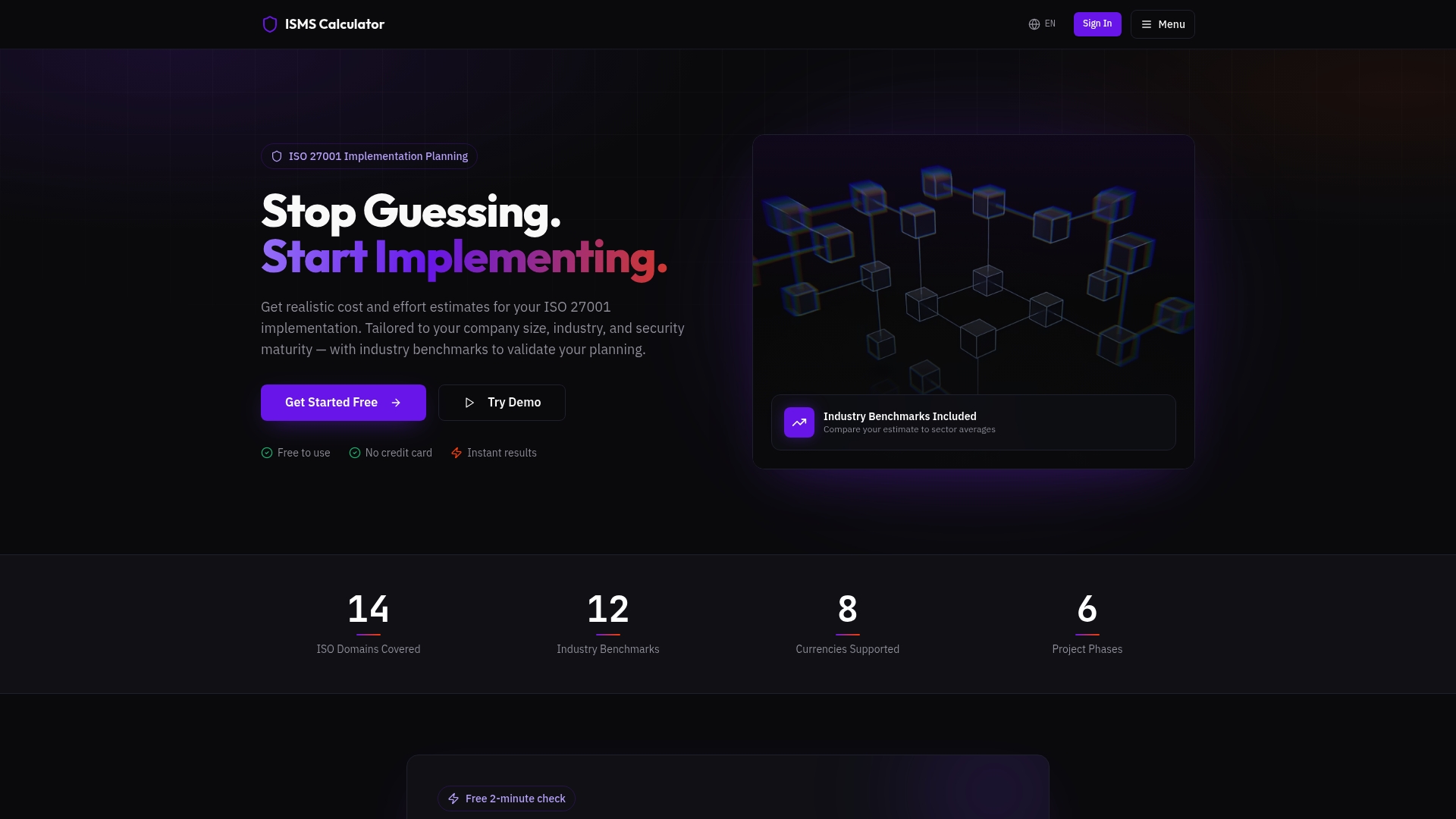
Le second problème, valider ses estimations, est là où la planification assistée par des outils prend tout son sens. Ismscalculator propose un calculateur de coût et d'effort de mise en œuvre en temps réel qui ajuste les estimations en fonction de la taille de votre organisation, de votre secteur et de votre niveau de maturité actuel en sécurité sur les quatre thèmes de contrôle de l'Annex A. La plateforme inclut des comparaisons avec des références modèles afin que vous puissiez comparer votre plan à cette référence, un diagramme de Gantt personnalisable pour les phases de mise en œuvre, et un autodiagnostic de préparation gratuit en 2 minutes qui fait immédiatement ressortir vos principales lacunes.
L'évaluation de préparation ISO 27001 va plus loin, fournissant aux responsables conformité et aux responsables informatiques un profil de maturité domaine par domaine qu'ils peuvent utiliser pour prioriser les travaux de remédiation et construire un dossier budgétaire défendable auprès de la direction.
La réalité honnête d'ISO 27001, c'est que la norme n'est pas techniquement complexe. Le défi est organisationnel : amener les bonnes personnes à s'approprier les bons actifs, maintenir les preuves en continu plutôt que de se démener avant les audits, et maintenir l'engagement de la direction à travers la revue de direction. Un ISMS bien délimité, piloté par les risques, avec des estimations budgétaires et calendaires réalistes, a bien plus de chances d'obtenir la certification — et de la conserver — qu'un programme ambitieux qui s'essoufflera six mois après le lancement.
Sources utiles et lectures complémentaires
Les sources primaires sont essentielles ici, car les normes évoluent. Vérifiez toujours les exigences dans la version publiée actuelle d'ISO/IEC 27001:2022, et non dans un résumé issu d'un blog tiers.
| Source | Ce qu'elle couvre | Usage recommandé |
|---|---|---|
| ISO/IEC 27001:2022 | Norme d'exigences pour le ISMS | Utiliser pour vérifier les exigences de certification et les obligations par clause |
| ISO/IEC 27002 | Guide de mise en œuvre des contrôles ISO 27001 | Utiliser lors de la sélection et de la mise en œuvre de contrôles spécifiques |
| NIST Cybersecurity Framework | Cadre de cybersécurité fondé sur les risques pour les organisations américaines | Utiliser pour l'alignement NIST et la cartographie de conformité fédérale |
| Règlement GDPR (UE) | Règlement européen sur la protection des données | Utiliser pour l'AIPD et les mesures techniques au titre de l'article 32 |
| Règle de sécurité HIPAA | Exigences américaines de sécurité des données de santé | Utiliser pour la cartographie des mesures de protection des informations de santé protégées vers les contrôles ISMS |
| Blog Ismscalculator | Guides de mise en œuvre ISO 27001, modèles et parcours par domaine | Utiliser pour des conseils pratiques de mise en œuvre et des modèles de planification |
Cet article constitue une information générale et ne constitue pas un conseil juridique ou de conformité. Vérifiez les exigences actuelles auprès de la norme ISO officielle, des autorités réglementaires compétentes ou d'un consultant ISO 27001 qualifié pour votre situation spécifique.