
An ISMS policy is a short, top-level document that states your organization’s commitment to protecting information, sets the framework for information security objectives, and authorizes the entire Information Security Management System (ISMS). Think of it as the constitution of your ISMS: one page, signed by leadership, pointing to everything else.
Get a working policy in minutes:
- Ismscalculator toolkit — readiness assessment, policy templates, and evidence exports in one workflow (recommended starting point)
- Downloadable Word/DOCX templates — available from reputable compliance sites; require manual tailoring to your scope
- SaaS policy generators — produce draft text quickly but still need a human to map scope and sign off
Quick customization checklist:
- Define your ISMS scope (systems, locations, data types in scope)
- Name a policy owner and an approving executive
- Get top-management signature and date it
- Add one measurable information security objective
- Publish the signed document and log who received it
A typical ISO 27001–aligned policy library runs 15–30 policies for most organizations. The top-level ISMS policy is just one of them — the anchor that gives every other policy its authority.
Table of Contents
- What does ISO/IEC 27001:2026 actually require from your ISMS policy?
- A copy-ready ISMS policy example you can use today
- How to tailor this template to your organization
- Common mistakes that cause audit findings
- Where to get ISMS policy templates and generators
- ISO/IEC 27001:2026 clause mapping for your policy
- Key Takeaways
- The part most teams get wrong about policy adoption
- Ismscalculator cuts the time from draft policy to audit-ready evidence
- Useful sources and downloads
What does ISO/IEC 27001:2026 actually require from your ISMS policy?
ISO/IEC 27001:2022 Clause 5.2 is the governing requirement. It is shorter than most people expect, but auditors read it carefully. Top management must establish an information security policy that:
- Is appropriate to the organization’s purpose
- Includes information security objectives or provides a framework for setting them
- Commits to satisfying applicable information security requirements
- Commits to continual improvement of the ISMS
The policy must be documented, communicated internally, and made available to interested parties as appropriate. That last phrase matters: external parties such as customers or regulators may need to see it, so write it with that audience in mind.
Clause 5.2 does not stand alone. Clause 5.1 requires top management to demonstrate leadership and commitment, which means the policy must carry a real signature from someone with authority, not just the IT manager’s name. Clause 4.3 governs scope determination, which feeds directly into what the policy covers. Clauses 6.1.2 and 6.1.3 require a risk assessment methodology and risk treatment plan, so the policy should reference a risk-based approach even if it does not describe the methodology in detail.
What auditors actually want to see goes beyond the document itself. They look for:
- A signed, dated policy approved by top management
- Evidence the policy was communicated (distribution logs, onboarding acknowledgements, read receipts)
- Proof that relevant personnel understood it (training records, signed acknowledgement forms)
- A defined review cycle and records of past reviews
“The most common audit failure against Clause 5.2 is the absence of recorded proof of communication and understanding. Auditors expect records — onboarding acknowledgements, signed policies, automated read receipts — not just a published document sitting on an intranet.” — ISO 27001:2022 Clause 5.2 guidance
Pro Tip: Set up a simple acknowledgement workflow the day you publish the policy. A shared form, an e-signature tool like DocuSign, or even an email thread with replies logged in a spreadsheet all satisfy the auditor’s evidence requirement. The format matters less than the record.

A copy-ready ISMS policy example you can use today
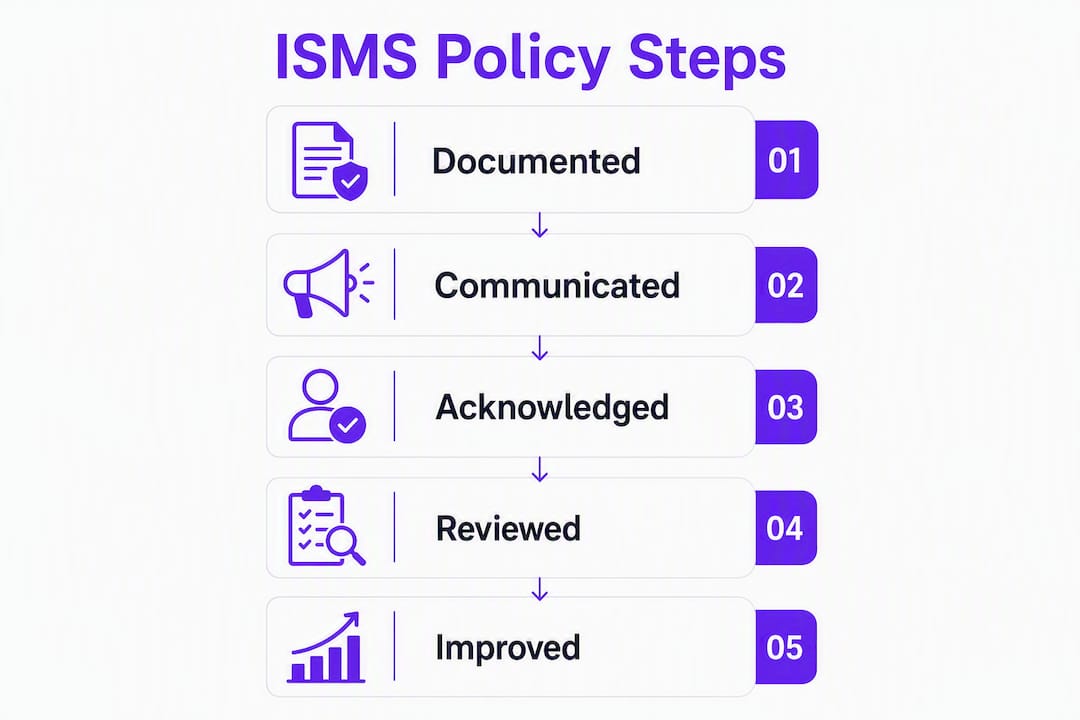
The text below is a production-ready top-level policy. Replace bracketed placeholders with your organization’s details. Keep the document to one page — guidance consistently recommends a short top-level policy that links to topic-specific policies rather than embedding operational detail.

INFORMATION SECURITY POLICY [Organization Name] | Policy ID: ISP-001 | Version: 1.0 Owner: [CISO / IT Director] | Approved by: [CEO / Board] | Approval Date: [Date] | Next Review: [Date + 12 months] | Classification: Public / Internal
Purpose and scope (Clause 5.2 — appropriate to purpose; Clause 4.3 — scope) [Organization Name] is committed to protecting the confidentiality, integrity, and availability of all information assets within the scope of its ISMS. This policy applies to [describe scope: e.g., “all information systems, personnel, and third parties supporting the delivery of [product/service] from [location(s)]”].
Objectives (Clause 5.2 — objectives or framework for them; Clause 6.2) The organization shall establish, monitor, and review measurable information security objectives. Objectives are documented separately and reviewed at least annually by management.
Risk-based approach (Clauses 6.1.2–6.1.3) Information security risks shall be identified, assessed, and treated in accordance with the organization’s risk assessment methodology. Risk treatment decisions are documented in the Risk Treatment Plan.
Compliance (Clause 5.2 — applicable requirements) The organization commits to satisfying all applicable legal, regulatory, contractual, and internal information security requirements.
Continual improvement (Clause 5.2 — continual improvement; Clause 10) The organization commits to the continual improvement of the ISMS through regular management reviews, internal audits, and corrective actions.
Roles and responsibilities (Clause 5.3) Top management is accountable for this policy. The [CISO / IT Director] is responsible for maintaining the ISMS and reporting on its performance. All personnel are responsible for complying with this policy and related topic-specific policies.
Supporting policies This policy is supported by topic-specific policies including, but not limited to: Access Control Policy, Incident Response Policy, Data Classification Policy, Third-Party Risk Policy, and Business Continuity Policy.
Signed: _________________________ [CEO / Board Chair] Date: _____________
Notes on using this template:
- Keep the signed original in your document management system with version history
- Reference each supporting policy by name and document ID — do not copy their content here
- The Ismscalculator toolkit includes exportable DOCX versions of this template and supporting policies; the ISMS framework guide covers how they connect
How to tailor this template to your organization
Generic text fails audits. Auditors spot copy-paste policies that reference departments or controls that do not exist in the organization. Follow these steps in order.
-
Define your ISMS scope first. Identify which systems, locations, business units, and data types fall inside the boundary. Write one or two sentences that a non-technical auditor can verify against your asset register. For a US-based SaaS company, this might read: “All cloud infrastructure, source code repositories, and customer data processed in support of the [Product Name] platform, operated from our Austin, TX headquarters.”
-
Identify interested parties. List internal stakeholders (employees, contractors) and external ones (customers, regulators, auditors, cloud providers). This determines how the policy is distributed and what level of detail is appropriate for external publication.
-
Set 1–3 measurable information security objectives. Vague commitments fail Clause 6.2. Concrete examples for US organizations:
- “Reduce mean time to detect security incidents to under 72 hours by Q4 2026, measured via SIEM reporting.”
- “Achieve 100% completion of annual security awareness training for all employees by December 31, 2026.”
-
Assign ownership and approval authority. The policy owner maintains and updates the document. The approver (CEO, Board, or equivalent) signs it. These are two different people. IT managers typically lead ISMS implementation, but the approver must be a senior executive with organizational authority.
-
Link to control-level procedures, not embed them. The policy says what and why. Procedures say how. Reference your Access Control Procedure by document ID; do not paste its contents into the policy. This keeps the policy stable when operational processes change.
-
Set a review schedule and stick to it. Annual review is the minimum. Trigger an out-of-cycle review after significant organizational changes, major incidents, or scope changes. Log every review with date, attendees, and outcome.
Records to keep for each step:
| Step | Evidence to collect |
|---|---|
| Scope definition | Scope statement document, asset register excerpt |
| Interested parties | Stakeholder register |
| Objectives | Objectives register with metrics and targets |
| Ownership and approval | Signed policy with approver name and date |
| Communication | Distribution log, acknowledgement records |
| Review | Management review minutes, version history |
Common mistakes that cause audit findings
Most ISMS policy failures fall into a short list of repeatable errors. Fix these before your auditor walks in.
- Over-detailing the policy. Embedding procedures, technical configurations, or step-by-step instructions turns a one-page policy into a 20-page document that nobody reads and nobody maintains. Policies state what and why; procedures state how.
- Mixing policy with procedure. When a policy changes every time a process changes, it loses authority. Keep them separate.
- Using a generic template without tailoring. Referencing a “Data Center Security Team” when your organization uses AWS and has no physical data center is an immediate red flag. Scope first, then write.
- Missing top-management signature. A policy approved by the IT manager alone does not satisfy Clause 5.1. The signature must come from someone with organizational authority.
- No evidence of communication. Publishing a document on an intranet is not the same as communicating it. Auditors want records.
- Unclear ownership. “The IT department” is not an owner. Name a specific role.
- No defined review cadence. If the policy has no next review date, auditors assume it has never been reviewed.
- Inconsistent scope. The scope in the policy must match the scope statement in your ISMS documentation. Discrepancies suggest the documents were written independently.
- Wrong audience distribution. External parties may need a version of the policy; internal staff need the full version plus acknowledgement. Sending the wrong version to the wrong audience creates gaps.
- Referencing controls that don’t apply. If you excluded an Annex A control, document the justification in your Statement of Applicability. Do not leave ghost references in the policy.
Three audit-day red flags to fix immediately:
- No version number or approval date on the policy document
- No acknowledgement records for current employees
- Objectives stated as aspirations (“we aim to improve security”) rather than measurable targets
Where to get ISMS policy templates and generators
Template sources fall into four categories, each with a different trade-off between speed, tailoring depth, and audit defensibility.
In-house drafting gives you maximum control and zero licensing cost, but it requires someone who knows Clause 5.2 well enough to write to it. Best for large enterprises with a dedicated security team and time to spare.
Downloadable templates (Word, PDF, DOCX) from compliance sites are fast to acquire and easy to customize. The risk is that they are generic by design. You must still scope them, remove irrelevant sections, and add your organization’s specifics before they are audit-ready. A practical guide for business leaders on security policy explains what makes a policy genuinely useful versus decorative.
SaaS policy generators produce draft text in minutes based on inputs about your organization. The better ones map output to specific ISO clauses. The trade-off is that the output still needs human review, and some generators produce text that is too generic to survive a certification audit without significant editing.
Consultant-created policies offer the highest audit defensibility because an experienced implementer tailors every line to your scope and risk profile. The cost is higher and the timeline is longer. For regulated industries — financial services, healthcare, defense contractors — this is often the right call.
Decision checklist:
| Situation | Recommended source |
|---|---|
| Startup, tight timeline, limited budget | SaaS generator + readiness check |
| Regulated financial services firm | Consultant-created, scope-first approach |
| Large enterprise with internal security team | In-house drafting with template reference |
| Mid-market company, first ISO 27001 attempt | Downloadable template + consultant review |
For financial services organizations, the ISMS for financial data protection guide covers how to tailor scope and controls for regulated environments specifically.
Pro Tip: Whatever source you use, run a readiness check before you finalize the policy. Ismscalculator’s free 2-minute self-assessment flags gaps in your policy and ISMS setup before an auditor does — saving you a corrective action finding on day one of certification.
ISO/IEC 27001:2026 clause mapping for your policy
Use this table to validate each section of your policy during internal reviews or pre-audit checks.
| Policy element | Example policy statement | ISO clause(s) | Evidence expected |
|---|---|---|---|
| Purpose and scope | “This policy applies to all information assets supporting [Product] from [Location].” | 4.3, 5.2 | Scope statement, asset register |
| Management commitment | “Top management is committed to establishing and maintaining the ISMS.” | 5.1, 5.2 | Signed policy, meeting minutes |
| Information security objectives | “Measurable objectives are set, monitored, and reviewed annually.” | 5.2, 6.2 | Objectives register with metrics |
| Risk-based approach | “Risks are identified, assessed, and treated per the risk assessment methodology.” | 6.1.2, 6.1.3 | Risk register, risk treatment plan |
| Applicable requirements | “The organization commits to satisfying legal, regulatory, and contractual requirements.” | 5.2 | Legal register, contract review records |
| Continual improvement | “The organization commits to continual improvement of the ISMS.” | 5.2 | Management review records, audit reports |
| Roles and responsibilities | “The CISO is responsible for ISMS maintenance and performance reporting.” | 5.3 | RACI chart, job descriptions |
| Communication and availability | “This policy is communicated to all personnel and available to interested parties.” | 5.2 | Distribution log, acknowledgement records |
For a deeper walkthrough of how these clauses connect across the full ISMS framework, the clause-by-clause breakdown covers Clauses 4 through 10 in sequence.
Key Takeaways
A compliant ISMS policy requires a signed top-management commitment, measurable objectives, a defined scope, and documented proof that every relevant person received and acknowledged it.
| Point | Details |
|---|---|
| Keep the policy short | One page is the target; link to procedures rather than embedding operational detail. |
| Prove communication | Distribution logs and acknowledgement records are what auditors check, not just the published document. |
| Scope before you write | Define systems, locations, and data types in scope first; then tailor every policy statement to match. |
| Set measurable objectives | Vague commitments fail Clause 6.2; tie each objective to a metric and a target date. |
| Use Ismscalculator | The free 2-minute readiness check and policy toolkit help you identify gaps and export audit-ready evidence before certification day. |
The part most teams get wrong about policy adoption
The single most overlooked failure in ISMS policy work is not a drafting problem. It is a distribution and culture problem. Organizations spend weeks perfecting policy language, then publish the document on an intranet page that nobody visits and call it done. Six months later, an auditor asks for acknowledgement records and the room goes quiet.
The fix is simpler than most people think: tie the policy briefing to onboarding. Every new employee or contractor should read and sign the policy as part of their first week, logged in your HR system. Then schedule a brief policy review into quarterly all-hands or team meetings, not as a compliance lecture, but as a five-minute reminder of what the policy covers and why it matters. That cadence creates a paper trail and, more importantly, it creates a security culture where the policy is a living document rather than a forgotten PDF.
The management review process is the natural home for annual policy review — use it to update objectives, confirm scope, and re-sign the document when anything material changes.
Ismscalculator cuts the time from draft policy to audit-ready evidence
Writing a compliant ISMS policy is one step. Proving it to an auditor is another. Ismscalculator connects both. The platform’s readiness assessment maps your current state against ISO 27001:2022 requirements across the four Annex A control themes, so you know exactly which policy gaps to close before you submit for certification. The policy toolkit includes exportable DOCX templates pre-mapped to Clause 5.2, and the evidence export feature packages acknowledgement records, review logs, and objective tracking into the format auditors expect.
For teams that want expert guidance alongside the toolkit, Ismscalculator’s independent ISO 27001 consultant network connects you with implementers and lead auditors who can review your policy, validate your scope, and prepare you for certification. Start with the free 2-minute readiness self-assessment to see where your policy and ISMS stand right now.
Useful sources and downloads
- ISO/IEC 27001:2022 — official standard page (ISO.org) — the authoritative source for all ISMS requirements
- Security frameworks for SMB firms — practical advice on choosing and tailoring frameworks for smaller organizations
- Ismscalculator toolkit and templates — readiness assessments, policy templates, Gantt planning, and evidence exports for ISO 27001 implementation
Version control reminder: Every policy version should carry a unique version number, approval date, and change summary. Keep a change log attached to the document and retain superseded versions for at least three years. Auditors frequently request prior versions to verify that review cycles actually happened. Store distribution records alongside each version so you can demonstrate, at any point, who received which version and when.