La gestion des incidents ISO 27001 repose sur cinq contrôles de l'Annex A, de 5.24 à 5.28, ainsi que sur l'exigence de signalement du personnel au contrôle 6.8. Un programme conforme nécessite une équipe de gestion des incidents (IMT) désignée nominativement, une matrice de sévérité documentée, au moins un playbook testé, et des enregistrements de preuves avec une chaîne de conservation défendable. Les auditeurs ne veulent pas seulement des politiques. Ils veulent la preuve que la boucle allant de la détection au retour d'expérience se ferme réellement.
En résumé :
- La mise en place d'une équipe de gestion des incidents documentée, dotée d'une autorité claire et d'une délégation de rôles définie, est essentielle pour une conformité ISO 27001 efficace.
- Les organisations doivent établir un processus de classification de la sévérité mesurable afin de garantir une prise de décision et une escalade rapides dans les délais impartis.
- La collecte de preuves, notamment les journaux et les instantanés mémoire, doit être planifiée à l'avance avec une chaîne de conservation afin d'éviter toute perte de données lors de la réponse aux incidents.
- Les exercices de simulation réguliers et les incidents réels sont indispensables pour tester l'ensemble de la boucle, de la détection au retour d'expérience, et pas seulement la documentation des politiques.
- L'utilisation d'outils d'évaluation permet d'identifier rapidement les lacunes dans la préparation à la gestion des incidents, assurant ainsi la disponibilité opérationnelle avant qu'un incident réel ne survienne.
Table des matières
- Que couvre la gestion des incidents ISO 27001 ?
- Les cinq contrôles de gestion des incidents, expliqués contrôle par contrôle
- Qui pilote l'équipe de gestion des incidents ?
- Comment classifier la sévérité des incidents ?
- Confinement, éradication, reprise et communication parallèle
- Collecter des preuves sans ralentir la réponse
- Transformer les incidents en améliorations du SMSI
- Que demandent les auditeurs lors des tests ?
- Comment ISMS Calculator accélère la préparation à la gestion des incidents
- Point de vue de l'auteur : la gestion des incidents comme programme itératif
- Démarrez votre bilan de préparation à la gestion des incidents ISO 27001
- Sources
Que couvre la gestion des incidents ISO 27001 ?
Les référentiels de sécurité de l'information établissent une distinction nette entre un « événement » et un « incident ». Un événement est tout fait observable survenant dans un système, un réseau ou un service. La plupart des événements sont du bruit de fond : une tentative de connexion échouée, un scan de port bloqué, une pièce jointe signalée. Un incident est un événement (ou une série d'événements) qui compromet la confidentialité, l'intégrité ou la disponibilité avec des conséquences réelles pour l'activité. Cette distinction est fondamentale, car elle détermine le moment où le dispositif de gestion des incidents se met en marche.
ISO/IEC 27001:2022 intègre les exigences de gestion des incidents dans l'Annex A, aux contrôles 5.24 à 5.28, avec un contrôle d'appui en 6.8 relatif au signalement par le personnel. Ces cinq contrôles se distinguent des contrôles préventifs qui dominent la majeure partie de l'Annex A — contrôle d'accès, cryptographie, segmentation réseau — car ils présupposent qu'un problème a déjà eu lieu. Les contrôles préventifs cherchent à éteindre l'incendie avant qu'il ne démarre. Les contrôles de gestion des incidents vous indiquent quoi faire une fois que la fumée est dans la pièce.
Il s'agit d'un choix structurel délibéré. Un ensemble de règles de pare-feu et un playbook d'incidents résolvent des problèmes différents : l'un réduit le risque de compromission, l'autre régit ce qui se passe lorsque ce risque se matérialise. Les organisations qui traitent la gestion des incidents comme une extension de leurs contrôles techniques ont tendance à rédiger des playbooks que personne ne suit, parce que les contrôles ressemblent davantage à une architecture de sécurité qu'à un manuel opérationnel.
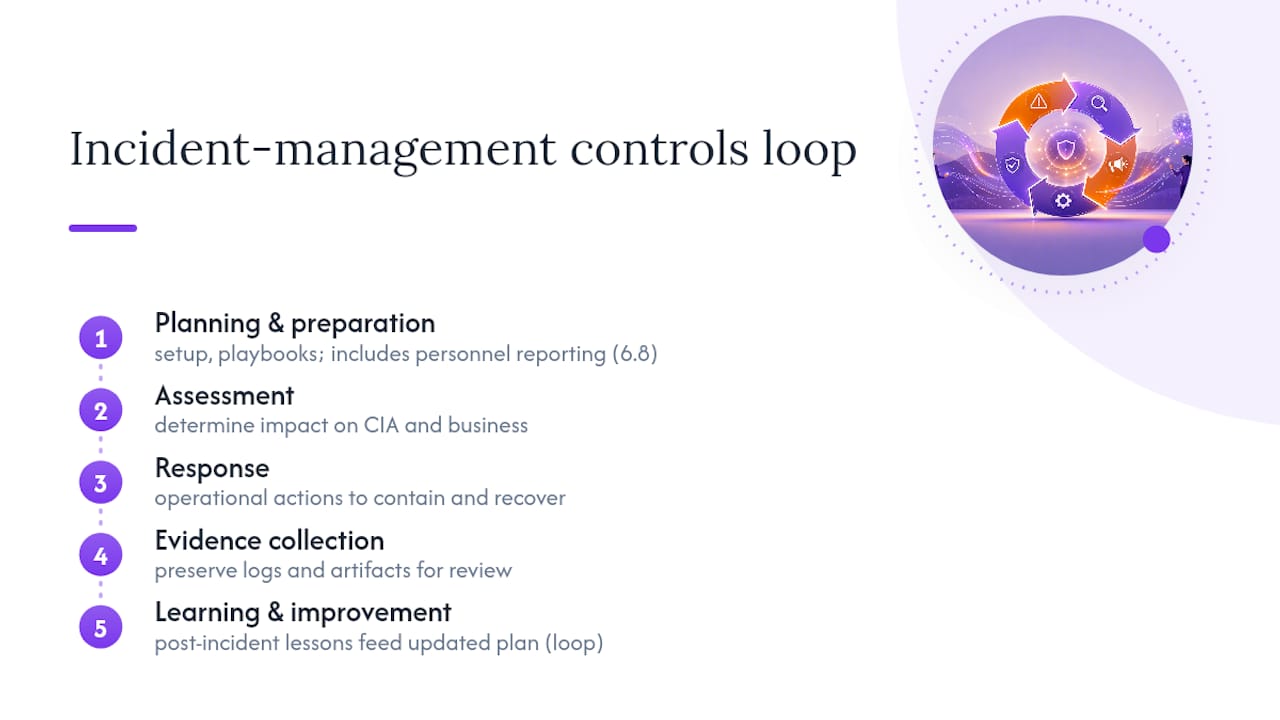
Les cinq contrôles forment une boucle, non une liste de contrôle. La planification et la préparation alimentent l'évaluation, l'évaluation alimente la réponse, la réponse alimente la collecte de preuves, et la collecte de preuves alimente le retour d'expérience, qui met ensuite à jour le plan. Les guides pratiques relatifs au jeu de contrôles de gestion des incidents présentent cette boucle comme ce que les auditeurs testent réellement, souvent en parcourant un incident réel ou un exercice de simulation plutôt qu'en lisant des documents de manière isolée. Un classeur rempli de textes de politique sans aucune preuve que la boucle a déjà fonctionné constitue le constat le plus fréquent lors des audits de surveillance.
Les cinq contrôles de gestion des incidents, expliqués contrôle par contrôle
Chaque contrôle correspond à une phase distincte du cycle de vie de l'incident, et chacun produit un artefact spécifique qu'un auditeur demandera à consulter. Omettre l'artefact, même lorsque l'activité sous-jacente a eu lieu, revient fonctionnellement à omettre le contrôle.
5.24, Planification et préparation de la gestion des incidents. Ce contrôle exige une politique documentée définissant ce qui constitue un incident, qui a l'autorité de le déclarer et comment l'organisation y répondra. C'est le fondement sur lequel tout le reste repose.
- Une équipe de gestion des incidents (IMT) nommément désignée avec des rôles définis
- Des playbooks écrits pour les scénarios courants (rançongiciel, exposition de données, déni de service, abus interne)
- Des canaux de communication et des chemins d'escalade, y compris les contacts en dehors des heures ouvrables
- Des modèles pré-approuvés pour les communications internes, les notifications aux autorités de contrôle et les communications clients
5.25, Évaluation et décision. Une fois un élément signalé, quelqu'un doit décider rapidement s'il s'agit d'un véritable incident et de son niveau de sévérité. Ce contrôle requiert une méthode de classification reproductible, et non un jugement rendu de façon improvisée à chaque fois.
- Enregistrer l'événement déclencheur avec un horodatage et la source
- Appliquer une classification de sévérité (détaillée ci-dessous)
- Décider de déclarer formellement l'incident ou non
- Consigner la décision et le temps nécessaire pour y parvenir
5.26, Réponse. Il s'agit du cœur opérationnel : contenir le problème, en supprimer la cause, rétablir le service normal et tenir les parties prenantes informées en permanence. Les auditeurs s'attendent à ce que les mesures de confinement n'aient pas attendu une analyse complète de la cause profonde. La rapidité prime sur l'exhaustivité dans les premières heures.
5.27, Retour d'expérience sur les incidents. Chaque incident clôturé devrait donner lieu à une revue succincte : ce qui s'est passé, pourquoi, ce qui va changer. Ce contrôle est là où un programme renforce sa maturité ou stagne. Les organisations qui sautent cette étape se retrouvent à gérer le même incident, parfois avec la même cause profonde, un an plus tard.
5.28, Collecte de preuves. Les journaux, captures d'écran, images mémoire et enregistrements de communications doivent disposer d'une chaîne de conservation documentée dès le moment de leur collecte. Cela est important même lorsque le contentieux semble improbable au moment de l'incident, car cette hypothèse se révèle fréquemment erronée avec le recul.
Le libellé des clauses de l'édition 2022 est intentionnellement peu prescriptif quant aux outils ou formats exacts. Cette flexibilité est un avantage pour les organisations qui disposent déjà d'une gestion des services informatiques mature, et un piège pour celles qui interprètent « flexible » comme « facultatif ». Le guide des contrôles de l'Annex A d'Ismscalculator explique comment ces cinq contrôles s'articulent avec le reste de l'Annex A si vous avez besoin d'une vue d'ensemble plus large.
Qui pilote l'équipe de gestion des incidents ?
Une IMT qui n'existe que sur un organigramme est pire qu'une absence d'IMT, car elle fournit aux auditeurs un document à passer au crible. L'équipe doit comporter des personnes nommément désignées, une autorité définie et un processus de passation documenté pour les cas où le contact principal n'est pas joignable.
Une IMT opérationnelle comprend généralement :
- Le responsable de la gestion de l'incident — détient le pouvoir de déclarer, d'escalader ou de clôturer un incident, et coordonne tous les autres rôles pendant la réponse active
- Le responsable technique — dirige les travaux de confinement et d'éradication sur les systèmes, faisant appel à des ingénieurs spécialisés selon les besoins
- Le responsable communication — rédige et valide les communications internes, les notifications aux clients et les communiqués de presse avant toute diffusion
- Le représentant juridique ou conformité — décide du moment où des avocats externes ou des spécialistes en investigation numérique sont impliqués et suit les obligations de notification réglementaire
- Le représentant RH ou ressources humaines — traite les cas impliquant des menaces internes, des manquements de collaborateurs ou des suites disciplinaires
L'autorité est la dimension que les organisations sous-documentent le plus. Le responsable technique peut-il isoler un serveur de production sans ouvrir un ticket de gestion des changements ? Le responsable de la gestion de l'incident peut-il autoriser une notification client avant la validation du service juridique, si la rapidité prime sur la forme ? Ces réponses doivent figurer dans le plan lui-même, et non dans la mémoire de quelqu'un sur « la façon dont on gère ça habituellement ».
Documentez la délégation d'autorité de la même manière que vous documenteriez tout autre contrôle : personne nommée, périmètre de l'autorité, date d'effet, et signature ou enregistrement système attestant de la prise de connaissance. Associez-y des enregistrements de formation montrant que chaque membre de l'IMT a participé à au moins un exercice de simulation dans son rôle. Les auditeurs demandent les deux, et une équipe dotée d'une autorité mais sans preuve de formation paraît presque aussi peu préparée qu'une équipe ne disposant ni de l'un ni de l'autre.
Comment classifier la sévérité des incidents ?
Le contrôle 6.8 exige que les organisations offrent au personnel un moyen clair et accessible de signaler les événements de sécurité suspectés. Si le signalement nécessite trois approbations et un ticket dans un système dont personne ne se souvient des identifiants, les personnes ne signaleront pas, et l'ensemble de la boucle de gestion des incidents s'asséchera à la source. Les canaux efficaces comprennent un alias e-mail dédié, une permanence téléphonique disponible vingt-quatre heures sur vingt-quatre, et une intégration dans l'outil de messagerie instantanée que les collaborateurs utilisent déjà au quotidien.
Une fois un signalement reçu, quelqu'un doit le trier rapidement. Une matrice de sévérité à deux axes — impact métier sur un axe, niveau de confiance dans le signalement sur l'autre — donne aux intervenants un moyen cohérent d'y procéder sans réinventer la logique à chaque fois.
- Impact élevé, confiance élevée → déclarer immédiatement, activer l'IMT au complet, viser une décision dans les 30 minutes
- Impact élevé, confiance faible → escalader au responsable technique pour validation rapide, décision dans les 2 heures
- Impact faible, confiance élevée → traiter via le processus opérationnel standard, enregistrer et surveiller
- Impact faible, confiance faible → enregistrer pour analyse des tendances, aucune escalade immédiate requise
La matrice remplit un double rôle. Elle fournit aux intervenants un cadre de décision, et elle offre aux auditeurs un enregistrement visible et horodaté de la rapidité avec laquelle l'organisation est passée du signalement à la décision — ce qui correspond exactement à la métrique que les audits de surveillance aiment sonder.
Conseil pratique : Définissez vos objectifs de délai de décision avant d'en avoir besoin sous pression. Une organisation qui écrit « répondre de manière appropriée » plutôt que « déclarer dans les 30 minutes pour un incident de niveau 1 » se ménage la possibilité de justifier a posteriori une réponse lente — et offre à un auditeur un constat facile à formuler.
Confinement, éradication, reprise et communication parallèle
La réponse dans le cadre du contrôle 5.26 comporte quatre composantes qui se déroulent de manière simultanée, et non en séquence stricte.
- Confinement — isoler les systèmes affectés, limiter le trafic suspect ou appliquer des restrictions d'accès temporaires pour endiguer la propagation sans nécessairement remédier à la cause
- Éradication — supprimer les logiciels malveillants, combler la vulnérabilité exploitée, révoquer les identifiants compromis et corriger la faiblesse sous-jacente
- Reprise — restaurer les systèmes à partir de sauvegardes saines, valider l'intégrité des données et remettre les services en ligne dans un ordre contrôlé
- Communication — menée en parallèle tout au long des travaux techniques, et non ajoutée après coup
Le volet communication est là où des réponses techniquement solides déraillent. Les mises à jour internes doivent parvenir à la direction et aux équipes concernées selon une cadence définie, même lorsqu'il n'y a rien de nouveau à signaler — le silence est perçu comme une perte de contrôle. Les communications externes, à destination des clients, partenaires ou autorités de contrôle, nécessitent des modèles pré-validés afin que personne ne rédige une notification de violation depuis une page blanche sous pression à deux heures du matin.
Conseil pratique : Élaborez vos modèles de notification aux autorités de contrôle et aux clients dans le calme, bien avant tout incident, et obtenez la validation juridique du contenu standard en amont. Modifier un modèle pré-approuvé dans l'urgence est une tâche fondamentalement différente que de le rédiger sur une page blanche pendant que les parties prenantes attendent.
La planification du retour arrière appartient à la phase d'éradication, et non comme une réflexion après coup. Si un correctif crée une dépendance défaillante ou si la révocation d'identifiants verrouille un compte de service légitime, vous avez besoin d'un chemin de retour testé vers l'état antérieur connu comme sain. Pour une séquence propre à un secteur spécifique, le guide de réponse aux incidents pour les SMSI bancaires d'Ismscalculator détaille comment les entreprises régulées structurent cette passation — et le cadre s'adapte à d'autres secteurs régulés avec peu d'ajustements. La conception de playbooks gagne généralement à traiter chaque type d'incident comme son propre scénario plutôt qu'à utiliser un modèle générique unique ; les recommandations opérationnelles sur les playbooks de réponse aux incidents plaident dans le même sens en faveur de runbooks spécifiques à chaque scénario plutôt qu'un document fourre-tout.
Collecter des preuves sans ralentir la réponse
Le contrôle 5.28 demande aux organisations d'identifier, de collecter, d'acquérir et de préserver les preuves de manière à ce qu'elles restent utilisables pour une investigation ou une soumission réglementaire ultérieure. Il s'agit d'une discipline documentaire qui se superpose à la réponse technique, et il est facile de l'ignorer lorsque la priorité du moment est de remettre les systèmes en ligne.
Les preuves à capturer lors de presque tout incident comprennent :
- Les journaux système et applicatifs de la période concernée, exportés avant que leur rotation ne les efface
- Les images mémoire ou les instantanés forensiques des systèmes soupçonnés d'être activement compromis
- Une chronologie des actions entreprises, par qui et à quel moment, y compris les décisions de confinement
- Des copies des communications internes et externes envoyées pendant la réponse
La chaîne de conservation n'a pas besoin d'être complexe. Un simple registre — qui a collecté la preuve, à quelle heure, où elle est stockée et qui y a accédé depuis — satisfait la plupart des auditeurs, et c'est le type d'artefact que le guide d'Ismscalculator sur les types de preuves pour les audits ISO 27001 détaille avec des modèles concrets.
La vraie tension est entre rapidité et intégrité. La restauration d'un serveur compromis à partir d'une sauvegarde peut détruire l'état mémoire exact qu'un investigateur forensique aurait voulu analyser. La solution est une règle simple intégrée à l'avance dans le playbook : pour tout incident classifié au-dessus d'un seuil de sévérité défini, marquer une pause avant d'effacer ou de reconstruire un système, le temps de capturer une image forensique. Ce seul point de contrôle — décidé à l'avance plutôt que négocié en cours d'incident — prévient la plupart des erreurs destructrices de preuves.
Transformer les incidents en améliorations du SMSI
Le contrôle 5.27 est d'une simplicité trompeuse à décrire et véritablement difficile à exécuter correctement : analyser l'incident, identifier la cause profonde, corriger ce qui l'a permis, et prouver que la correction a été effectivement appliquée. Les organisations qui traitent cela comme une formalité rédigent un résumé d'une page et passent à autre chose. Celles qui le prennent au sérieux s'en servent pour conduire de véritables améliorations du SMSI.
Une revue post-incident qui résiste à l'examen d'un auditeur couvre :
- Ce qui s'est passé, sous forme d'une chronologie factuelle sans commentaires subjectifs
- La cause profonde, clairement distinguée des facteurs contributifs
- Les actions correctives et préventives, chacune avec un responsable nommé et une échéance
- Quel traitement du risque ou quelle politique existante l'incident a révélé comme inadéquat
L'étape que l'on omet est la dernière. Un rapport d'incident qui ne touche jamais au registre des risques ni aux documents de politique est une narration, pas une entrée dans le SMSI. Les auditeurs cherchent spécifiquement le lien entre « ceci s'est produit » et « voici ce qui a changé dans nos contrôles documentés en conséquence ». Sans ce lien, même un post-mortem bien rédigé n'apporte rien à votre certification.
Que demandent les auditeurs lors des tests ?
Les organismes de certification acceptent rarement un classeur de politiques comme preuve suffisante du bon fonctionnement des contrôles de gestion des incidents. La pratique courante lors des audits de surveillance consiste à parcourir un incident réel du cycle précédent, ou à réaliser un exercice de simulation en direct sur place, pour vérifier si l'IMT connaît réellement son propre playbook.
Une cadence de test raisonnable comprend un exercice de simulation complet par an, couvrant un scénario réaliste comme un rançongiciel ou une violation chez un prestataire tiers, ainsi que des simulations ciblées pour les domaines à risque plus élevé identifiés lors de l'évaluation des risques. Preuves à conserver pour chaque exercice :
- Le scénario écrit et les objectifs
- La liste de présence et les attributions de rôles pour les participants
- Les notes sur les décisions prises et le temps nécessaire pour y parvenir
- Une liste suivie des actions correctives révélées par l'exercice, avec leur statut de suivi
Lorsque les auditeurs demandent des échantillons, ils souhaitent généralement consulter un rapport d'incident clôturé montrant l'intégralité de la boucle de la détection au retour d'expérience, un enregistrement de chaîne de conservation issu d'une collecte de preuves réelle ou simulée, et des enregistrements de formation prouvant que les membres de l'IMT ont exercé leurs rôles assignés. Un modèle pratique de plan de réponse aux incidents peut aider à structurer ces artefacts si vous partez de zéro. La liste de contrôle de certification d'Ismscalculator indique où ces types de preuves s'inscrivent dans le parcours global en 80 étapes vers la certification.
Une chose qu'ISO ne fait délibérément pas : fixer des délais de notification des violations. Ceux-ci proviennent de la réglementation applicable selon la zone géographique d'activité de l'organisation — lois américaines de notification des violations selon les États, HIPAA pour les données de santé, règles de la SEC pour les sociétés cotées. Les contrôles d'incidents ISO régissent le processus interne, mais le compte à rebours externe court de manière indépendante, et la mise en correspondance de votre calendrier de décision interne avec ces délais réglementaires est une tâche que la norme vous laisse entièrement.
Comment ISMS Calculator accélère la préparation à la gestion des incidents
Construire les artefacts évoqués ci-dessus depuis zéro — matrice de sévérité, playbooks, modèles de preuves — est là où la plupart des calendriers de mise en œuvre dérapent. Une évaluation de préparation sur mesure identifie précisément lesquels des contrôles 5.24 à 5.28 disposent déjà d'une documentation opérationnelle et lesquels ne sont que du texte de remplacement — avant qu'un auditeur ne découvre la lacune à votre place.
L'évaluation de maturité d'Ismscalculator sur les quatre thèmes de contrôle de l'Annex A note la gestion des incidents aux côtés du reste de votre SMSI, afin que vous puissiez déterminer si c'est votre domaine le plus faible ou un point de force relatif. Une fois les lacunes cartographiées, les outils Gantt et de planification temporelle de la plateforme vous permettent de séquencer les travaux : matrice de sévérité en premier, documentation de l'IMT en deuxième, un playbook testé en troisième, et les modèles de preuves en parallèle.
Le bilan de préparation gratuit prend environ deux minutes et fournit un benchmark par rapport à des organisations de taille et de secteur similaires — un contexte utile lorsque vous évaluez si votre cadence actuelle d'exercices de simulation est insuffisante ou globalement comparable à celle de vos pairs. Les responsables conformité disposant de peu de temps ont tendance à l'utiliser comme premier passage, puis à approfondir les détails spécifiques au domaine une fois qu'ils savent où se situent les vraies lacunes.
Point de vue de l'auteur : la gestion des incidents comme programme itératif
Le piège de maturité que j'observe le plus souvent n'est pas un contrôle manquant. C'est une mise en œuvre conçue entièrement pour l'audit plutôt que pour l'incident. Les équipes rédigent une magnifique politique 5.24, organisent un exercice de simulation la semaine avant l'arrivée de l'évaluateur, puis laissent le playbook inutilisé pendant un an. Cela passe la certification. Cela ne résiste pas à un vrai événement de rançongiciel.
Commencez plus modestement et plus honnêtement. Construisez une matrice de sévérité avec des seuils réels, désignez une IMT réelle dotée d'une autorité réelle, et testez un playbook jusqu'à ce que les personnes puissent l'exécuter sans le document ouvert devant elles. Tout le reste — les modèles de preuves, les processus de notification, la cartographie réglementaire — devient plus facile une fois que cette boucle centrale fonctionne sous pression.
Traitez chaque incident, réel ou simulé, comme une entrée dans le SMSI plutôt que comme un problème à clôturer et oublier. C'est la différence entre un programme qui résiste à son premier vrai test et un programme qui n'a jamais survécu qu'à son audit.
— Martin
Démarrez votre bilan de préparation à la gestion des incidents ISO 27001
Construire les cinq contrôles de gestion des incidents depuis une page blanche coûte généralement des semaines d'allers-retours entre la conformité, l'informatique et le service juridique avant que quiconque sache ce qui manque réellement. L'évaluation de préparation ISO 27001 d'Ismscalculator raccourcit ce chemin en cartographiant votre documentation actuelle par rapport aux contrôles 5.24 à 5.28 directement — en signalant précisément où votre matrice de sévérité, vos enregistrements d'autorité de l'IMT ou vos modèles de preuves sont insuffisants.
L'évaluation prend environ deux minutes à démarrer et fournit un rapport de lacunes personnalisé, une comparaison avec le modèle de référence, et une estimation du délai de comblement des manques. Vous obtenez un rapport PDF partageable avec la direction ou un auditeur, une liste d'actions prioritaires, et la possibilité de sauvegarder vos résultats et de les comparer à une estimation future une fois les lacunes comblées. Si vous préférez explorer d'abord l'ensemble des outils — notamment le planificateur de mise en œuvre basé sur un diagramme de Gantt — la plateforme ISMS Calculator est le point de départ.
Sources
- ISO/IEC 27001:2022 - Systèmes de management de la sécurité de l'information
- Contrôles de gestion des incidents ISO 27001 pour la réponse et les enregistrements