
The Chief Information Security Officer is the primary owner of Information Security Management System governance in financial institutions under ISO 27001. The role of CISO in financial ISO 27001 programs covers three non-negotiable functions: defining the security strategy, owning the risk assessment methodology, and allocating documented responsibilities across the organization. Financial CISOs also operate under regulatory frameworks like DORA, which raises the stakes by placing board-level ICT risk accountability at the center of compliance. This article explains what that means in practice, where CISOs most often fall short, and how to build a governance model that holds up under audit.
How does the CISO lead risk assessment and treatment under ISO 27001 in finance?
The CISO owns the risk assessment process from methodology design to final approval. ISO 27001 Clause 6.1.2 requires a documented, repeatable risk assessment process that produces a risk register, a treatment plan, and a Statement of Applicability linking every risk to a specific control. Auditors treat these three documents as a connected chain. A gap in any one of them is a finding.
In financial institutions, the CISO’s risk assessment duties follow a clear sequence:
- Define the methodology first. The CISO sets the scoring criteria, likelihood scales, and impact definitions before any assessment begins. Changing methodology mid-cycle invalidates comparability across periods.
- Maintain the risk register continuously. The register is not a point-in-time document. The CISO assigns ownership for each risk and sets review cadences, typically quarterly for high-rated risks.
- Approve the risk treatment plan. Every accepted, mitigated, or transferred risk needs a documented decision. The CISO signs off on the treatment plan, creating the audit trail auditors expect.
- Align risks to Annex A controls. Each control selected in the Statement of Applicability must trace back to a documented risk. Most ISO 27001 audits fail due to inconsistencies between the risk register and the Statement of Applicability.
- Document risk acceptance formally. When a risk is accepted rather than treated, the CISO or a delegated executive must sign the acceptance record. Verbal agreement is not audit evidence.
The hardest part for financial CISOs is translating technical risk scores into business impact terms. A vulnerability with a CVSS score of 9.8 means little to a credit risk committee. The CISO must reframe it as potential regulatory fine exposure, customer data loss, or operational downtime measured in dollars.
Pro Tip: Build a risk translation layer into your register. Add a column that maps each technical risk to a business impact category such as regulatory, reputational, or financial. Auditors and board members both respond better to this framing.

What governance structures support the CISO’s role in financial ISO 27001 compliance?
Governance structure determines whether the CISO has real authority or just advisory influence. ISO/IEC 27001:2022 Clause 5.2 mandates clear allocation and documentation of information security roles, with each security-critical activity assigned an explicit owner. A RACI matrix is the standard tool for making that allocation visible and auditable.
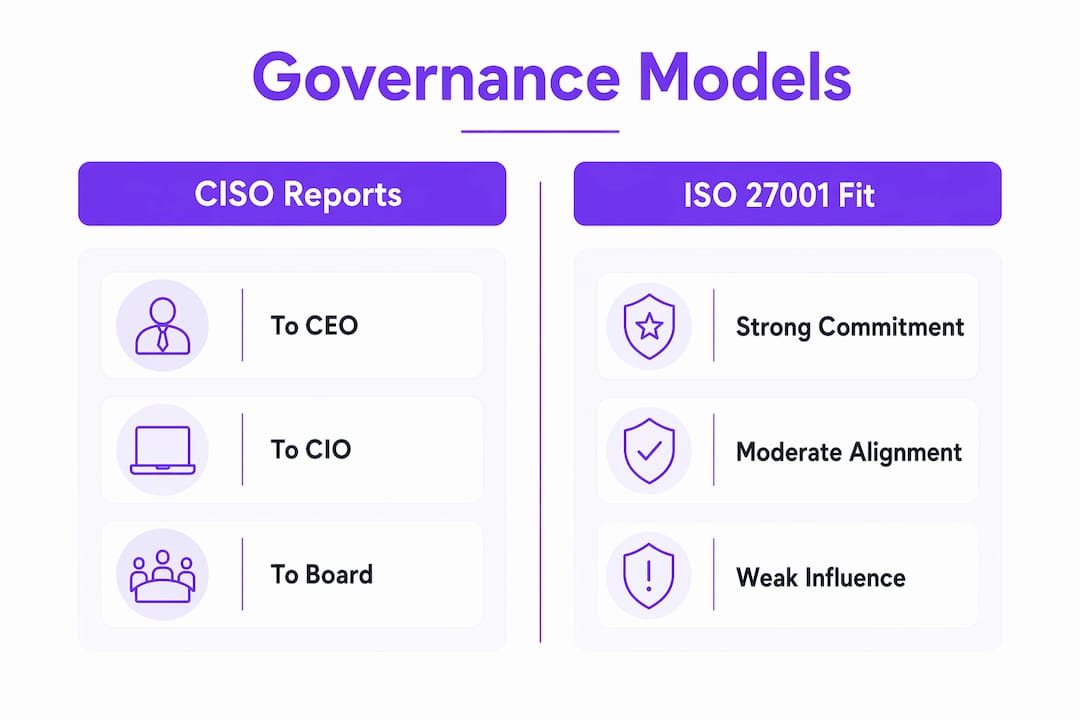
Financial CISOs typically report through one of three structures:
- Direct to CEO. This gives the CISO the authority to escalate security concerns without passing through a CTO or CRO filter. It works well in institutions where security is treated as a board-level concern.
- Through the CRO. Common in banks and insurers where operational risk and information risk are managed under a unified risk framework. The CISO gains access to risk governance forums but may compete for priority with credit and market risk.
- Via a risk or audit committee. Provides independence from operational management but can slow decision-making. Works best when the committee meets frequently and has real authority.
The choice of reporting line affects the CISO’s ability to fulfill ISO 27001 compliance roles effectively. A CISO buried three levels below the board cannot realistically drive top management commitment, which ISO 27001 Clause 5.1 requires explicitly.
| Governance model | ISO 27001 fit | DORA fit |
|---|---|---|
| CISO reports to CEO | Strong top management commitment | Supports board oversight requirements |
| CISO reports to CRO | Integrated risk framework | Aligns with ICT risk management mandate |
| CISO reports to CTO | Operational focus, weaker independence | Limited board visibility |
| CISO via audit committee | High independence | Slower escalation path |
The most common governance failure is informal accountability. A CISO who influences security decisions without documented authority cannot demonstrate ownership during an audit. Auditors expect formal governance, including escalation paths and appointment letters, not just role descriptions in a job posting.
Pro Tip: Request a formal appointment letter that specifies your authority over security-critical decisions. This single document resolves more audit questions than any policy ever will.
How does DORA influence the CISO’s responsibilities in ISO 27001 compliance?
DORA fundamentally changes the CISO’s position in financial governance. Article 5(2) of DORA specifies that the management body holds non-delegable ultimate responsibility for the ICT risk management framework. The board cannot hand that accountability to the CISO and walk away. The CISO’s job becomes supporting board oversight, not replacing it.
This shift has four direct consequences for CISOs managing ISO 27001 programs in financial institutions:
- Board reporting becomes a core CISO function. The CISO must produce regular reports that translate ICT risk into terms a non-technical board can act on. Dashboards showing vulnerability counts do not meet this standard.
- ISO 27001 ISMS outputs feed DORA governance. Risk registers, control effectiveness reports, and incident logs produced for ISO 27001 audits also serve as evidence for DORA compliance. Running separate tracks wastes resources and creates inconsistencies.
- The CISO becomes a governance translator. DORA’s board accountability reshapes the CISO’s role into one where translating digital security risks into business-relevant language is a primary skill, not a secondary one.
- Incident response documentation must satisfy both frameworks. ISO 27001 Annex A Control 5.24 and DORA’s incident reporting requirements overlap significantly. A unified incident management process satisfies both without duplication.
“Financial CISOs managing ISO 27001 programs should unify ISMS governance with regulatory compliance tracks to avoid duplicated evidence and inconsistencies in risk and controls management.” — DORA and ISO 27001 unified compliance
The practical implication is clear. CISOs who treat ISO 27001 and DORA as separate workstreams will produce conflicting evidence and exhaust their teams. The institutions that handle this well build a single governance model where ISO 27001 is the operating framework and DORA is the regulatory lens applied on top.
What best practices ensure audit-readiness for the CISO under ISO 27001?
Audit-readiness is not a pre-audit sprint. It is a continuous documentation discipline. Documented artifacts essential for ISO 27001 compliance include organizational charts, role policies, appointment letters, and clear ownership documentation for security-critical processes. Financial institutions that maintain these continuously pass audits. Those that assemble them weeks before the audit date consistently find gaps.
The most common audit failure patterns in financial institutions include:
- Missing appointment letters. The CISO and key role-holders such as asset owners and incident response leads need formal letters specifying their authority, not just job descriptions.
- Undocumented role changes. When a security role changes hands, the RACI matrix, organizational chart, and policy ownership records must all update simultaneously. Stale documentation is a finding.
- Informal patch and access review ownership. Auditors ask who owns the patching process and who reviews access rights. If the answer is “the IT team,” that is not a documented owner. A named individual with a formal assignment is required.
- Gaps between policy and practice. A policy that assigns access review responsibility to the CISO but shows no evidence of reviews being conducted is worse than no policy. It demonstrates awareness without compliance.
- Audit trail gaps. The purpose of an audit trail in ISO 27001 is to show that security activities happened, who authorized them, and when. Missing logs for critical activities are a major nonconformity.
Automated governance, risk, and compliance tools help financial CISOs maintain role assignments and review schedules without relying on manual tracking. The CISO’s role includes selecting and overseeing these tools, not just using them.
How can CISOs connect ISO 27001 requirements to broader cybersecurity leadership?
ISO 27001 certification is a governance maturity signal, not a security guarantee. CISOs in financial services who understand this distinction use the ISMS as a foundation for broader security leadership rather than treating it as a compliance checkbox.
The most effective approach integrates ISO 27001 with operational resilience in four steps:
- Map ISMS controls to operational resilience requirements. ISO 27001 Annex A controls covering business continuity, incident response, and supplier management directly support operational resilience obligations. Document the mapping so both programs share evidence.
- Align incident response with compliance reporting. ISO 27001 Clause 6.1.2 risk treatment and DORA incident classification should use the same severity definitions. Divergent definitions create confusion during actual incidents.
- Report cyber risk in financial terms. Board members respond to loss exposure, regulatory fine risk, and customer impact. The CISO who presents in these terms gets faster decisions and better resource allocation.
- Use ISO 27001 certification as a client trust signal. In fintech and financial services, early ISO 27001 adoption demonstrates governance maturity to enterprise clients and regulators before they ask for it.
Pro Tip: Create a one-page cyber risk summary for board meetings that maps your top five risks to financial exposure ranges. This single document does more for board engagement than a 40-slide technical deck.
The CISO’s value in financial institutions is measured by how well the organization understands and manages its security risks, not by how many controls are documented. ISO 27001 provides the structure. The CISO provides the judgment.
Key Takeaways
The CISO in a financial institution owns ISO 27001 ISMS governance by defining risk methodology, maintaining documented role authority, and translating technical risk into board-level oversight that satisfies both ISO 27001 and DORA requirements.
| Point | Details |
|---|---|
| CISO owns risk methodology | Define scoring criteria and approve the risk register, treatment plan, and Statement of Applicability before audits begin. |
| Formal authority beats informal influence | Appointment letters and RACI matrices are audit evidence; verbal agreements and job descriptions alone are not. |
| DORA and ISO 27001 share a governance model | Unify both compliance tracks into one ISMS operating model to avoid duplicated evidence and conflicting records. |
| Board communication is a core CISO skill | Translate ICT risks into financial exposure terms so the board can exercise the oversight DORA requires. |
| Audit-readiness is continuous | Maintain organizational charts, role policies, and ownership records year-round, not just before certification audits. |
What I’ve learned from watching CISOs navigate financial ISO 27001
The hardest part of this role is not the technical work. It is the governance translation problem. I have watched technically excellent CISOs lose board confidence because they reported in vulnerability counts and patch percentages. The board does not manage patches. It manages risk appetite and capital allocation. CISOs who learn to speak that language get the budget, the headcount, and the authority they need to actually run a compliant ISMS.
The second pattern I see consistently is the parallel compliance track problem. A team builds an ISO 27001 risk register, then builds a separate DORA ICT risk register, and within six months the two documents contradict each other. Auditors find this immediately. The fix is not more documentation. It is a single governance model where ISO 27001 is the operating framework and every regulatory obligation maps into it.
The third observation is about role clarity. Financial institutions that pass ISO 27001 audits cleanly almost always have one thing in common: every security-critical activity has a named owner with a formal appointment document. Not a team. Not a department. A person. That level of specificity feels bureaucratic until the auditor asks who approved the last access review. Then it feels like the only thing that matters.
The CISO role in financial ISO 27001 is evolving toward strategic governance leadership. The technical skills still matter. But the CISOs who thrive in 2026 are the ones who can run a board meeting as confidently as they can run a risk assessment.
— Martin
ISO 27001 readiness tools for financial security leaders
Financial CISOs managing ISO 27001 programs need more than policy templates. They need a clear picture of where their ISMS stands against certification requirements before an auditor arrives.
Ismscalculator provides a free 2-minute readiness check that gives financial security teams an immediate view of their compliance gaps across ISO 27001 domains. For a deeper analysis, the full ISO 27001 readiness assessment delivers tailored benchmarks by company size and industry, including financial services. CISOs who need implementation support can connect with independent ISO 27001 consultants who specialize in financial sector deployments. Start with the readiness check and know exactly where you stand.
FAQ
What does ISO 27001 Clause 5.2 require from a CISO?
ISO 27001 Clause 5.2 requires the organization to allocate and document information security responsibilities, with each security-critical activity assigned an explicit owner. The CISO typically leads this process and ensures the allocation is communicated across the organization.
How does DORA change the CISO’s role in financial institutions?
DORA places non-delegable ICT risk accountability at the board level, which means the CISO shifts from owning risk to supporting board oversight of risk. The CISO must translate technical security risks into business terms the board can act on.
What documents does an ISO 27001 auditor expect from a financial CISO?
Auditors expect organizational charts, role policies, appointment letters, a risk register, a risk treatment plan, and a Statement of Applicability. Audit failure most often results from missing formal authority documentation, not missing controls.
Can ISO 27001 and DORA compliance share the same evidence?
Yes. Combining ISO 27001 and DORA into a single governance program allows financial institutions to use one risk register, one incident log, and one set of control effectiveness reports for both frameworks. Running parallel tracks creates inconsistencies and wastes resources.
What is the Statement of Applicability and why does the CISO own it?
The Statement of Applicability is a document that lists every ISO 27001 Annex A control, states whether it applies, and links each applicable control to a documented risk. The CISO owns it because it is the central evidence that risk assessment decisions drove control selection, which auditors verify directly.