
La sécurité cloud constitue la couche fondamentale, observable par les auditeurs, du SMSI ISO 27001 d'une startup. Elle englobe les contrôles spécifiques au cloud et les preuves qui rendent votre produit hébergé certifiable — sans elle, l'énoncé du périmètre de votre SMSI est incomplet avant même qu'un auditeur n'ouvre le premier document.
Les cinq contrôles à mettre en œuvre en priorité, dans l'ordre :
- MFA et SSO partout — consoles de production, comptes administrateurs, pipelines CI/CD
- RBAC et moindre privilège — révoquer les accès inutilisés, imposer la séparation des rôles
- Journalisation et alertes centralisées — rétention de 30 à 90 jours, 10 à 15 alertes ciblées
- Analyse des dépendances (SCA) en CI — détecter les paquets vulnérables avant leur mise en production
- Gestion des secrets et durcissement de la configuration — aucun identifiant dans le code, aucun bucket public
Les auditeurs s'attendent à trouver des preuves documentées de ces contrôles dès le premier cycle de certification. Une équipe concentrée peut mettre en place les cinq en quelques semaines à quelques mois.
Table des matières
- Comment la sécurité cloud s'intègre-t-elle dans le périmètre d'un SMSI ISO 27001 ?
- Quels contrôles cloud correspondent à l'Annex A de l'ISO 27001 ?
- À quoi doit ressembler votre feuille de route sécurité cloud sur 90 jours ?
- Comment adapter les contrôles au stade de croissance de votre startup ?
- Quelles preuves les auditeurs attendent-ils réellement pour les contrôles cloud ?
- Quels outils prennent en charge la sécurité cloud pour un SMSI de startup ?
- Points clés à retenir
- Ce que les praticiens comprennent mal concernant la sécurité cloud dans un SMSI de startup
- Ismscalculator vous aide à définir le périmètre, estimer et vous préparer plus rapidement
- Sources utiles et lectures complémentaires
Comment la sécurité cloud s'intègre-t-elle dans le périmètre d'un SMSI ISO 27001 ?
Le périmètre est là où la plupart des startups achoppent. Le périmètre du SMSI d'une startup cloud-first doit nommer explicitement les systèmes qui traitent ou stockent des données sensibles : infrastructure de production, pipelines CI/CD, consoles d'administration, entrepôts de données clients et tout outil SaaS tiers disposant d'un accès privilégié. Ce que vous incluez définit ce que les auditeurs testeront. Ce que vous excluez doit être justifiable.
Le modèle de responsabilité partagée du cloud est le concept le plus important à documenter dans les enregistrements de votre SMSI. Votre fournisseur cloud (AWS, GCP, Azure) sécurise l'infrastructure physique et la couche hyperviseur. Vous êtes responsable de la conception des accès, de la configuration de la journalisation, de la sécurité des charges de travail et de la classification des données. Les auditeurs s'attendent à ce que cette frontière soit consignée explicitement, et non simplement supposée.

Conseil d'expert : Gardez votre périmètre précis et restreint. Un périmètre qui couvre uniquement ce que vous contrôlez réellement est plus facile à certifier et à maintenir qu'un périmètre trop large portant sur des systèmes que vous ne pouvez pas documenter.
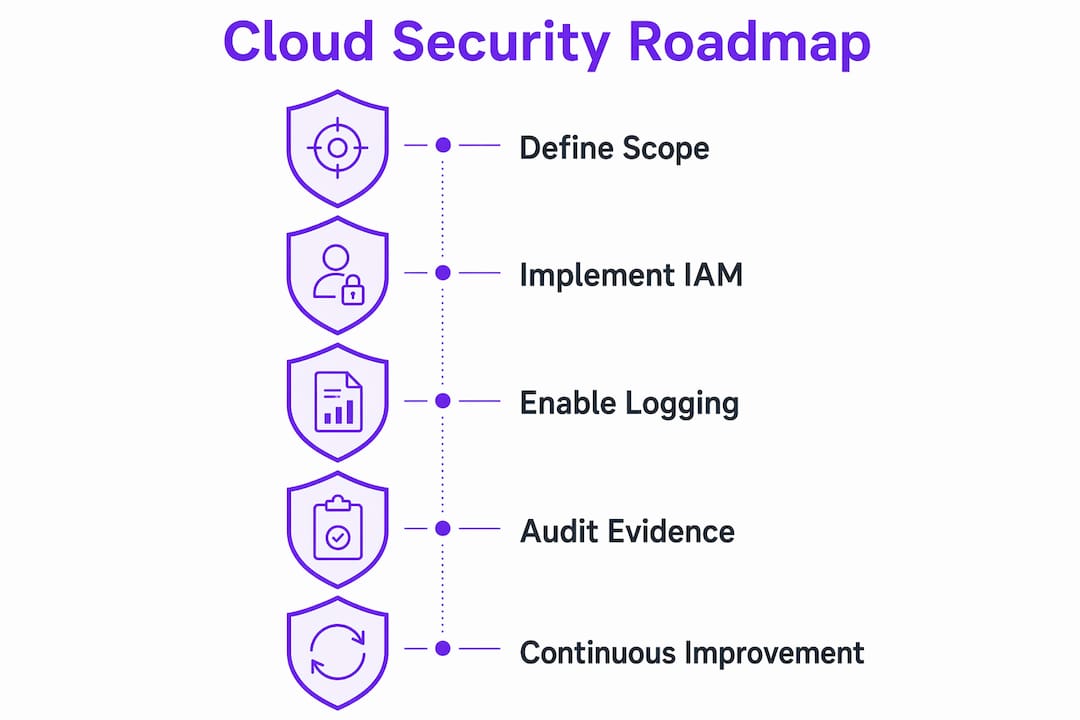
La proportionnalité des contrôles est également essentielle. Une startup de 12 personnes en phase d'amorçage n'a pas besoin du même niveau de détail dans son périmètre qu'une entreprise de 200 personnes en Série B. Adaptez le périmètre aux systèmes qui portent un risque réel et élargissez-le délibérément au fil de votre croissance.
Quels contrôles cloud correspondent à l'Annex A de l'ISO 27001 ?
Chaque contrôle cloud que votre équipe met en œuvre doit pouvoir être rattaché à au moins un domaine de contrôle de l'Annex A. Cette traçabilité est ce qui transforme une configuration en preuve d'audit.
| Catégorie de contrôle | Référence Annex A | Preuves auditables |
|---|---|---|
| Gestion des identités et des accès (MFA, RBAC, SSO) | A.9 (Contrôle d'accès) | Exports de politiques IAM, enregistrements de revues d'accès, captures d'écran de configuration SSO |
| Journalisation et supervision (centralisées, avec rétention suffisante) | A.12 (Sécurité opérationnelle) | Paramètres de rétention des journaux, configurations des règles d'alerte, tableaux de bord SIEM |
| Gestion des vulnérabilités et des dépendances (SCA, correctifs) | A.12, A.14 (Acquisition des systèmes) | Rapports d'analyse SCA, configurations des seuils de blocage dans les pipelines CI, enregistrements de correctifs |
| Configuration et posture de sécurité (analyse IaC, CSPM) | A.12, A.18 (Conformité) | Rapports de résultats CSPM, sorties d'analyse IaC, documents de durcissement de référence |
| Gestion des secrets | A.9, A.10 (Cryptographie) | Configurations des politiques Vault, journaux de rotation des secrets, résultats d'analyse des dépôts |
| Chiffrement (au repos et en transit) | A.10 (Cryptographie) | Politique de chiffrement, enregistrements de certificats TLS, paramètres de chiffrement du stockage |
| Sauvegarde et reprise d'activité | A.12 (Sécurité opérationnelle) | Plannings de sauvegarde, enregistrements de tests de restauration, documentation RTO/RPO |
| Développement sécurisé / contrôles en pipeline CI | A.14 (Acquisition des systèmes) | Configurations de pipeline, résultats des seuils SAST/SCA, enregistrements de déploiement |
Pour les startups SaaS mettant en œuvre l'ISO 27001, les lacunes les plus fréquemment signalées lors des audits sont l'absence de preuves de rétention des journaux et les revues d'accès non documentées. Ces deux points sont corrigeables en une journée avec les bons outils.
À quoi doit ressembler votre feuille de route sécurité cloud sur 90 jours ?
Des investissements en sécurité à fort impact durant les 90 premiers jours peuvent réduire significativement votre surface d'attaque exploitable et ramener le délai médian de détection de plusieurs semaines à quelques heures. Voici comment séquencer le travail :
Semaines 0–2 (gains rapides) :
- Activer le MFA sur chaque compte administrateur, console de production et système CI/CD
- Auditer et révoquer les accès inutilisés ; appliquer le moindre privilège sur tous les rôles cloud
- Activer le SSO pour les outils SaaS principaux
- Faire tourner toutes les clés API à longue durée de vie et les identifiants des comptes de service
- Activer l'analyse des secrets dans vos dépôts de code
Jours 14–60 (détection et hygiène) : 6. Ajouter l'analyse SCA à votre pipeline CI avec un seuil de blocage sur les vulnérabilités critiques 7. Centraliser les journaux des applications, des conteneurs et des API cloud avec une rétention de 30 à 90 jours 8. Configurer plusieurs alertes à haute valeur ajoutée : connexions suspectes à la console, exports massifs de données, nouveaux buckets publics 9. Déployer une protection endpoint de base (EDR) sur les appareils de l'équipe
Jours 60–90 (opérationnalisation) : 10. Rédiger et tester par simulation de crise (tabletop) un plan de réponse aux incidents 11. Réaliser une revue formelle des accès basée sur les rôles et documenter les résultats 12. Ajouter l'analyse IaC à votre pipeline de déploiement et documenter un standard de durcissement de référence 13. Tester les restaurations de sauvegardes et enregistrer les résultats avec horodatage
Statistique : Se concentrer sur le MFA/SSO, l'analyse des secrets et la correction des mauvaises configurations cloud permet de couvrir environ 80 % du risque de violation en phase précoce, souvent en moins de 20 heures de travail d'ingénierie.
Chaque étape accomplie génère un élément de preuve d'audit. Au bout de 90 jours, vous disposez d'un ensemble de contrôles défendables et d'une piste documentaire.
Comment adapter les contrôles au stade de croissance de votre startup ?
La sécurité cloud et de l'infrastructure domine les préoccupations des praticiens dans les startups de moins de 100 employés. C'est là qu'il faut investir en premier.
Une analyse de risque minimale mais auditable comporte quatre composantes : nommer vos actifs principaux (code source, données clients, systèmes d'authentification), lister les cinq principales menaces (vol d'identifiants, mauvaise configuration, compromission de la chaîne d'approvisionnement, accès interne non autorisé, exfiltration de données), évaluer chaque menace selon sa probabilité et son impact sur une échelle simple de 1 à 3, et assigner un traitement avec un responsable et une échéance. Cela suffit pour un audit de Phase 1.
Recommandations par stade :
- 0–25 employés : Se concentrer exclusivement sur les identités, les secrets et la journalisation. Une seule personne peut gérer le SMSI. Utiliser des outils cloud natifs pour minimiser la charge opérationnelle.
- 25–100 employés : Ajouter l'analyse SCA, l'analyse IaC et les revues d'accès formelles. Désigner un responsable sécurité distinct du responsable technique.
- 100–250 employés : Introduire un outil CSPM, un programme formel de gestion des vulnérabilités et des audits internes trimestriels. Envisager un RSSI à temps partiel pour piloter le programme.
Conseil d'expert : Associez chaque traitement de risque à un responsable nommé, une date cible et un élément de preuve spécifique. Les auditeurs suivent ce fil — s'il est rompu, le contrôle échoue.
Quelles preuves les auditeurs attendent-ils réellement pour les contrôles cloud ?
Les auditeurs ne cherchent pas la perfection. Ils cherchent la répétabilité et la preuve du fonctionnement.
| Type de preuve | Ce qu'il faut capturer | Rétention |
|---|---|---|
| Rapports IAM / accès | Attributions de rôles, statut MFA, validations des revues d'accès | 12 mois |
| Configurations de rétention des journaux | Captures d'écran des paramètres de rétention, export vers un stockage immuable | Période courante + période précédente |
| Rapports SCA / vulnérabilités | Sorties d'analyse du pipeline CI, tickets de remédiation | Par cycle de release |
| Enregistrements d'incidents | Version du plan de réponse, date de simulation, participants, constats | 3 ans |
| Tests de sauvegarde et restauration | Qui l'a effectué, quand, résultat, RTO atteint | Par cycle de test |
| Référentiels de configuration | Sorties d'analyse IaC, rapports CSPM, listes de contrôle de durcissement | Période courante + période précédente |
Les petites équipes peuvent générer la plupart de ces preuves automatiquement. La journalisation cloud native (CloudTrail, GCP Cloud Audit Logs, Azure Monitor) produit des enregistrements immuables sans développement spécifique. Les outils SCA intégrés aux pipelines CI génèrent des rapports à chaque build. L'essentiel est de capturer la sortie et de la stocker dans un endroit accessible aux auditeurs.
Pour les équipes qui gèrent l'inventaire des actifs de leur startup en parallèle des preuves de sécurité, centraliser les deux dans un même endroit réduit la précipitation avant l'ouverture d'une fenêtre d'audit.
Quels outils prennent en charge la sécurité cloud pour un SMSI de startup ?
Le choix des outils doit suivre la feuille de route sur 90 jours, et non l'inverse.
- Journalisation cloud native et CSPM : AWS Security Hub, GCP Security Command Center et Azure Defender couvrent la journalisation, la gestion de la posture et les alertes avec une configuration minimale. Commencez ici avant d'acquérir des outils tiers.
- Analyse SCA / des dépendances : GitHub Advanced Security (analyse des secrets + Dependabot), Snyk et OWASP Dependency-Check s'intègrent directement aux pipelines CI et génèrent des rapports exploitables en audit.
- Gestion des secrets : AWS Secrets Manager, GCP Secret Manager et HashiCorp Vault préviennent la dispersion des identifiants et produisent des journaux de rotation vérifiables par les auditeurs.
- IAM et SSO : Okta, JumpCloud et Google Workspace SSO centralisent la gestion des identités et génèrent les rapports d'accès requis par l'Annex A.9.
- Analyse IaC : Checkov et tfsec s'exécutent en CI et signalent les mauvaises configurations avant qu'elles n'atteignent la production.
- Journalisation centralisée (SIEM allégé) : Datadog, Elastic et Grafana Cloud agrègent les journaux de plusieurs sources et prennent en charge la configuration des 10 à 15 alertes préconisées par la feuille de route.
Pour la gestion opérationnelle des startups et les outils qui croisent le suivi des actifs et la collecte de preuves, des outils dédiés aux startups réduisent la charge de coordination qui ralentit la préparation des audits.
Lors de l'évaluation de fournisseurs cloud tiers, appuyez-vous sur leurs rapports SOC 2 Type II et leurs certifications ISO 27017 comme preuves de leur côté de la frontière de responsabilité partagée. Documentez les certifications sur lesquelles vous vous êtes appuyé et la date à laquelle vous les avez examinées.
Points clés à retenir
La sécurité cloud constitue le socle observable par les auditeurs d'un SMSI de startup : mettez en œuvre en premier les contrôles d'identité, la journalisation centralisée, l'analyse des dépendances, la gestion des secrets et les preuves documentées, puis faites évoluer les contrôles proportionnellement au stade de croissance.
| Point | Détails |
|---|---|
| Les contrôles d'identité en premier | Le MFA, le SSO et le RBAC sur tous les systèmes de production sont les contrôles à plus fort impact pour les équipes en phase précoce. |
| La journalisation nécessite une rétention et des alertes | Centralisez les journaux avec une rétention de 30 à 90 jours et configurez 10 à 15 alertes ciblées pour atteindre un niveau de détection quasi-entreprise. |
| La proportionnalité prévient les excès | Adaptez les contrôles à votre effectif et à votre profil de risque ; une équipe de 0 à 25 personnes a besoin de contrôles d'identité et de gestion des secrets, pas d'une suite CSPM d'entreprise complète. |
| Les preuves doivent être répétables | Les auditeurs vérifient la preuve du fonctionnement : horodatages, responsables, résultats et enregistrements de rétention pour chaque contrôle. |
| Vérification de maturité Ismscalculator | Effectuez le test de maturité gratuit en 2 minutes pour identifier vos lacunes avant votre premier cycle d'audit et vous comparer aux valeurs de référence. |
Ce que les praticiens comprennent mal concernant la sécurité cloud dans un SMSI de startup
La plupart des échecs de SMSI en startup ne sont pas d'ordre technique. Ils sont organisationnels. L'équipe met en place le MFA, configure la journalisation, puis suppose que le fournisseur cloud gère le reste. C'est précisément cette hypothèse que les auditeurs sondent.
La frontière de responsabilité partagée n'est pas un détail technique. C'est un engagement documenté. Quand un auditeur demande « qui a configuré la rétention de vos journaux ? » et que la réponse est « nous pensions qu'AWS s'en chargeait », le contrôle échoue. La correction consiste en un document d'une page qui attribue chaque contrôle de l'Annex A soit à la responsabilité du fournisseur, soit à celle de la startup, avec un responsable nommé pour le côté startup.
L'élargissement incontrôlé du périmètre est l'autre erreur courante. Les fondateurs veulent tout inclure pour paraître rigoureux. Le résultat est un périmètre si étendu que la collecte de preuves devient un travail à plein temps. Un périmètre précis et restreint couvrant votre environnement de production et les données clients est certifiable. Un périmètre tentaculaire englobant chaque outil interne utilisé par votre équipe ne l'est pas, du moins pas lors d'un premier cycle de certification.
Le conseil le plus pratique : consacrez les deux premières semaines aux identités et aux secrets, pas aux documents de politique. Une startup avec le MFA activé partout et aucun identifiant dans le code est genuinement plus sécurisée qu'une organisation dotée d'une politique de sécurité de 40 pages et de mots de passe administrateurs partagés. La documentation a son importance, mais elle doit décrire des contrôles qui existent déjà.
Ismscalculator vous aide à définir le périmètre, estimer et vous préparer plus rapidement
Savoir quels contrôles cloud mettre en œuvre est une chose. Savoir combien d'effort votre SMSI spécifique nécessitera, et si votre posture actuelle est prête pour un audit, c'est là où la plupart des équipes perdent des semaines.
Ismscalculator vous fournit une estimation en temps réel des coûts et des efforts adaptée à la taille de votre entreprise, à votre secteur et à votre niveau de maturité en sécurité, afin que vous puissiez valider votre plan sur 90 jours par rapport aux comparaisons de référence avant d'engager des ressources. Le test de maturité gratuit en 2 minutes identifie immédiatement vos principales lacunes. Pour les équipes ayant besoin d'un accompagnement structuré, l'évaluation complète de maturité ISO 27001 cartographie vos contrôles actuels par rapport à l'Annex A et produit une feuille de route d'implémentation priorisée. Si vous avez besoin d'un implémenteur indépendant ou d'un auditeur principal pour accélérer la certification, le répertoire de consultants vous met en relation avec des praticiens spécialisés dans les startups cloud-first.
Sources utiles et lectures complémentaires
- Cloud Security for SaaS Startups (CSA) — Les recommandations de la Cloud Security Alliance sur la maturité en sécurité par phases pour les startups cloud, couvrant l'architecture, le cycle de vie du développement logiciel et la gouvernance.
- What Is Cloud Security? (Google Cloud) — Explication claire du modèle de responsabilité partagée, de l'IAM, du SIEM et des fondamentaux de la sécurité cloud par un fournisseur cloud de référence.
- Startups and Cybersecurity Playbook (CyberReplay) — Liste de contrôle pratique couvrant la sécurité centrée sur l'identité, l'analyse SCA, la journalisation centralisée et les données sur la réduction de 40 à 70 % de la surface d'attaque.
- Security Program for Startups (Lorikeet Security) — Recommandations de sécurité proportionnelle avec des préconisations de contrôles adaptées au stade pour les équipes en phase précoce.
- Startup Security Guide (Sola Security) — Analyse de l'évolution des priorités en sécurité, de l'infrastructure cloud vers la sécurité applicative, à mesure que l'effectif croît.
- Startup Cybersecurity Strategy Playbook (FounderOperator) — Modèles d'analyse de risque allégés et cadres d'identification des actifs adaptés à la conformité en phase précoce.
- Startup Security Foundation (Decryption Digest) — Guide ciblé sur la couverture de 80 % du risque startup grâce au MFA, à l'analyse des secrets et aux corrections de mauvaises configurations pour moins de 100 $/mois.
- ISO 27001 Controls Checklist for Cloud Companies (Defenders.cloud) — Liste de contrôle pratique associant les contrôles ISO 27001 aux preuves spécifiques au cloud et aux frontières de responsabilité partagée.
- ISO 27001 Implementation Plan for SaaS Startups (Canadian Cyber) — Guide d'implémentation autonome avec des délais réalistes de 3 à 6 mois et les exigences documentaires pour les équipes SaaS.
- Build an ISMS From Scratch: Startup Guide (Ismscalculator) — Guide étape par étape pour construire un SMSI pour les startups, couvrant le périmètre, l'implémentation par phases et la collecte de preuves.
Recommandé
- ISO 27001 pour les entreprises SaaS et tech : Guide pratique | ISMS Calculator
- Construire un SMSI de zéro : Guide pour startups | ISMS Calculator
- Le rôle du RSSI dans la planification sécurité d'une startup : Guide pour fondateurs | ISMS Calculator
- Pourquoi les fondateurs de startups doivent comprendre le SMSI | ISMS Calculator