
A formal Information Security Management System (ISMS) is the foundational operating framework banks need to manage cybersecurity risks and meet compliance requirements effectively. The industry term is ISMS, defined under ISO 27001 as a systematic approach to managing sensitive information through people, processes, and technology. Banks operate under a uniquely demanding security environment: regulatory bodies like the Reserve Bank of India (RBI), Switzerland’s FINMA, and the European Union’s Digital Operational Resilience Act (DORA) all expect documented, auditable security governance. A formal ISMS is not optional for banks that want to satisfy these regulators, protect customer data, and remain competitive in B2B markets where ISO 27001 certification is increasingly a contract requirement.
Why banks need formal ISMS: the core case
The most direct answer to why banks need formal ISMS is risk volume. Banks should identify and manage 40–80 distinct security risks across multiple categories within their ISMS. That number reflects the reality of modern banking: payment systems, customer portals, third-party vendors, mobile apps, and core banking platforms all carry separate threat profiles. No ad hoc security program handles that volume consistently.
A formal ISMS delivers several concrete benefits that informal security programs cannot replicate:
- Systematic risk management. The ISMS forces a structured risk register, risk treatment plan, and documented controls. Every identified risk gets an owner and a response.
- Reduced breach costs. Breaches cost banks $40,000–$120,000 on average, and structured controls directly reduce both breach frequency and severity.
- Audit efficiency. ISO 27001 certification gives regulators a recognized framework to audit against, cutting inspection time and reducing the documentation burden on your compliance team.
- B2B contract eligibility. ISO 27001 or SOC 2 certification is mandatory for onboarding in many banking B2B partnerships. Without it, your institution loses contracts before the conversation starts.
- Customer trust. Certification signals to retail and corporate clients that their data is protected by an internationally recognized standard, not internal promises.
Pro Tip: Start your ISMS scope definition with your highest-value data assets, not your IT inventory. Banks that anchor scope to customer data and payment systems build a more defensible ISMS from day one.
A mature ISMS also transforms information security into an operational culture with continuous feedback loops rather than a set of auditor checkboxes. That cultural shift is what separates banks that recover quickly from incidents from those that scramble.

How do regulatory expectations drive the need for formal ISMS in banks?
Regulators do not accept informal security programs as evidence of governance. Regulators use ISO 27001 as the international anchor for auditing banking security governance, improving audit efficiency and compliance confidence. That preference is not accidental. ISO 27001 provides a documented, auditable trail that regulators can verify without reconstructing your entire security program from scratch.
Key regulatory frameworks that push banks toward formal ISMS adoption include:
- RBI Master Directions on IT Governance (India): Require banks to maintain documented information security policies, risk assessments, and incident response procedures aligned with recognized standards.
- FINMA Circulars (Switzerland): Mandate operational resilience and documented security controls for licensed financial institutions.
- DORA (EU): Requires ICT risk management frameworks, incident reporting, and third-party risk oversight. ISO 27001 maps directly to many DORA requirements.
- PCI DSS: Mandates specific controls for payment card data that an ISMS framework organizes and maintains systematically.
Experienced consultants can help banks achieve ISO 27001 certification in 15–20 days with zero compliance findings during regulatory inspections. That outcome is only possible when the ISMS is operationally embedded, not assembled at audit time. Banks that treat certification as a preparation exercise rather than a documentation sprint consistently perform better in regulatory reviews.
Pro Tip: Map your ISMS controls directly to your primary regulatory framework before your first internal audit. A controls crosswalk between ISO 27001 Annex A and DORA or RBI requirements saves weeks of rework during external assessments.
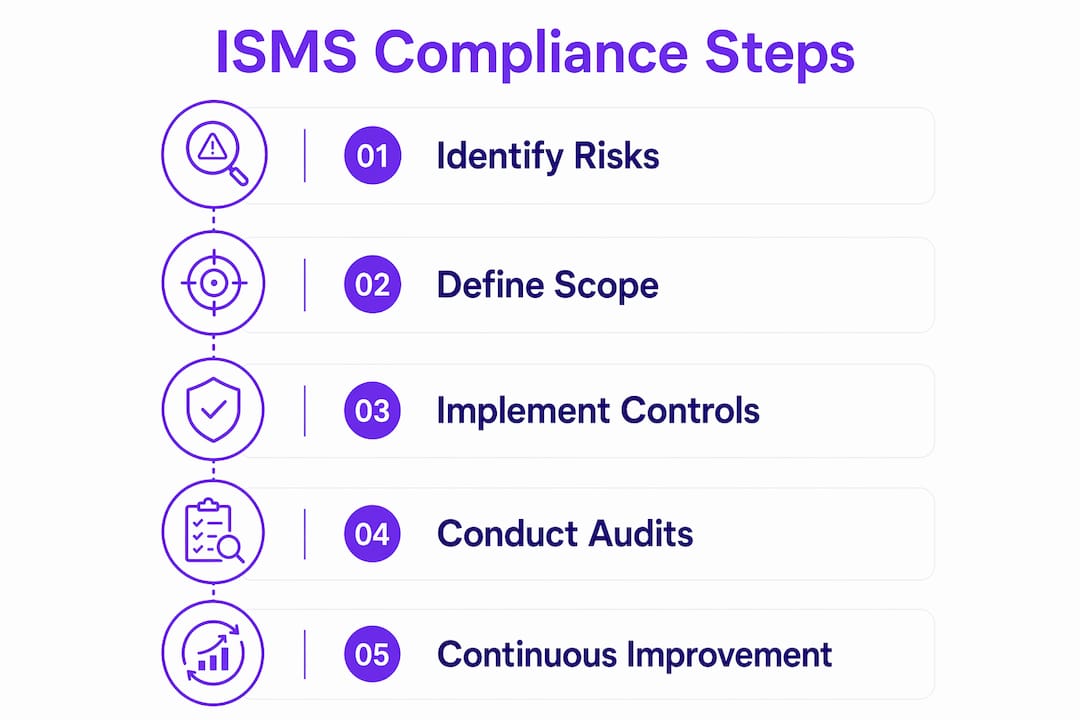
Regulatory frameworks demand operational resilience beyond ISO 27001 compliance alone, making the ISMS a starting point, not a finish line, in banking security governance. That framing matters for decision-makers: certification earns you credibility with regulators, but the ongoing ISMS operation is what keeps you compliant between audits. For a detailed look at audit preparation for finance companies, the regulatory mapping process is worth reviewing before your next inspection cycle.
What are common ISMS implementation pitfalls banks face?
Most ISMS failures in banking trace back to the same set of avoidable mistakes. Knowing them in advance is the difference between a certification that holds and one that collapses under its first real audit.
-
Treating ISMS as a document library. Treating ISMS as mere documentation rather than embedding it operationally is the most common pitfall causing audit failures in financial services. Policies that exist in a SharePoint folder but are never enforced operationally fail the moment an auditor asks for evidence of control effectiveness.
-
Scoping errors. Scope definition errors, either overly broad or too narrow, are principal causes of certification failures and security gaps in banking ISMS implementations. A scope that covers retail banking but excludes the treasury platform leaves a material gap. A scope that tries to cover every system in the bank creates an unmanageable audit surface.
-
Excluding backend infrastructure. Excluding backend infrastructure like developer workstations and communication platforms risks ISMS audit failures and business consequences. Banks routinely forget that internal Slack channels, developer laptops, and CI/CD pipelines carry sensitive data and need controls.
-
Compliance theater. Documented controls that are not enforced operationally create a false sense of security. An access control policy that says “privileged access is reviewed quarterly” but has no evidence of those reviews is a liability, not a control.
-
Absent leadership. ISMS programs without executive sponsorship stall at the policy stage. Security culture requires visible commitment from the C-suite and board, not just the CISO.
Pro Tip: Assign a named control owner for every ISO 27001 Annex A control during implementation. Ownership without a name attached is ownership that belongs to no one.
Reviewing common ISO 27001 finance implementation mistakes before you begin can save your team months of rework and protect your certification timeline.
How can banks practically build and maintain a formal ISMS?
Building a formal ISMS in banking follows a clear sequence. The PDCA cycle, Plan-Do-Check-Act, is essential to continuously improve ISMS effectiveness and adapt to evolving threats. That cycle is the engine of every ISO 27001 program.
The implementation roadmap
The practical path from zero to certified ISMS breaks into four phases:
- Gap assessment. Measure your current controls against ISO 27001 requirements. Identify what exists, what is missing, and what is partially implemented. This phase typically takes 2–4 weeks for a mid-size bank.
- Risk assessment and treatment. Build your risk register, score each risk by likelihood and impact, and assign treatment options: accept, mitigate, transfer, or avoid. This is the analytical core of the ISMS.
- Control implementation. Deploy the controls from ISO 27001 Annex A that address your identified risks. Implementing core security measures takes 4–12 weeks, with full ISMS upgrades taking 3–9 months depending on bank complexity.
- Certification audit. An accredited certification body conducts a Stage 1 documentation review and a Stage 2 operational audit. Banks with well-embedded ISMS programs pass with minimal findings.
Integrating with existing frameworks
Successful ISO 27001 implementation in banks integrates with existing regulatory frameworks and operational risk programs to minimize duplication and maximize coverage. ISO 27001 controls overlap significantly with PCI DSS requirements, NIST Cybersecurity Framework categories, and SOX IT general controls. Mapping these overlaps before implementation reduces the total control count your team needs to manage and maintain.
Management reviews, internal audits, and staff training complete the operational cycle. A bank that certifies but never runs internal audits or trains new staff will drift out of compliance within 12–18 months. The ISMS is a living system, not a one-time project. For a step-by-step blueprint, the financial sector ISMS implementation plan covers the full sequence from gap assessment through surveillance audits.
Key Takeaways
Banks that implement a formal ISMS aligned with ISO 27001 gain a systematic, auditable security program that satisfies regulators, reduces breach costs, and opens B2B markets that require certification as a condition of doing business.
| Point | Details |
|---|---|
| Risk volume demands structure | Banks face 40–80 distinct security risks; only a formal ISMS manages them consistently. |
| Regulators expect ISO 27001 | RBI, FINMA, and DORA all align with ISO 27001 as the recognized governance standard. |
| Scoping errors cause failures | Scope that is too broad or too narrow is the leading cause of certification failure in banking. |
| PDCA drives continuous improvement | The Plan-Do-Check-Act cycle keeps the ISMS effective as threats and regulations evolve. |
| Certification opens B2B markets | ISO 27001 certification is a mandatory onboarding requirement in many banking partnerships. |
The cost of waiting is not theoretical
Banks that delay formal ISMS adoption tend to frame the decision as a cost question. That framing is wrong. The real question is whether a fragmented security program can absorb the regulatory, financial, and reputational consequences of a breach or a failed inspection.
I have seen banks with mature IT departments and strong technical talent still fail regulatory audits because their security controls were not documented, not assigned to owners, and not reviewed on any cycle. The controls existed in practice but could not be demonstrated. That gap, between what you do and what you can prove you do, is exactly what a formal ISMS closes.
The competitive angle is equally real. ISO 27001 certification is increasingly a condition of doing business, not a differentiator. Banks that treat it as a future project will find themselves excluded from partnerships and procurement processes where certified institutions already sit. Early adoption compounds: the benefits of early ISO 27001 adoption include faster B2B onboarding, stronger regulatory relationships, and a security culture that is harder for competitors to replicate quickly.
Leadership commitment is the variable that determines whether an ISMS program succeeds or stalls. Boards and executive teams that treat information security as a governance priority, not an IT budget line, build institutions that are genuinely resilient. The ones that delegate it entirely to the CISO and move on tend to discover the gap at the worst possible moment.
— Martin
How Ismscalculator helps banks assess ISMS readiness
Banking decision-makers who want to move from awareness to action need a clear picture of where their institution stands before committing to a full implementation program.
Ismscalculator provides a free 2-minute readiness check that gives banks a preliminary view of their ISO 27001 compliance gaps without any setup. For a deeper baseline, the ISMS readiness assessment benchmarks your current maturity across all four ISO/IEC 27001:2022 control themes and maps your position against model reference values. Banks that need implementation support can use the independent ISO 27001 consultant directory to find experienced implementers and lead auditors who specialize in financial institutions. Every tool on the platform is built around the specific cost, effort, and timeline variables that banking teams need to plan with confidence.
FAQ
What is a formal ISMS in banking?
A formal ISMS is a documented, auditable system for managing information security risks, typically aligned with ISO 27001. It covers people, processes, and technology across the bank’s defined scope.
How long does it take a bank to implement an ISMS?
Core security measures take 4–12 weeks to implement, while a full ISMS upgrade and certification process typically takes 3–9 months depending on the bank’s size and complexity.
Which regulations require banks to have a formal ISMS?
RBI Master Directions, FINMA circulars, and the EU’s DORA all require documented security governance frameworks. ISO 27001 aligns with all three and is the most widely recognized standard regulators accept.
What is the biggest mistake banks make when implementing an ISMS?
Treating the ISMS as a documentation exercise rather than an operational system is the most common failure. Controls must be actively enforced and evidenced, not just written into policy documents.
Does ISO 27001 certification affect B2B banking partnerships?
ISO 27001 or SOC 2 certification is a mandatory onboarding requirement in many banking B2B relationships. Banks without certification are frequently excluded from contracts and procurement processes before negotiations begin.