
ISO 27001 audit evidence is documented or observable proof that your information security controls are implemented and working. Policies alone do not satisfy auditors. The four main evidence categories are documented information, operational records, observations and interviews, and technical outputs. Each category maps to specific Annex A controls and audit stages. Auditors verify all four during Stage 1 and Stage 2 assessments, using sampling, interviews, and direct technical checks. Understanding the types of evidence for ISO 27001 audits before your assessment is the difference between a clean certification and a list of nonconformities.
1. What are the main types of documented information used as evidence?
Documented information is the foundation of ISO 27001 compliance documentation. It includes policies, procedures, risk assessments, Statements of Applicability (SoA), and risk treatment plans. Stage 1 audits focus almost entirely on this category, typically running one to two days, and auditors use it to confirm your ISMS is designed correctly before verifying execution.

Auditors expect every document to carry an approval date, version number, and owner. An undated policy with no revision history signals that the document was created for the audit, not maintained as a living control. The SoA is particularly scrutinized because it must justify every included and excluded Annex A control with a clear rationale.
Common documents auditors request include:
- ISMS scope statement with defined boundaries and exclusions
- Information security policy approved by senior management
- Risk assessment report with methodology, asset inventory, and risk scores
- Risk treatment plan with control selections and acceptance decisions
- Statement of Applicability with justifications for all 93 Annex A controls
- Internal audit reports and management review minutes
- Corrective action records from previous audit cycles
Pro Tip: Organize your document repository by ISMS clause and Annex A control number. Auditors move fast during Stage 1. A clearly labeled folder structure in SharePoint or a dedicated compliance tool cuts review time and reduces the chance of a document being missed.
2. How do operational records serve as evidence in ISO 27001 audits?
Operational records prove that controls run continuously, not just on paper. Stage 2 audits verify operational effectiveness through sampling of records, interviews, and technical checks over three to eight days depending on organization size. That duration reflects how thoroughly auditors dig into actual execution.
Records auditors commonly sample include:
- System access logs showing who accessed what and when
- Access control review reports with reviewer identity and sign-off dates
- Incident management logs with classification, response timeline, and resolution
- Backup and restore test records with success or failure outcomes
- Change management logs with approvals, risk assessments, and rollback plans
- Supplier security review records including assessments and contract references
Auditors expect evidence to be traceable, time-referenced, and showing repeated operation across required periods, not just a single point-in-time snapshot. A single access review screenshot from last week does not demonstrate a quarterly review cycle. Auditors want to see the last three or four cycles to confirm the control runs on schedule.
Pro Tip: Pre-stage multi-period extracts before the audit. Pull the last four quarters of access reviews, patch logs, and backup records into a single folder per control. Auditors can then sample directly without waiting for you to retrieve records during the session.
3. What role do observations and interviews play as evidence during audits?
Observations and interviews are the human layer of ISO 27001 audit evidence. Auditors use walkthroughs, direct observation, and staff interviews to verify that people understand and actually practice the controls documented in your policies. A perfectly written incident response procedure means nothing if the team responsible cannot explain the process.
Interview focus areas typically include:
- Security awareness — can staff identify phishing attempts and report incidents?
- Incident handling — do responsible personnel know the escalation path and their specific role?
- Supplier security — do procurement teams understand third-party risk requirements?
- Risk assessment — can the risk owner explain how risks were identified and scored?
- Access management — do system owners understand their responsibility for periodic reviews?
Auditors conducting remote audits use video calls and screen shares to replicate on-site walkthroughs. They may ask a system administrator to demonstrate a live access review or show how a change request is logged. The goal is to confirm that the control is embedded in daily work, not rehearsed for the audit.
Preparing staff is straightforward. Run internal mock interviews covering the five areas above. Brief every control owner on what their control does, why it exists, and how they execute it. Staff who can speak confidently about their role reduce auditor follow-up questions significantly. For sector-specific preparation, the ISO 27001 audit prep guide for finance companies covers interview expectations in detail.
4. How technical outputs function as objective evidence in ISO 27001 audits
Technical outputs are electronic evidence generated directly by IT systems. They demonstrate that technical controls are configured and operating as intended. Auditors treat them as objective evidence because they are harder to fabricate than narrative descriptions.
| Technical Output | Control It Supports |
|---|---|
| System configuration snapshots | Access control, hardening standards |
| Vulnerability scan histories | Vulnerability management |
| Penetration test reports | Security testing |
| Monitoring and alerting logs | Incident detection |
| Audit trails from applications | Accountability and traceability |
| Patch deployment records | Patch management |
Auditors expect multi-period data, documented remediation, and test evidence for technical controls. A penetration test report from 18 months ago with no remediation tracking does not satisfy the control. The audit trail purpose in ISO 27001 is specifically to provide this kind of time-stamped, system-generated proof that links actions to individuals and timestamps.
For patch management, auditors sample patch deployment records to confirm that critical patches are applied within the timeframe defined in your policy. If your policy states 30 days for critical patches, your records must show consistent compliance with that threshold across multiple cycles. Understanding why patch management matters for ISO 27001 helps teams build the right record-keeping habits before the audit window opens.
5. How to manage and organize ISO 27001 audit evidence effectively
Evidence management is where most organizations lose points they should not lose. Complete evidence sets containing review reports, responsible person identities, remediation tickets, and multi-cycle data reduce audit back-and-forth during sampling. Single artifacts submitted without context force auditors to ask follow-up questions, which extends the audit and signals weak evidence management.
The most effective approach follows these steps:
- Map every piece of evidence to a specific control. Use your SoA as the master index. Each Annex A control should have a corresponding evidence folder.
- Apply version control to all documents. Every policy and procedure needs a version number, effective date, and approver name.
- Timestamp all operational records. System-generated timestamps are preferred. Manual records must include the date, time, and name of the person completing the activity.
- Cover required frequencies. If a control runs monthly, you need at least three to four months of records. Quarterly controls need at least two cycles.
- Centralize your repository. Tools like SharePoint, Confluence, or dedicated compliance platforms keep evidence accessible and auditable.
- Build evidence packages per control. Each package should contain the policy reference, the procedure, and the operational records proving execution.
Auditors prefer evidence that includes dates, responsible persons, scope, and explicit linkage to the control being supported. Evidence statements must match records like logs or signed documents rather than narrative claims alone. A statement that says “access reviews are conducted quarterly” is not evidence. A signed review report dated march 15 with the reviewer’s name and the list of accounts reviewed is evidence.
Pro Tip: Build one evidence package per Annex A control before the audit. Each package should contain the policy reference, the procedure, and at least two cycles of operational records. Auditors can then sample from the package directly, which cuts the time spent retrieving records during the session.
For a structured view of what audit-ready ISMS documentation looks like across all clauses, the Ismscalculator documentation guide breaks down requirements by control area.
Key takeaways
Passing an ISO 27001 audit requires four distinct evidence types, each traceable, time-referenced, and mapped to specific Annex A controls.
| Point | Details |
|---|---|
| Four evidence categories | Documented information, operational records, observations, and technical outputs each serve a distinct audit purpose. |
| Policies are not enough | Auditors require operational records and technical outputs to confirm controls are practiced, not just written. |
| Traceability is non-negotiable | Every piece of evidence must show who did what, when, and which control it supports. |
| Multi-period coverage matters | Single snapshots fail sampling. Auditors expect repeated execution across required cycles. |
| Evidence packages speed audits | Organizing evidence per control reduces auditor follow-up and shortens the overall audit duration. |
What I have learned from watching audits go wrong
The most common audit failure I have seen is not a missing policy. It is a team that has excellent documentation and almost no operational proof. The policies are current, the SoA is complete, and the risk assessment is thorough. Then the auditor asks for six months of access review records and the team produces one screenshot from the week before the audit.
Strong evidence portfolios are built from ongoing operational practice, not last-minute documentation. Auditors scrutinize logs, tickets, and decision trails generated continuously. They know the difference between a record created as part of a real process and one assembled under pressure. The timestamps, the language, and the gaps in the data tell the story.
The second failure I see regularly is unprepared staff. Control owners who cannot explain their own process in plain language create doubt, even when the records are solid. A 30-minute internal mock interview session per control owner, run two weeks before the audit, eliminates most of that risk.
My practical advice: treat evidence collection as a monthly operational task, not an annual audit task. Set calendar reminders for every recurring control. Archive the outputs immediately. By the time the auditor arrives, your evidence is already three cycles deep and organized by control. That is the difference between a confident audit and a stressful one.
— Martin
Ismscalculator tools for ISO 27001 audit readiness
Preparing evidence across 93 Annex A controls is a significant effort. Ismscalculator gives you a structured starting point with tools built specifically for this process.
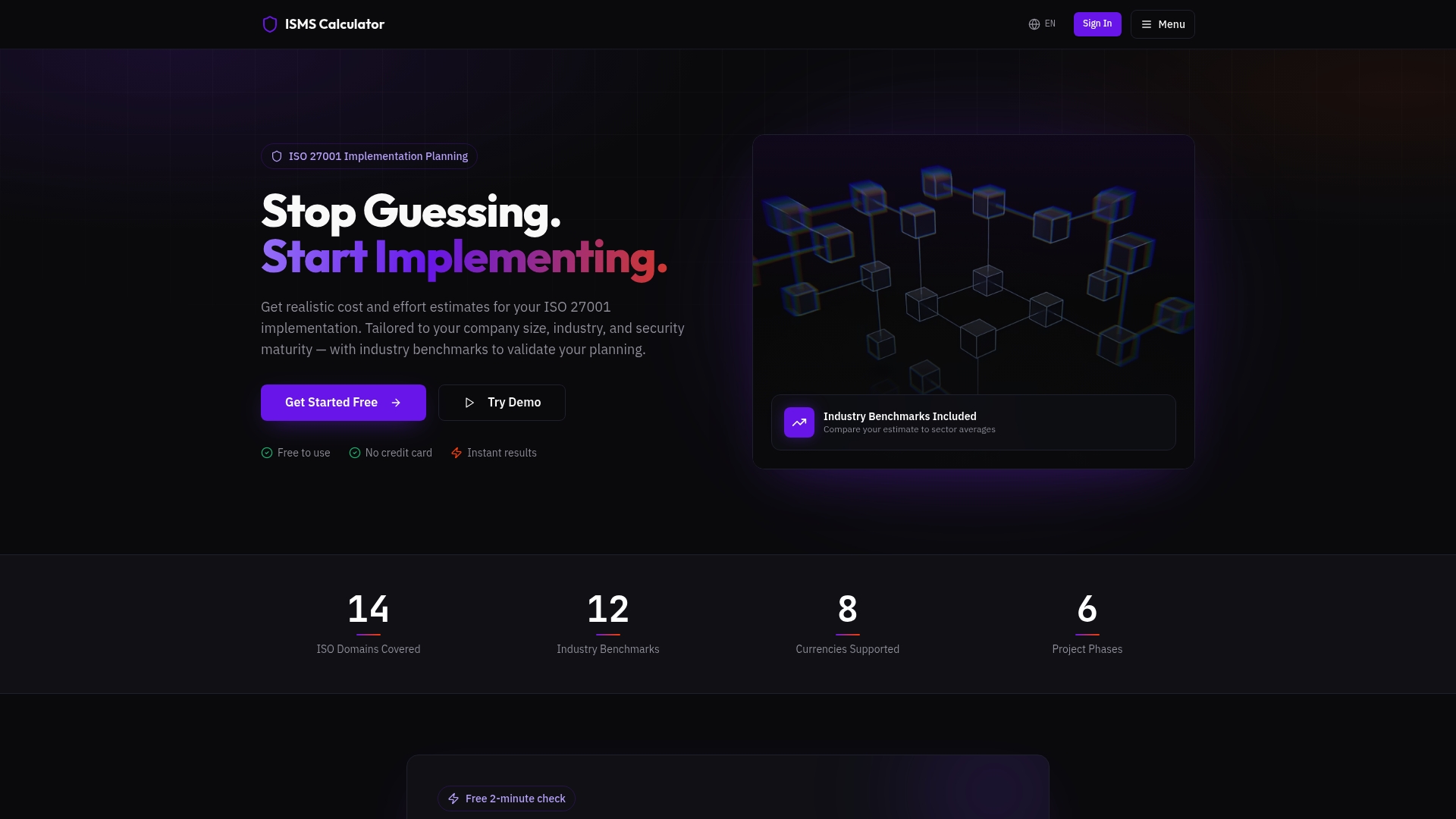
The ISO 27001 Readiness Assessment maps your current controls against audit requirements and identifies evidence gaps before your auditor does. The platform covers maturity assessments across all four ISO/IEC 27001:2022 control themes and generates a clear picture of where your evidence is strong and where it needs work. If you need hands-on support, Ismscalculator connects you with independent ISO 27001 consultants experienced in audit preparation and evidence organization. Start with the free 2-minute readiness check to get an immediate baseline.
FAQ
What is audit evidence in ISO 27001?
ISO 27001 audit evidence is documented or observable proof that information security controls are implemented and functioning. It includes policies, operational records, staff interviews, and technical outputs.
What are the four types of ISO 27001 objective evidence?
The four main types are documented information, operational records, observations and interviews, and technical outputs. Each maps to specific Annex A controls and is verified during Stage 1 or Stage 2 audits.
How far back should operational records go for an ISO 27001 audit?
Auditors expect evidence covering at least two to four cycles of the required control frequency. For a quarterly control, that means at least six to twelve months of records showing consistent execution.
Can screenshots serve as ISO 27001 audit evidence?
Screenshots can support evidence but rarely stand alone. Auditors require dates, responsible persons, scope, and linkage to the specific control. System-generated logs with timestamps are preferred over manual screenshots.
What happens if evidence is missing during a Stage 2 audit?
Missing or insufficient evidence typically results in a nonconformity. Minor nonconformities require a corrective action plan. Major nonconformities can delay certification until the gap is resolved and re-verified.