
An Information Security Management System (ISMS) is a structured framework that defines how an organization identifies, manages, and reduces information security risks. Understanding why startup founders should understand ISMS is not optional in 2026. Enterprise buyers, investors, and regulators now treat an ISMS, formalized through ISO 27001, as a baseline signal of operational maturity. Founders who treat security as a technical afterthought lose deals, fail due diligence, and expose their companies to regulatory liability. The ones who build an ISMS early turn security into a competitive asset.
What is an ISMS and how does it work for startups?
An ISMS is not a product you buy. It is a management system that governs how your company handles information security across people, processes, and technology. ISO 27001 is the international standard that specifies what a certifiable ISMS must include.
The ISO 27001 standard is built around two layers. The first is a set of mandatory clauses that define the management framework, covering leadership, planning, risk assessment, and performance evaluation. The second is Annex A, a catalog of controls covering 14 security domains, from access management to supplier relationships. Founders who understand both layers can make informed decisions about which controls apply to their business and which carry the most risk.
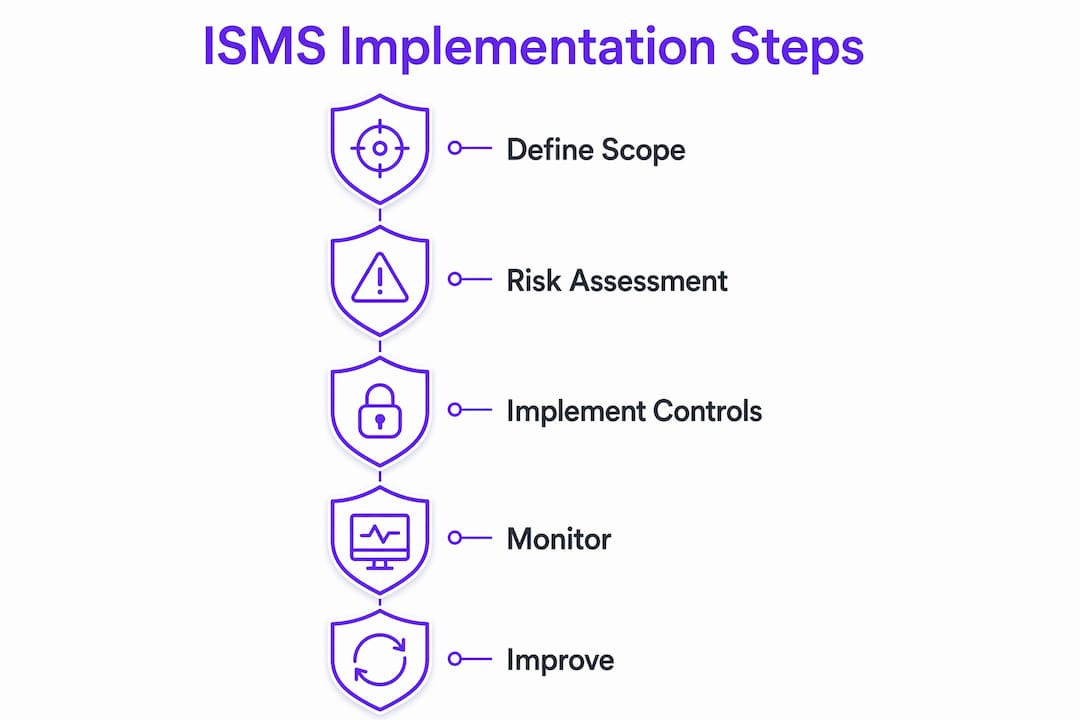
An ISMS operates as a continuous cycle, not a one-time project. The Plan-Do-Check-Act model drives it: you assess risks, implement controls, measure their effectiveness, and improve. Ongoing evidence collection for audits is the most time-intensive part of the entire process. That means the real work begins after your initial documentation is done.

Pro Tip: Map your ISMS controls to your actual business processes from day one. Generic templates that sit in a folder do not pass audits and do not protect your company.
Most startups can build a foundational ISMS in 8 to 14 weeks. That timeline assumes active founder involvement, a defined scope, and a clear risk register. Startups that delegate the entire process to a junior IT hire routinely take longer and produce weaker results.
- Policies: Written rules governing how employees handle data, access systems, and report incidents.
- Risk assessments: Structured reviews that identify threats, rate their likelihood and impact, and prioritize treatment.
- Controls: Technical and organizational measures drawn from ISO 27001 Annex A that reduce identified risks.
- Evidence: Records proving your controls are active and effective, required for both internal reviews and external audits.
Why does ISMS matter for founders in sales, compliance, and investment?
The commercial case for understanding ISMS is direct. ISO 27001 certification is a procurement requirement for enterprise sales to companies with 500 or more employees and for any startup targeting EU or UK markets. Without it, your sales team hits a wall during vendor security reviews. The deal does not stall. It ends.
The importance of ISMS for startups becomes clearest in B2B SaaS. Enterprise procurement teams send security questionnaires before any contract discussion. A certified ISMS gives your team a documented, audited answer to every question. Founders without one spend weeks scrambling to produce ad hoc responses that rarely satisfy a security-conscious buyer.
Investor scrutiny follows the same pattern. Investor due diligence now includes a direct review of security posture and operational maturity. ISO 27001 certification serves as strong, third-party-validated evidence that your company manages risk systematically. Founders who can present a certified ISMS during a Series A process signal a level of operational discipline that most early-stage companies cannot match.
Regulatory compliance adds another layer of urgency. ISO 27001 is not legally mandated in most jurisdictions, but it functions as credible evidence of compliance with data protection laws including GDPR and India’s 2023 Digital Personal Data Protection Act. That distinction matters. You do not need ISO 27001 to comply with GDPR, but having it makes proving compliance far easier during a regulatory inquiry.
- Enterprise sales: Certification removes the security review bottleneck in deals with large buyers.
- Regulatory defense: A documented ISMS provides evidence of due diligence if a data incident triggers regulatory scrutiny.
- Investor confidence: Third-party certification validates operational maturity during funding rounds.
- Customer trust: Published security practices reduce friction in procurement and renewal conversations.
How should founders approach building and managing an ISMS?
Founder involvement is the single biggest predictor of ISMS success. Founders who delegate ISMS entirely to IT create disconnected documentation that fails audits and does not reflect the company’s actual security posture. The ISMS requires decisions about risk tolerance, business scope, and resource allocation. Those are founder decisions, not IT decisions.
The practical starting point is defining your scope. Scope determines which systems, processes, and teams fall under the ISMS. A narrow scope reduces implementation cost and time. A scope that is too narrow creates gaps that auditors and enterprise buyers will find. Most early-stage startups scope their ISMS around their core product infrastructure and customer data.
Aligning ISO 27001 with SOC 2 early is a significant efficiency gain for startups targeting both US and EU markets. Mapping ISO 27001 and SOC 2 controls from the start avoids duplicating documentation and reduces overall compliance cost. Founders who treat these as separate projects pay twice for the same work.
Pro Tip: Use an ISMS maturity assessment before you start implementation. It tells you exactly where your gaps are across all four ISO/IEC 27001:2022 control themes, so you spend time on what matters.
| Implementation phase | Founder responsibility | Typical timeline |
|---|---|---|
| Scope and risk assessment | Define boundaries and risk appetite | Weeks 1–3 |
| Policy and control development | Approve policies, allocate resources | Weeks 4–8 |
| Evidence collection and testing | Review audit logs, validate controls | Weeks 9–12 |
| Internal audit and review | Lead management review meeting | Weeks 12–14 |
Managing an ISMS after certification is where most startups underestimate the effort. Controls need regular testing. Evidence needs continuous collection. The management review, a formal leadership meeting to evaluate ISMS performance, must happen at least annually. Founders who treat certification as the finish line find their ISMS degrading within 12 months.
- Schedule quarterly control reviews from the start, not just before surveillance audits.
- Assign a named ISMS owner who reports directly to the founder or CEO.
- Build evidence collection into existing workflows rather than treating it as a separate task.
What are the common misconceptions founders have about ISMS?
The most damaging misconception is that an ISMS is primarily a documentation exercise. Founders who believe this produce policies that no one follows and controls that exist only on paper. An ISMS that does not change how your team actually works provides no security benefit and fails certification audits.
A second misconception is that ISMS is only for large companies. The benefits of ISMS for startup success are most pronounced at the early stage, when security habits are still forming and the cost of retrofitting controls is lowest. Building an ISMS at 20 employees is far cheaper than rebuilding security practices at 200.
Timing is also widely misunderstood. Premature certification is a strategic mistake. Startups that pursue formal audits before their processes are stable waste money and often fail their first certification attempt. The right trigger for certification is a specific commercial need, such as an enterprise deal that requires it, not an arbitrary milestone.
“An ISMS is not a security guarantee. It is a framework for managing security risk systematically. Certification proves you have the framework. It does not prove you are immune to incidents.” — ISO 27001 implementation guidance
A fourth misconception is that ISMS is purely a compliance cost. The shift from viewing security as a cost to viewing it as a trust and resilience enabler is the most significant mindset change for founders. Companies with mature ISMS frameworks close enterprise deals faster, retain customers longer, and recover from incidents with less damage.
- ISMS is not legally required but is commercially critical for B2B growth.
- Certification timing should follow revenue opportunity, not a fixed calendar.
- The 8–14 week implementation window is realistic only with active leadership involvement.
- An ISMS reduces risk. It does not eliminate it.
Key Takeaways
Startup founders who build an ISMS early convert security from a cost center into a sales asset, a regulatory defense, and a signal of operational maturity that investors recognize.
| Point | Details |
|---|---|
| ISMS is a management system | It governs people, processes, and technology, not just technical controls. |
| Certification opens enterprise doors | ISO 27001 is a procurement requirement for buyers with 500+ employees and EU/UK entities. |
| Founders must lead, not delegate | Delegating ISMS to IT alone produces documentation that fails audits and misses real risks. |
| Build foundations before certifying | Pursue formal certification when a specific revenue opportunity demands it, not before. |
| Align ISO 27001 with SOC 2 early | Mapping controls across both frameworks from the start cuts duplication and compliance cost. |
Why I think most founders wait too long on ISMS
The pattern I see repeatedly is a founder who treats ISMS as something to handle “after we hit product-market fit.” That logic sounds reasonable until a $500,000 enterprise deal stalls because the buyer’s security team sends a 200-question vendor assessment and your company has no documented answers.
The founders who get this right do not treat ISMS as a compliance checkbox. They treat it the same way they treat their financial controls: as infrastructure that makes everything else work. When your ISMS is real, meaning your team actually follows the policies and your controls are tested, it becomes a sales tool. You can answer security questionnaires in hours instead of weeks. You can walk into investor due diligence with a certified framework and a clean audit history.
The uncomfortable truth is that ISMS maturity is a proxy for overall operational maturity. Investors and enterprise buyers know this. When they see a certified ISMS at a 30-person startup, they read it as evidence that the founder thinks like an operator, not just a product builder. That perception has real commercial value.
My advice is to start with a readiness assessment, understand your gaps across the four Annex A control themes, and build a phased plan. Do not rush to certification. Build the foundation correctly, and certification becomes a formality rather than a scramble. The audit-ready documentation process is far less painful when your controls are already working.
— Martin
How Ismscalculator helps founders plan their ISO 27001 readiness
Estimating the cost and effort of ISO 27001 implementation is one of the first real barriers founders face. Ismscalculator removes that barrier with a real-time calculator that delivers tailored estimates based on your company size, industry, and current security maturity.
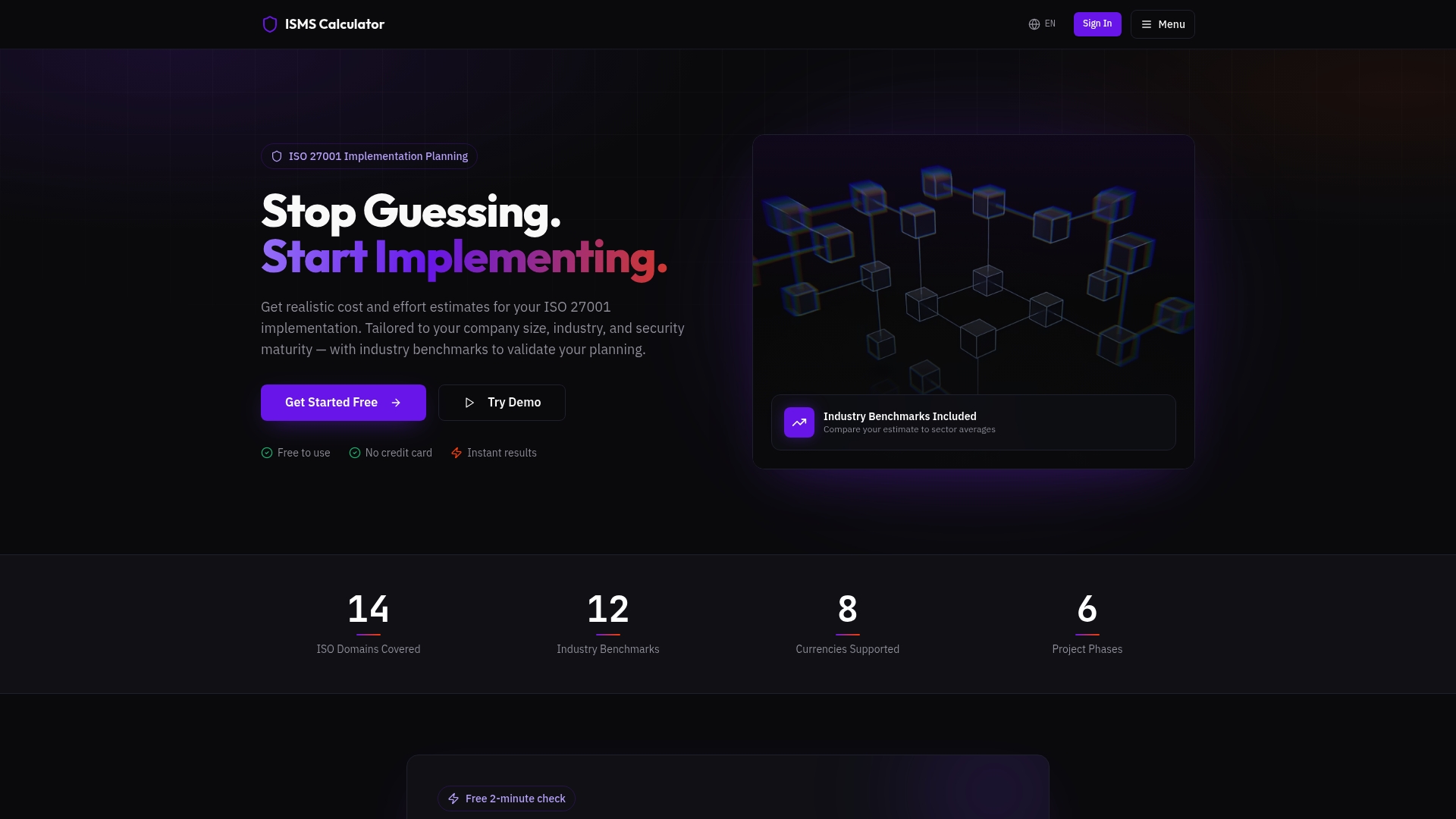
The platform includes a free 2-minute readiness check that identifies your biggest gaps without requiring a consultant call. For founders ready to go deeper, the full ISO 27001 readiness assessment covers all four ISO/IEC 27001:2022 control themes and produces a prioritized implementation plan. Ismscalculator also connects founders with independent ISO 27001 consultants who specialize in startup implementations, so you get expert support without the enterprise price tag.
FAQ
What is an ISMS in simple terms?
An ISMS is a management system that defines how a company identifies, controls, and reduces information security risks. ISO 27001 is the international standard that specifies what a certifiable ISMS must include.
Is ISO 27001 certification legally required for startups?
ISO 27001 is not legally mandated in most jurisdictions, but it serves as credible evidence of compliance with regulations like GDPR and India’s DPDP Act, and it is a procurement requirement for many enterprise buyers.
How long does it take a startup to build an ISMS?
Most startups can build a foundational ISMS in 8 to 14 weeks, assuming active founder involvement and a clearly defined scope.
When should a startup pursue ISO 27001 certification?
Startups should pursue certification when a specific commercial opportunity, such as an enterprise deal or market entry requirement, demands it. Premature certification drains resources and often fails without stable processes in place.
Can a small startup realistically manage an ISMS?
Yes. The benefits of early ISMS adoption are greatest at the startup stage, when security habits are still forming and the cost of building controls correctly is far lower than retrofitting them later.