
Breach response is the control-set inside your ISO 27001 ISMS that converts detection into defensible financial outcomes and regulator-ready evidence. For finance organizations, that is not a theoretical benefit. It is the difference between a contained incident and a multi-million-dollar regulatory event.
This week, do three things:
- Confirm your RACI for the first 72 hours, naming who authorizes regulator notifications under NYDFS, GLBA, and SEC rules
- Verify forensic log preservation is active and time-stamped across all in-scope systems
- Run the free 2-minute readiness check on Ismscalculator to baseline your current maturity against ISO 27001 Annex A.16 (information security incident management)
Table of Contents
- Why breach response is especially critical for finance organizations
- How ISO 27001 embeds breach response across your ISMS controls
- Governance and decision-making: who owns what during a finance-sector breach
- Operational components that most affect financial outcomes
- Measuring financial impact: KPIs, cost categories, and an example model
- How to plan and budget ISO 27001 implementation to strengthen breach response
- Closing the loop: how post-incident learning updates your ISMS
- Key Takeaways
- What practitioners consistently get wrong about breach response planning
- Ismscalculator turns your maturity gaps into a defensible budget
- Authoritative sources for further reading
Why breach response is especially critical for finance organizations
Preparedness is the single most significant factor in minimizing financial fallout from a breach. Documented plans and cross-functional simulations reduce time-to-contain and downstream costs more than any single technical control. Finance organizations face a harder version of this problem than most sectors.
Financial services breach costs often run into millions of USD per incident, with long detection and containment times as the primary cost driver, according to IBM/Ponemon benchmarks.
The regulatory clock compounds the financial pressure. Financial institutions face overlapping notification obligations with hard deadlines: NYDFS requires notification within 72 hours, the SEC requires disclosure within four business days of a materiality determination, PCI DSS triggers a 24-hour brand notification, and FTC/GLBA can require notification within 30 days depending on conditions. Missing any one of those windows while managing an active incident is how a containable breach becomes a regulatory enforcement action.
AI adoption is adding a new layer of exposure. A significant share of organizations lack governance policies for AI (https://www.ibm.com/downloads/documents/us-en/131cf87b20b31c91/), and the vast majority of AI-related incidents involve systems without proper access controls. For finance teams building or updating their ISMS, ungoverned AI is a hidden attack surface that standard Annex A controls do not automatically cover.
How ISO 27001 embeds breach response across your ISMS controls
Annex A.16 is the primary home for incident management, but it does not stand alone. Supporting controls from A.8 (asset and data classification), A.12 (operations security), A.13 (communications security), and A.18 (compliance) must all be explicit in any finance ISMS that expects to manage breach costs. A gap in any one of them creates a documentation hole that regulators will find.
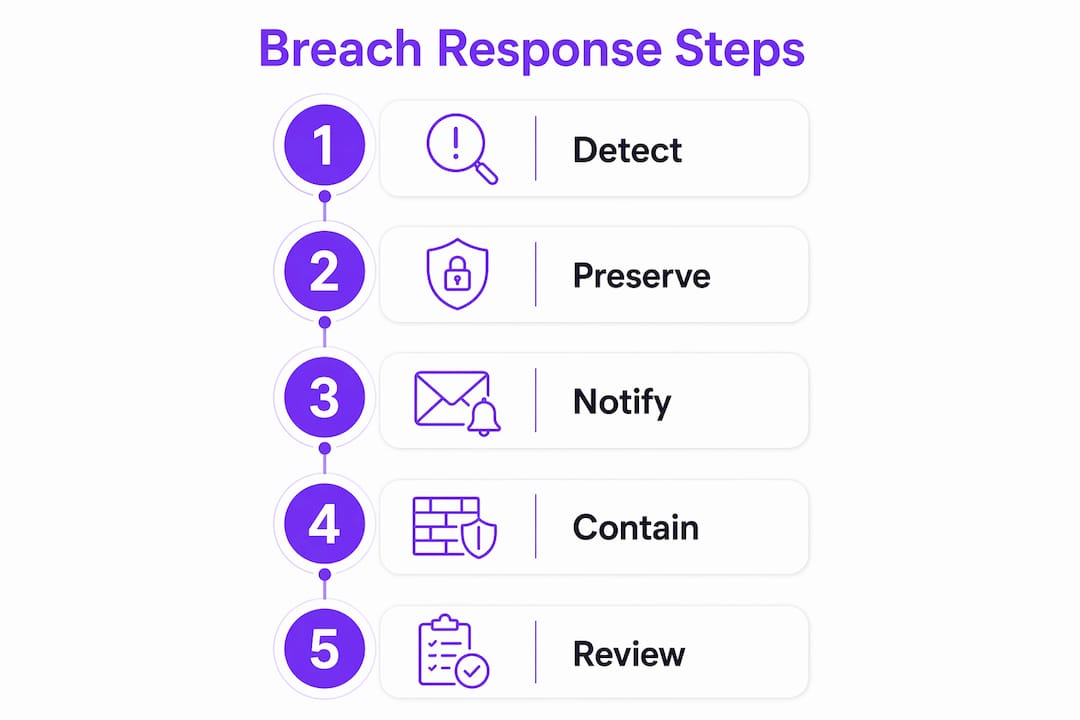
| ISO 27001 Clause | Breach Response Activity | Evidence Required |
|---|---|---|
| — | Assign IR roles and escalation paths | RACI chart, signed role descriptions |
| — | Detect and report suspected incidents | Incident ticket, time-stamped log entry |
| — | Triage and classify breach severity | Decision log with timestamp and approver |
| — | Contain, eradicate, recover | Containment record, forensic report |
| — | Post-incident review and control update | Corrective action record, updated SoA |
| — | Scope financial data vs. PII | Data inventory, classification policy |
| — | Regulatory notification decisions | Notification letters, regulator correspondence |
On scoping financial data: your Statement of Applicability should distinguish between financial transaction data (account numbers, payment records) and PII. Regulators treat them differently. GLBA and NYDFS focus on customer financial information; PCI DSS scopes cardholder data specifically. Collapsing them into a single “sensitive data” bucket in your SoA creates ambiguity during an audit.
- Reference A.16.1.4 in your SoA as “applicable” with the justification: “Financial regulatory obligations require documented escalation decisions within 72 hours of incident detection.”
- Link A.18.1 explicitly to your regulatory notification matrix so auditors can trace a notification decision back to a specific clause.
Governance and decision-making: who owns what during a finance-sector breach
Board participation in breach simulations and documented authority structures materially improve regulatory defensibility. Silent boards create documentation gaps. When regulators review your incident response, they look for evidence that decisions were made by the right people at the right time, not just that technical fixes were applied.
The CISO’s role in financial ISO 27001 compliance sits at the center of this structure, but the CISO cannot hold every decision authority alone.
72-hour RACI (core assignments):
| Role | Responsible | Accountable | Consulted | Informed |
|---|---|---|---|---|
| Regulator notification (NYDFS/SEC) | Legal Counsel | CISO/CIO | Board Chair | CEO |
| Public/customer disclosure | Communications | CEO | Legal, CISO | Board |
| Forensic investigation | IR Lead | CISO | IT Operations | Legal |
| Ransom/payment decision | CFO | CEO | Legal, CISO | Board |
| Evidence preservation | IT Operations | IR Lead | Legal | CISO |
Pro Tip: Time-stamp every decision log entry with the name of the approver, the information available at that moment, and the rationale. Regulators do not just want to see what you decided. They want to see that you decided it deliberately, with the right people in the room. Run a tabletop with board observers at least quarterly so the authority structure is practiced, not just documented.
Operational components that most affect financial outcomes
Rapid detection, evidence preservation, and coordinated communications drive down the biggest cost buckets: detection and escalation, notification, and lost business. The first six hours set the trajectory for everything that follows.

Incident response checklist:
0–6 hours
- Isolate affected systems without destroying volatile memory (capture RAM images first)
- Activate the IR team and notify the CISO and legal counsel
- Open a time-stamped decision log; record every action and approver
- Preserve all relevant logs with chain-of-custody documentation
- Assess whether the incident meets regulatory notification thresholds
6–72 hours 6. Engage external forensics if internal capacity is insufficient 7. File required regulator notifications (NYDFS 72-hour, PCI brand notification) 8. Notify affected financial institutions if account data is involved (per FTC guidance) 9. Prepare customer communication drafts; hold pending legal review 10. Document containment status with timestamps for each milestone
3–30 days 11. Complete forensic analysis and root-cause determination 12. File SEC materiality determination and disclosure if applicable 13. Issue customer notifications with specific guidance on protective steps 14. Begin remediation of exploited controls; update the ISMS SoA 15. Conduct post-incident review and feed findings into the next management review
Forensic procedures that protect financial defensibility:
- Maintain chain-of-custody documentation for all evidence collected
- Archive regulator communications in a dedicated, access-controlled repository
- Enforce vendor notification SLA clauses in “hours, not days” terms so third-party delays do not blow your own regulatory windows
Measuring financial impact: KPIs, cost categories, and an example model
Break breach cost into four categories and track three KPIs. Everything else is a derivative of these.
KPIs: Mean Time to Detect (MTTD), Mean Time to Contain (MTTC), and time-to-notify regulators. Customer churn rate post-incident is the lagging indicator that captures reputational loss.
| Cost Category | Typical U.S. Range | Primary Drivers |
|---|---|---|
| Detection & escalation | $400K–$1.2M | Forensics, IR team hours, tooling |
| Notification | — | Legal review, credit monitoring, mailing |
| Post-breach remediation | — | Control upgrades, staff retraining, audits |
| Lost business | $1M–$3M+ | Customer churn, downtime, reputational damage |
Ranges are illustrative, derived from IBM/Ponemon financial services benchmarks. Actual figures vary by breach size, data sensitivity, and regulatory footprint.
Sample calculation (50,000 records, 10-day containment):
- Detection & escalation: ~$600K (external forensics plus 10 days of IR team time)
- Notification: ~$400K (legal review, credit monitoring for 50K individuals)
- Remediation: ~$750K (control gaps identified, staff retraining, audit fees)
- Lost business: ~$1.2M (estimated churn and downtime)
- Modeled total: ~$2.95M before regulatory fines or insurance offsets
Cyber insurance can offset notification and remediation costs, but coverage gaps are common. Verify that your policy covers regulatory fines, forensic costs, and third-party claims separately. Benchmarks should inform budgets but not replace tailored modeling; adjust for your data value, contract obligations, and regulatory footprint before presenting figures to the board.
How to plan and budget ISO 27001 implementation to strengthen breach response
Prioritize investments that shorten detection and containment and improve decision documentation. Those two levers offer the highest return against breach cost benchmarks, and they are also the areas where post-breach investment consistently concentrates: threat detection, data protection, and IR planning.
Three-phase implementation Gantt (typical for a mid-size U.S. financial firm):
| Phase | Timeline | Key Cost Drivers |
|---|---|---|
| Prepare (gap assessment, scope, RACI) | Months 1–3 | Consultant fees, staff time, tooling audit |
| Implement controls | Months 3–8 | IR tooling, forensics retainer, training |
| Test and certify (tabletops, audit, cert) | Months 8–12 | External audit, tabletop facilitation, remediation |
Budget line items that directly reduce breach cost:
- IR retainer with a forensics firm (hours-not-days SLA)
- SIEM or log management tooling for MTTD reduction
- Staff training on incident classification and escalation
- Legal counsel on retainer for notification decisions
Pro Tip: Before finalizing your budget, run Ismscalculator’s readiness check and benchmarking tool. It maps your maturity across all four ISO/IEC 27001:2022 control themes, generates a phase Gantt, and lets you save and compare estimates. That output gives you a defensible line-item budget to present to finance and the board, not a rough guess.
For AI-related controls, foundational Azure AI governance training can help technical staff understand access-control requirements before those gaps become breach vectors.
Also check your cyber insurance policy against your ISMS scope. Common gaps: policies that exclude regulatory fines, cap forensic costs below actual market rates, or require pre-approved IR vendors. Validate vendor notification timelines in contracts before an incident, not during one.
Closing the loop: how post-incident learning updates your ISMS
Every incident must feed a time-stamped corrective-action record and a measurable improvement to controls. Without that, your ISMS is a static document, and regulators will treat it as one.
Corrective action template:
| Field | Content |
|---|---|
| What failed | Specific control or process that did not perform as designed |
| Root cause | Technical, process, or governance failure (one level deeper than the symptom) |
| Remediation | Specific action taken, owner, and completion date |
| Verification | How you confirmed the fix worked, with date |
Management review inputs for the next ISMS cycle:
- Updated risk register reflecting the incident’s exploited vectors
- Revised SoA entries for any controls found inadequate
- MTTD and MTTC trend data compared to prior periods
- Regulatory correspondence and notification timelines (as evidence of compliance)
- Tabletop exercise results and any authority-structure gaps identified
Pro Tip: Archive the 72-hour decision log, forensic reports, and all regulator communications in a dedicated, access-controlled folder within your ISMS documentation system. Retention periods vary by regulation (NYDFS requires at least three years for certain records), but keeping everything in one place means you can produce a complete incident narrative in hours, not days, when a regulator asks.
Key Takeaways
Breach response in a finance ISMS is not a standalone plan. It is the mechanism that converts every ISO 27001 control investment into measurable financial protection and regulator-ready evidence.
| Point | Details |
|---|---|
| Confirm RACI before a breach | Assign named owners for regulator notifications, forensics, and disclosure decisions before an incident occurs. |
| Map Annex A to your SoA | Reference Annex A explicitly, with justifications tied to NYDFS, SEC, and PCI notification deadlines. |
| Track four cost categories | Detection, notification, remediation, and lost business are the four buckets that drive total breach cost in financial services. |
| Close the loop after every incident | Feed a time-stamped corrective-action record into the next management review to reduce reoccurrence cost. |
| Use Ismscalculator to budget | Run the readiness check and benchmarking tool to convert maturity gaps into phase-based line items the board can approve. |
What practitioners consistently get wrong about breach response planning
Most finance teams treat breach response as an IT problem with a legal notification step bolted on at the end. That framing is where the real cost accumulates.
The documentation gap is the most expensive mistake. Regulators in finance increasingly expect a time-stamped forensic record of decisions, not just technical remediation steps. A team that contained a breach in 48 hours but cannot show who authorized the regulator notification, when, and on what information will face harder scrutiny than a team that took 72 hours and documented everything. The technical outcome matters less than the governance narrative.
The second mistake is treating ISO 27001 implementation as a one-time certification project rather than the operational backbone of breach response. Annex A.16 controls that are documented but untested offer almost no financial protection. Quarterly tabletops with board observers, practiced escalation paths, and vendor SLAs that actually enforce hours-not-days response times are what separate organizations that contain breaches cheaply from those that do not. The common implementation mistakes in finance ISMS projects almost always trace back to governance gaps, not technical ones.
Ismscalculator turns your maturity gaps into a defensible budget
Knowing your ISMS needs stronger breach response controls is one thing. Presenting a line-item budget to your CFO and board is another. Ismscalculator closes that gap directly: its real-time calculator maps your current maturity across all four ISO/IEC 27001:2022 control themes, benchmarks your gaps against financial-model reference values, and generates a phase Gantt you can hand to a project manager the same day.
The free 2-minute readiness check gives you an instant baseline. The full platform lets you save and compare multiple estimates, export a PDF report for board presentations, and request introductions to independent ISO 27001 consultants if you need hands-on implementation support. For teams that need a deeper engagement, the ISO 27001 readiness assessment converts your specific company size, industry, and security maturity into a tailored implementation plan with realistic cost ranges. Start with the readiness check today and have a budget draft ready before your next board meeting.
Authoritative sources for further reading
- IBM Cost of a Data Breach Report 2025 — The primary benchmark for financial services breach costs, cost categories, and the ROI of IR investments. Use it to anchor your budget conversations.
- EY: Why data breach response is a board-critical issue for BFSI — Forensic practitioner guidance on board governance, decision documentation, and the 72-hour evidence window.
- Financial Services Breach Response Regulatory Matrix (GLBA, NYDFS, SEC, PCI, FFIEC) — Maps each U.S. regulation to its notification trigger and deadline; essential for building your regulatory response timeline.
- FTC Data Breach Response Guide for Business — Practical federal guidance on notification obligations, forensic steps, and consumer communication.
- FDIC Breach Response Plan — The FDIC’s own documented RACI and breach response procedures; a useful structural reference for any U.S. financial institution building or auditing its own plan.
This article provides general information about ISO 27001 implementation and data breach response planning. It is not legal or regulatory advice. Confirm current notification requirements and compliance obligations with qualified legal counsel and the relevant regulatory authorities for your specific situation.