
Vendor risk is the exposure your startup takes on the moment you hand a third party access to your data, your systems, or a process customers depend on. If that vendor gets breached, goes down, or mishandles regulated data, the damage lands on you, not them. The first action to take, today, in under an hour: build a vendor inventory and flag which vendors are Tier 1 critical.
That single move separates startups that can answer a customer’s security questionnaire from ones that scramble and lose the deal. You don’t need a compliance team or a six-figure GRC platform. You need a spreadsheet, an hour, and a clear head about which vendors actually touch sensitive data or keep your product running.
Start the inventory with four columns: vendor name, what they do, what data or systems they touch, and whether losing them for a day would break something customers notice. Anything touching customer data, payment flows, authentication, or production infrastructure gets marked Tier 1. Everything else waits.
- List every vendor with system, network, or data access, including “free” tools connected via API keys.
- Mark Tier 1 for anything touching customer data, payments, or production uptime.
- Note contract renewal dates so reviews don’t slip for a year.
- Flag any vendor a buyer’s security questionnaire is likely to ask about by name.
Buyers increasingly expect proof, not promises. When enterprise procurement teams ask for a SOC 2 report or reference ISO 27001 certification, they’re really asking whether you know which vendors could hurt you and whether you’ve checked. NIST’s supply chain risk guidance treats this as a foundational risk management practice, not an optional extra. A one-hour inventory is the cheapest insurance you’ll ever buy against losing a deal to a security review.
Key Takeaways
A minimum viable vendor risk program built on inventory, tiering, and proportionate evidence collection protects startups without enterprise overhead.
| Point | Details |
|---|---|
| Build the inventory first | List every vendor with data access, then flag Tier 1 critical vendors within an hour. |
| Tier by exposure, not size | Match assessment depth (SOC 2, questionnaire, or nothing) to what each vendor actually touches. |
| Prioritize two contract clauses | Push hardest for breach notification timelines and data portability rights. |
| Reassess on triggers, not just dates | A vendor breach, ownership change, or SLA miss should force an immediate review. |
| Size the work with a readiness estimator | Ismscalculator’s free two-minute check shows where vendor controls rank against other ISO 27001 priorities. |
Table of Contents
- What Is Vendor Risk for Startups, Exactly?
- Why Vendor Risk Matters More for Startups Than for Big Companies
- Building a Minimum Viable Vendor Risk Management Program
- How to Run a Vendor Risk Assessment Without Slowing Down the Business
- Contract Clauses That Actually Reduce Vendor Risk
- Monitoring Vendors After You’ve Signed the Contract
- Sizing Vendor-Control Work With an ISO 27001 Readiness Estimator
- Get a Clear Estimate for Your Vendor Control Work
- Frequently Asked Questions
- Sources
What Is Vendor Risk for Startups, Exactly?
Vendor risk splits into six practical categories, and most startups get blindsided by at least two of them before they’ve hired a security lead.
Cybersecurity and supply chain risk tops the list. This is the scenario where a vendor you barely think about, an email platform, a customer support tool, a cloud storage provider, gets compromised, and the breach flows straight into your environment. The UnitedHealth incident, where a hack at a technology subsidiary exposed data tied to 190 million Americans, shows how a single third-party compromise can cascade across an entire ecosystem of downstream companies. Startups rarely make headlines this size, but the mechanism is identical: you inherit your vendor’s worst day.
Operational risk shows up as downtime you don’t control. Your payment processor has an outage during a product launch. Your identity provider goes dark and locks every employee out of every tool at once. These aren’t hypothetical; they’re the kind of event that turns a good week into a customer churn problem.
Compliance and regulatory risk hits when a vendor processes regulated data (health records, payment card data, EU personal data) without the controls that regulation requires. If you’re subject to GDPR and your vendor mishandles a data subject request or lacks a proper data processing agreement, the fine and the reputational fallout are yours to manage, not theirs.
Financial risk is the vendor that goes under mid-contract, leaving you scrambling for a replacement with no notice. Reputational risk is what happens when your name appears next to a vendor’s breach headline, fair or not.
AI vendor risk is the newest category, and the one most founders underestimate. When you send data to an AI tool for coding help, customer support, or analytics, you need to know: does the vendor train on your inputs, where does the data live, and can you delete it on request. Many AI startups skip publishing this information entirely, which is itself a red flag.
- Cybersecurity/supply chain: a vendor breach exposes your customer data through no fault of your own.
- Operational: a payment processor or identity provider outage stops your product cold.
- Compliance: a vendor processes regulated data without adequate controls, and the liability lands on you.
- Financial/reputational: a vendor’s insolvency or public breach drags your brand down with it.
- AI-specific: unclear data training, retention, or deletion practices at an AI tool vendor.
Why Vendor Risk Matters More for Startups Than for Big Companies
Big companies spread vendor dependency across dozens of redundant systems. Startups don’t. You’re running on a handful of tools, and if any one of them fails or leaks, there’s no backup system quietly absorbing the hit.
That concentration is exactly what makes vendor risk a startup problem first and an enterprise problem second. A Fortune 500 company losing its email provider for a day is an inconvenience. A ten-person startup losing its identity provider on the day of a product demo can lose the deal.
Enterprise procurement has also gotten sharper about this. Ask any founder who’s tried to close a mid-market or enterprise customer in the last two years: the security questionnaire arrives before the contract does. Buyers now routinely request a SOC 2 report, ask which subprocessors you use, and want a written answer on how you vet your own vendors. If you can’t produce that answer in the sales cycle, the deal stalls, sometimes permanently, while a competitor with a one-page vendor policy sails through.
Single-vendor dependency compounds the fragility. Most early-stage companies run on one cloud provider, one payment processor, one identity system, and one email platform. There’s nothing wrong with that consolidation; it’s usually the right call for speed. But it means a failure at any single point doesn’t just cause an incident, it can halt the business entirely for hours or days. Startup-focused playbooks consistently point to this concentration as the reason a lightweight, proportionate VRM program pays for itself the first time it’s needed, long before a full audit ever happens.
Investors and acquirers have caught on too. Due diligence checklists for Series A and beyond now regularly include a request for your vendor list, your data processing agreements, and evidence that you’ve assessed the vendors touching customer data. A founder who can hand over a clean vendor inventory in the data room looks materially more buttoned up than one who has to build it from scratch under deadline pressure, and due diligence timelines rarely allow for that scramble.
- Enterprise buyers ask for SOC 2 evidence and a vendor list before they’ll sign, not after.
- Single-vendor dependency means one outage can stop your whole product, not just slow it down.
- Investor due diligence checklists increasingly ask for documented vendor risk practices.
- A clean, current vendor inventory signals operational maturity that a scramble-built one can’t fake.
Building a Minimum Viable Vendor Risk Management Program
You don’t need enterprise GRC software to run a credible vendor risk management program. You need four things: an inventory, a tiering rubric, a time budget per tier, and a place to store evidence. Startup playbooks built around this exact structure routinely satisfy SOC 2’s vendor management expectations (control CC9.2) without a single enterprise tool in the stack.
1. Capture the right fields in your vendor inventory
A usable inventory needs more than a vendor name. Track: vendor name and service, what data or systems they access, the internal owner responsible for that relationship, contract start and renewal dates, and any subprocessors the vendor itself relies on. That last field matters more than founders expect. Your payroll vendor might use a sub-vendor for background checks, and that sub-vendor is now, functionally, your risk too.
2. Tier vendors by actual exposure, not vendor size
A three-tier rubric works for nearly every startup:
- Tier 1, critical: touches customer data, payment flows, production infrastructure, or authentication. Full assessment required, evidence collected, contract reviewed.
- Tier 2, moderate: touches internal data or non-critical systems, limited customer exposure. Lightweight questionnaire, basic evidence check.
- Tier 3, low: no data access, no system integration (think office supplies or a marketing subscription with no customer data). Skip formal assessment; note it and move on.
The tiering itself is the time saver. Founders who try to assess every vendor with equal rigor burn a week on vendors that pose almost no risk, then run out of time for the ones that matter.
3. Budget your hours realistically
For a startup with 15 to 40 vendors, a full pass looks like this: a Tier 1 vendor takes two to four hours, mostly reading a SOC 2 report and running through a short questionnaire call. A Tier 2 vendor takes 30 to 60 minutes, usually a form and a quick document check. Tier 3 vendors take five minutes each, just enough to confirm they belong in that tier. A founder or ops lead working through this alone can realistically clear the whole inventory in one to two focused weeks, not months.

Pro Tip: Assign one named owner for vendor risk, even if it’s you part-time. A responsibility that belongs to “the team” gets reassessed never; a responsibility that belongs to a name gets reassessed on schedule.
4. Collect evidence that scales with tier
Tier 1 vendors should produce a current SOC 2 report, an ISO 27001 certificate if they have one, or at minimum a recent penetration test summary. Tier 2 vendors can usually satisfy you with a completed security questionnaire and a link to their published security page. Tier 3 vendors need nothing beyond the inventory entry itself.
The goal isn’t a perfect audit trail on day one. It’s a defensible, documented answer to “how do you manage vendor risk” that holds up in a sales cycle, a due diligence room, or an actual incident. Objective evidence like a SOC 2 report or a recent pen test summary validates far faster than a vendor’s own claims, and it’s the difference between a five-minute review and a week of back-and-forth email.
How to Run a Vendor Risk Assessment Without Slowing Down the Business
A repeatable assessment process beats a one-time deep dive every time, because deep dives don’t scale past your fifth vendor and repeatable checklists do.
Start every Tier 1 and Tier 2 assessment with the same core questions: what data types does the vendor touch, who at the vendor has access to it, does the vendor use subprocessors and are they disclosed, what does their security program actually look like, and what’s their incident response and notification process if something goes wrong. CISA’s supply chain risk management template offers a ready-made set of standardized questions built for exactly this, and it’s free to adapt down to startup scale.
- Data types and sensitivity: what exactly does the vendor store, process, or transmit?
- Access scope: who at the vendor, and what systems, can reach your data?
- Subprocessor disclosure: does the vendor name every downstream party with access?
- Security program basics: encryption at rest and in transit, access controls, employee training.
- Incident response: what’s their notification timeline if they’re breached?
On evidence, don’t just collect documents, check them. A SOC 2 report has a scope section; read it and confirm it actually covers the service you’re buying, not a different product line. An ISO 27001 certificate has an expiration date and a certification body; verify both are current and legitimate. A penetration test summary should show a date within the last 12 months and at least a high-level list of findings, not just a clean bill of health with no detail.
- Request the evidence document directly rather than accepting a vendor’s verbal assurance.
- Check the scope, date, and certifying body before treating any document as valid.
- Flag anything older than 12 to 18 months for a follow-up question, not automatic rejection.
Red flags that should trigger real pushback, or a search for an alternative vendor: refusal to share any security documentation, no named contact for security incidents, undisclosed subprocessors discovered after the fact, or a breach history the vendor didn’t proactively disclose. None of these are automatically disqualifying on their own, but two or more together on a Tier 1 vendor should slow down the signature.
Contract Clauses That Actually Reduce Vendor Risk
Assessment tells you where the risk sits. Contract language is what makes that risk someone’s contractual problem instead of just your headache. Every gap your assessment surfaces should turn into a specific clause, not a note you forget about six months later.
The clauses worth fighting for, in rough priority order:
- Breach notification timelines. Get a specific number of hours or days, not “prompt notification.” Seventy-two hours is a common, reasonable ask.
- Data portability and export rights. You need the ability to pull your data out in a usable format if you switch vendors or the relationship ends badly.
- Subprocessor disclosure and approval. The vendor should notify you before adding a new subprocessor with access to your data, not after.
- SLAs with real consequences. An uptime guarantee without a service credit or termination right attached is a suggestion, not a commitment.
- Audit and evidence rights. The right to request a current SOC 2 report or security questionnaire annually, written into the contract itself.
Early-stage startups have less negotiating leverage than they’d like, but you have more than you think on the clauses above. Most vendors selling to startups have standard riders for exactly these requests because enough customers ask. Push hardest on breach notification and data portability; they cost the vendor almost nothing to grant and protect you the most if things go wrong.
Monitoring Vendors After You’ve Signed the Contract
Vendor risk doesn’t end at signature. It’s an ongoing relationship that needs a cadence, or it quietly rots into the same blind spot you started with.

Set your review cadence by tier: Tier 1 vendors get reassessed annually at minimum, with a lighter check any time their contract renews. Tier 2 vendors get reassessed every 18 to 24 months. Tier 3 vendors just get confirmed as still low-risk whenever you happen to notice them.
Event-based triggers matter more than the calendar, though. Reassess immediately if a vendor discloses a breach, changes ownership through an acquisition, launches a major new product feature that changes their data handling, or misses an SLA badly enough to raise questions.
- Set calendar reminders tied to contract renewal dates, not just annual anniversaries.
- Build a one-page incident runbook naming who contacts the vendor, who notifies affected customers, and who documents the timeline.
- Store every assessment, questionnaire response, and evidence document in one place so a reassessment starts from the last one, not from zero.
Pro Tip: Keep a simple log of every vendor review, even a one-line dated entry. Auditors and enterprise buyers care less about how sophisticated your process looks and more about whether you can prove you actually did it.
Sizing Vendor-Control Work With an ISO 27001 Readiness Estimator
Vendor risk management overlaps heavily with ISO 27001’s supplier relationship controls (Annex A domain 5.19 through 5.23), which means the work you do tiering vendors and collecting evidence isn’t wasted even if certification isn’t on your roadmap yet. It’s the same groundwork, reused.
An ISO readiness estimator turns that overlap into a number you can plan around: person-days needed to document vendor policies, build assessment records, and prepare evidence for an eventual audit. Instead of guessing whether vendor controls will eat a week or a month, a tailored estimate based on your company size and current maturity gives you a real figure to work from.
- Benchmarks show how your vendor-control effort compares to similar-sized companies in your industry.
- A Gantt-style output sequences vendor documentation work against everything else in an ISO 27001 timeline.
- The free readiness check flags which of the four Annex A control themes, supplier management among them, need attention first.
Run the free two-minute readiness check before you sink real hours into vendor documentation, and you’ll know within minutes whether that work belongs at the top of your list or can wait.
A founder’s honest tradeoff on speed versus control
Every founder wants to move fast, and every serious buyer wants proof you haven’t cut corners. Neither instinct is wrong. What actually works is proportional control: a lightweight vendor inventory and tiering system that costs a week of focus now, then thickens into real process as headcount, revenue, and buyer scrutiny grow. Skipping it entirely just moves the cost later, with interest.
Get a Clear Estimate for Your Vendor Control Work
Most vendor risk advice stops at “build an inventory and hope for the best.” Ismscalculator gives you an actual number instead: a tailored estimate of how much effort your vendor-related ISO 27001 controls will take, based on your company’s size, industry, and current security maturity, so you’re planning against real figures rather than a guess.
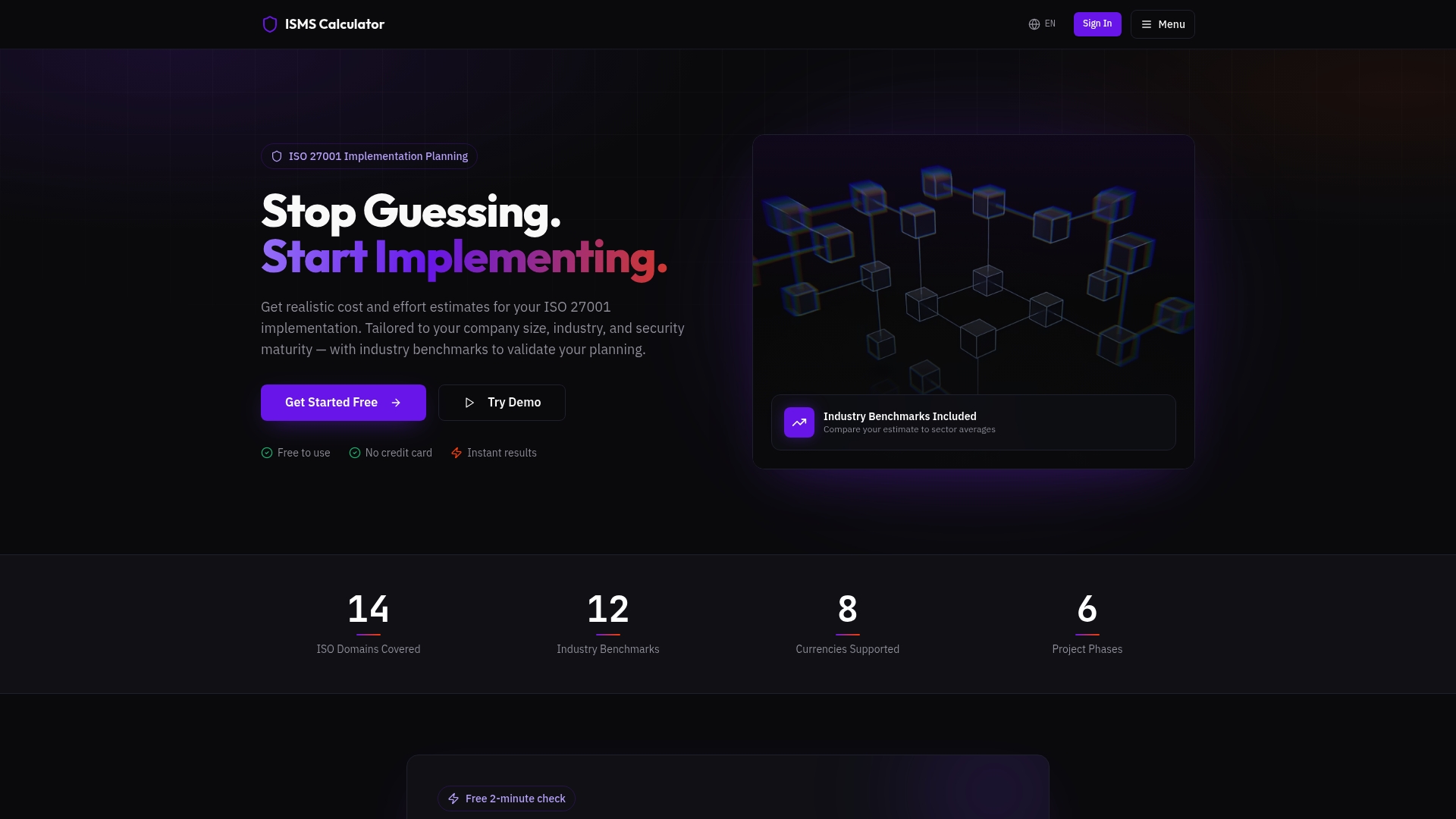
Start with the free two-minute readiness check to see where vendor and supplier controls rank against the other 13 ISO domains you’d eventually need to cover. From there, the full readiness assessment breaks the work into a benchmarked estimate and a Gantt-style timeline you can hand to a cofounder, an investor, or an auditor. You can save multiple estimates, compare scenarios as your team grows, and export a PDF report the moment a buyer’s security questionnaire lands in your inbox. Run the free check today and find out exactly how many person-days your vendor risk program actually needs.
Frequently Asked Questions
What is vendor risk for startups, in one sentence? Vendor risk for startups is the exposure created when a third party has access to your data, systems, or a process your customers depend on, and something goes wrong on their end that affects your business.
How do I start a vendor risk assessment with no security team? Build a vendor inventory, tier vendors by data access and business impact, then request a SOC 2 report or completed questionnaire for anything in Tier 1. Most founders can complete a first pass in one to two weeks.
What vendor risk examples should startups worry about most? A third-party data breach exposing customer records, a payment processor or identity provider outage, and a vendor processing regulated data without adequate controls are the three that cause the most damage fastest.
Do startups really need SOC 2 or ISO 27001 evidence from vendors? Yes, for any Tier 1 vendor touching customer data or production systems. It’s the fastest way to validate a vendor’s security claims without running your own audit.
How often should startups reassess vendor risk? Annually for critical vendors at minimum, sooner if the vendor discloses a breach, changes ownership, or misses a service commitment badly enough to raise concerns.
Sources
- NIST SP 800-161 r1: Cybersecurity Supply Chain Risk Management Practices for Systems and Organizations
- Vendor and supply chain risk management (SCRM) template — CISA
- Vendor risk management for startups — ThirdProof